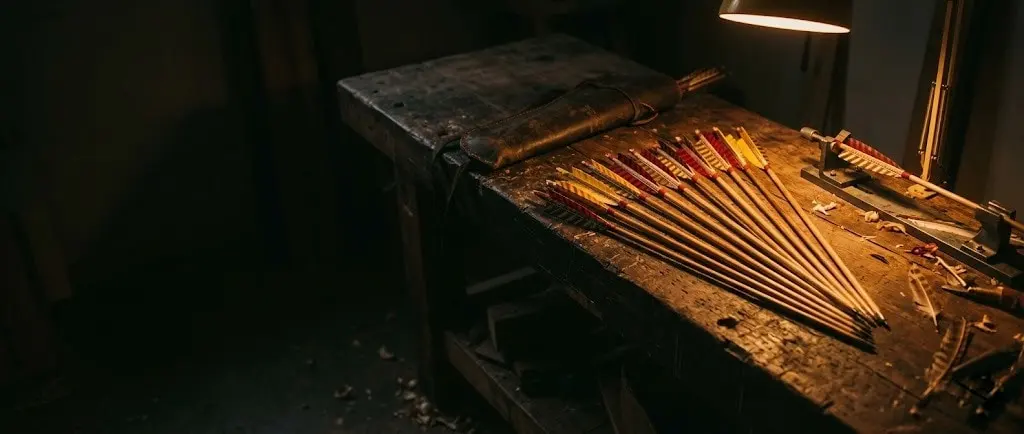
 AI illustration
Arrow fletching
Glue three feathers to a shaft at the same angle, a third of a turn apart. A jig does the geometry and an evening does a set of arrows.
What it is like
Fletching is the three feathers at the back of an arrow. They steer it, and when they are damaged the arrow flies badly. Replacing them is the first piece of arrow making most archers learn.
A jig clamps one feather at a set angle and turns the shaft exactly a third of a turn for the next. The skill is in clean shafts, thin glue lines and patience.
From here it grows naturally: cutting your own shapes, splitting feathers from a turkey wing, and eventually building whole arrows from bare shafts.
Fletching is small, precise work that sits between woodworking and fly-tying. Each feather has a curve set by the wing it came from, and that curve spins the arrow in flight; three feathers from the same wing, glued at the same angle and spacing, make the arrow spin the same way every time. A jig takes the guesswork out of the spacing, so the craft becomes choosing the cut, the length and the angle, and gluing cleanly.
It is also the gateway to building arrows outright. Once refletching is easy, the next steps - cutting shafts to length, fitting nocks and points, painting crests, matching weights - follow naturally, and many traditional archers end up making every arrow they shoot. Matched, well-fletched arrows group tighter than a mixed handful, which is the practical reward.
- A session
- An evening for a set of arrows, mostly waiting for glue.
- A week
- As often as arrows need it; most archers refletch a few at a time.
- Season
- All year; winter is when many archers redo their arrows.
Indoors · Solo, A club
Kinds and styles
Natural feathers, usually turkey, cut to shape. Light and forgiving when they brush a bow shelf, which is why traditional archers use them.
Molded vanes that shrug off rain and wear, used mostly on compound bows shot from a rest.
The outline of the feather: shield cut has a notched back, parabolic a smooth curve, banana a long low profile. Shape changes steering and noise a little.
How the fletching sits on the shaft: in line, at a slight angle, or wrapped in a twist. More twist means more spin and stability, at a little speed.
Three is the tradition; four lower fletchings can clear a bow more easily on some setups.
Big spiral or untrimmed feathers that slow the arrow quickly, for shooting at aerial targets without losing arrows.
Is it for you?
You will probably love it if
- You shoot a bow and are tired of paying for repairs
- Exact, repeatable hand work pleases you
- You want arrows in your own colors
Maybe not, if
- You do not shoot: the arrows have nowhere to go
- You rush glue
- You want to start by building whole arrows from bare wood
What to buy first
- 01Fletching jig, single arrowHolds the feather at a fixed angle and indexes a third of a turnFind it on Amazon$54
- 02Fletching glueStays slightly flexible so feathers survive impactsFind it on Amazon$7
- 03Feather fletchings, 5 inch shield cut, 1 dozenPre-cut and from one wing, so every arrow matchesFind it on Amazon$20
- 04Three arrows that need new feathersStrip the old vanes and practice on shafts you already ownFree
- Everything you need to beginAbout $8 a month after that$81
Typical US prices for entry-level gear, rounded. Last checked October 2026. How we get the numbers
The Amazon links open a search for that type of item, not a product chosen for us, and the prices in the list are our typical figures, or the listing of the shop a line names, not Amazon's price for any listing. If you buy through one we may earn a commission at no extra cost to you; as an Amazon Associate we earn from qualifying purchases.
What to buy next
- 01Helical fletching clampA clamp curved to wrap the feather in a twistFind it on Amazon For more arrow spin
- 02Feather burner or chopperCuts full-length feathers to a consistent profileFind it on Amazon Trimming your own shapes
- 03Grain scaleWeighs each arrow so the set flies the sameFind it on Amazon Building matched sets
- 04Cresting paint or wrapsPainted bands or wraps to identify your arrowsFind it on Amazon Personalizing arrows
- 05Full-length turkey feathersCheaper per arrow and any shape you likeFind it on Amazon Trimming your own
No prices here on purpose: these are later buys, and what to spend depends on how far the hobby has taken you. The Amazon links work like the ones above: a search for the type of item, and a possible commission for us at no extra cost to you.
Fletching jigs and supplies compared
A kit, a jig, tape and feathers from one maker of traditional archery gear, Bearpaw in Germany, with what each contains by its own description. New feathers change an arrow's weight and balance; the arrow weight and FOC calculator linked on this page checks both.
| Model | Type | Specs | Who it suits | Links |
|---|---|---|---|---|
| Bearpaw Arrow Making Kit, straight fletching | Starter kit | The basic Fletching Jig Deluxe with two straight clamps, a roll of fletching tape, 10 g of archery glue and two glue dosers; also sold with right-wound clamps | A first set of arrows, start to finish | Find it on AmazonMaker's page |
| Bearpaw Fletching Jig Deluxe | Fletching jig | A heavy metal base unit for straight, right- or left-wound fletching; expands from 3 to 4 or 6 fletches with the base plate; holds thin and thick shafts and centres the nock | Building arrows for years | Find it on AmazonMaker's page |
| Bearpaw Fletching Tape | Adhesive tape | Double-sided tape for natural feathers on wood, aluminium and carbon shafts, about 1,830 cm (720 in) a roll; made in Germany; Bearpaw notes it needs almost no drying time, unlike liquid glue | Fletching without waiting for glue | Find it on AmazonMaker's page |
| Bearpaw RW Shield 5 inch feathers | Feathers | Genuine turkey feathers, right wing, in a 5 in shield cut with a flatter profile; Bearpaw recommends the 5 in length for heavier draw weights | Refletching traditional arrows | Find it on AmazonMaker's page |
How we put this together. All details come from Bearpaw's own product pages, read on 26 October 2026; no prices, because they change. We have not tested these side by side. Checked on 26 October 2026. There are no prices in this table: the Amazon link searches for the exact model, and we may earn a commission if you buy through it.
From a bare shaft to a matched set of fletched arrows, step by step
Fletching keeps an arrow from tumbling in flight (Wikipedia): three matched feathers glued at the same angle, a third of a turn apart. A jig does the geometry. This guide goes from matching the shafts and choosing feathers to clamping, gluing and sealing, with the choices at each step.
Warning: Before you start Shoot only arrows matched in spine and length to your bow, and flex and inspect every shaft before shooting: a cracked arrow can break on release and injure the hand. Feathers sold for fletching are legal farmed turkey. Feathers from nearly all wild birds are protected by the Migratory Bird Treaty Act in the United States and may not be collected or used; wild turkey feathers from a legally taken bird are a common exception, under state rules.
Scrape the old fletchings and glue off, then wipe the shaft with rubbing alcohol.
Choose straight or a slight offset, and set the clamp so the feather sits about an inch in front of the nock.
A thin line of glue along the quill, clamp it to the shaft, leave it for the time on the tube. The odd-colored feather goes at a right angle to the string.
Turn the jig a third of a turn for the second and third feathers.
A drop of glue on the front and back tip of each quill. Let the set cure overnight before shooting.
Three feathers on the shaft
The back of the arrow from the side, and end-on from the nock.
- A Cock feather Odd colour At a right angle to the string. Step 6 →
- B Nock About 1 in behind The feathers start about an inch in front of it. Step 5 →
- C Glue at the tips Both quill tips Cure overnight. Step 7 →
- D Second and third A third of a turn From the same wing as the first. Step 7 →
Steps 1-4Before gluing
- Step 1 of 8 · Before gluing
Match the shafts to the bow
Spine is a shaft's stiffness - how little it bends when compressed - and heavier draw weights generally need stiffer arrows; most traditional bows are not centre-shot and shoot best with a narrow spine range (Wikipedia). A set must be similarly spined to group.
Goes wrong: Ignoring spine. Perfect fletching cannot fix an arrow too stiff or too weak for the bow.
- Step 2 of 8 · Before gluing
Choose feathers or vanes
Warning: NOTICE Fletching feathers are sold from farmed turkeys. Feathers of nearly all wild birds are protected by the US Migratory Bird Treaty Act and may not be collected or used.
Wikipedia: feathers compress against a bow's shelf and suit traditional bows; on compound bows feathers add noise and plastic vanes work better.
Most people: turkey feathers, shield cut (traditional bows).
Start here Turkey feathers, shield cutBest forTraditional bows
Light and forgiving when they brush the shelf; pre-cut from one wing.
Plastic vanesBest forCompound bows
Shrug off rain and wear.
- Step 3 of 8 · Before gluing
Use feathers from one wing
A feather's curve spins the arrow. Traditional lore pairs right-wing feathers with a right-handed archer and left-wing with a left-handed one (Wikipedia).
Goes wrong: Mixing left and right wings. Feathers from different wings curve opposite ways and fight each other in flight.
- Step 4 of 8 · Before gluing
Strip and clean the shaft
Scrape the old fletchings and glue off, then wipe the shaft with rubbing alcohol so the new glue bonds.
Steps 5-7Fletching
- Step 5 of 8 · Fletching
Set the jig
Choose the clamp's angle and set it so the feather sits about an inch in front of the nock.
Most people: offset (most hunting and target arrows).
Start here OffsetBest forMost hunting and target arrows
Feathers at a slight angle, so the arrow spins (Wikipedia).
HelicalBest forMost stability
Feathers set in a twist: more spin, a little less speed.
StraightBest forSimplest
In line with the shaft; relies on the feather's own curve.
Goes wrong: Fletching too close to the nock. Fingers and string catch the feathers; leave about an inch.
- Step 6 of 8 · Fletching
Glue the first feather
Run a thin line of fletching glue along the quill, clamp it to the shaft and leave it for the time on the tube. The odd-coloured feather - the cock feather - goes at a right angle to the string.
- Step 7 of 8 · Fletching
Index, repeat and seal
Turn the jig a third of a turn for the second and third feathers. Then put a drop of glue on the front and back tip of each quill and let the set cure overnight.
Goes wrong: Glue only in the middle. A loose front tip can lift and cut the hand as it passes the bow.
Step 8Next
- Step 8 of 8 · Next
Inspect, then choose a next project
Flex and inspect every shaft before shooting; a cracked arrow can break on release.
Most people: building arrows from bare shafts (full control).
Start here Building arrows from bare shaftsBest forFull control
Cutting to length, nocks and points as well as fletching.
Flu-flu arrowsBest forAerial targets
Big spiral or untrimmed feathers that slow the arrow quickly.
Four-fletchBest forSome bow setups
Four lower feathers can clear a bow more easily.
In shortIf it goes wrong
- Ignoring spine.
- Step 1 · Match the shafts to the bow
- Mixing left and right wings.
- Step 3 · Use feathers from one wing
- Fletching too close to the nock.
- Step 5 · Set the jig
- Glue only in the middle.
- Step 7 · Index, repeat and seal
How you get better
- First eveningRefletch three arrows
Strip, clean and refletch arrows you already own with pre-cut feathers in a single-arrow jig.
- Weeks 2 to 4A full matched set
A dozen arrows with the same feather cut, length and offset, checked for weight.
- Months 2 to 3Helical clamps and trimming
Helical fletching for more spin, and trimming full-length feathers to shape with a burner or a template.
- Months 3 to 6Building arrows from shafts
Cutting shafts to length, fitting nocks and points, cresting with painted bands, and matching spine to your bow.
- After thatWooden arrows and special flights
Cedar arrows built from raw shafts, flu-flus, and your own feather designs.
- Stripping old fletching
- Cleaning and preparing shafts
- Setting a fletching jig
- Choosing feather cut and length
- Left- or right-wing feathers
- Gluing an even line
- Indexing the cock feather
- Straight, offset and helical clamps
- Sealing feather ends
- Burning or trimming to shape
- Cresting and nock fitting
- Spine and weight matching
Small things that help
- Use feathers all from the same wing - left or right - on one arrow, so they all curve the same way.
- Clean the shaft with rubbing alcohol before gluing; oil from fingers weakens the bond.
- Mark the cock feather a different color so you nock the arrow the right way without looking.
- Let the glue cure fully overnight before shooting.
- Refletch damaged feathers early; a torn feather changes how the arrow flies.
- Keep a record of feather cut, length and offset for each set.
Beginner mistakes
- 01Mixing left and right wingsFeathers from different wings curve opposite ways and fight each other in flight.
- 02Glue only in the middleA loose front tip can lift and cut the hand passing the bow. Seal both ends of every quill.
- 03Fletching too close to the nockLeave about an inch so the fingers and the string do not catch the feathers.
- 04Ignoring spinePerfect fletching cannot fix an arrow too stiff or weak for the bow; match the shaft first.
Feather angle
| Setting | Spin | Use |
|---|---|---|
| Straight | Little | Fastest, least forgiving |
| Offset | Moderate | The general-purpose choice |
| Helical | Most | Steadies broadheads, costs some speed |
Why people quit
- 01Mixed wingsLeft-wing and right-wing feathers curve opposite ways. All three on one arrow must match.
- 02Feathers peelingGlue on a dirty shaft lets go. Clean with alcohol first.
- 03Shooting too soonClamp time is not cure time. Wait overnight.
Words you will meet
- Fletching
- The fins at the back of an arrow that make it fly straight.
- Vane
- A plastic fletching.
- Cock feather
- The odd-colored feather set at a right angle to the string; also called the index feather.
- Hen feathers
- The other two feathers of a three-fletch arrow.
- Offset
- Fletching set at a slight angle to the shaft.
- Helical
- Fletching wrapped in a twist around the shaft.
- Nock
- The notch at the back of the arrow that fits the string.
- Spine
- How stiff an arrow shaft is; it must suit the bow's draw weight.
- Cresting
- Painted bands near the fletching, used to identify arrows.
- Flu-flu
- An arrow with oversized fletching that slows it down quickly.
Questions people ask
Feathers or vanes?
Feathers for bows shot off the shelf or the hand, since they fold when they brush it; vanes for compound bows with rests and for wet weather.
Which wing should I use?
Either, as long as all the feathers on one arrow come from the same wing. Many archers pick the wing that spins the arrow away from the bow.
Can I use feathers I find?
In the US, feathers of most wild native birds are protected under the Migratory Bird Treaty Act. Fletching feathers sold commercially come from domestic turkeys.
How long do feathers last?
Until they are torn or flattened; a good set can last a long season, but every arrow that hits something hard should be checked.
Do I need a jig?
Fletching by eye is possible, but a jig makes every arrow match, which is the point of a set.
Where to go next
- 01Traditional archeryShoot the arrows you fletched. $231 to start
- 02Fly tyingAnother craft of feathers, thread and a vise-like jig. $128 to start
How it compares
| Arrow fletching | Traditional archery | Fly tying | Leathercraft | |
|---|---|---|---|---|
| Start cost | $81 | $231 | $128 | $119 |
| Each month | $8 | $15 | $15 | $20 |
| Space | A desk | A club range | A desk corner | A desk |
| Noise | Quiet | Quiet | Quiet | Low |
| First result | 1 evening | 1 afternoon | 1 evening | 1 weekend |
| Mess | Feather trimmings | None | Feather fluff | Scraps and dye |
Where to learn more
- 01USA ArcheryThe US national archery body: clubs, certified coaches and beginner programs.
- 02US Fish and Wildlife Service - Migratory Bird Treaty ActWhich feathers are protected and why commercial fletching uses domestic turkey.
Sources: U.S. Fish & Wildlife Service: Migratory Bird Treaty Act of 1918 · Wikipedia, Ötzi (the quiver and arrows) · Wikipedia, Fletching · Wikipedia, Arrow
Researched and written by the Fjords Team.