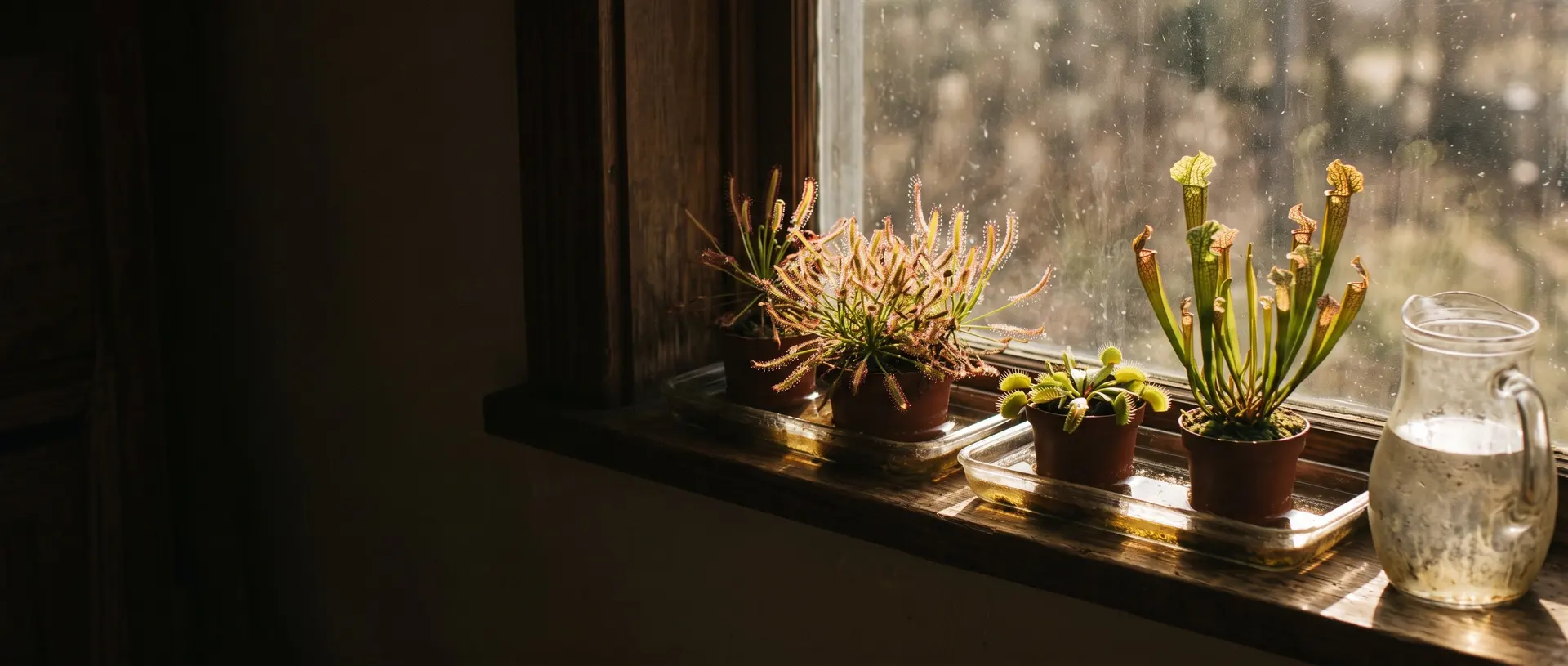
 AI illustration
Carnivorous plants
Sundews, flytraps and pitcher plants want three things: strong light, pure water and wet feet. Give them that and they do the rest.
What it is like
Carnivorous plants grow in bogs so poor in nutrients that they evolved to take their nitrogen from insects. That history explains every rule of keeping them: water low in minerals because dissolved salts build up and harm them, no fertiliser in the soil of flytraps and sundews because it is a quick way to kill them, and strong light because catching flies is expensive and the leaves have to pay for it.
Most people meet the hobby through a Venus flytrap in a plastic cup, which soon dies on a dim desk. The cape sundew is the better first plant. It lives on a windowsill in a saucer of rainwater, catches the gnats that live in your other houseplants, and flowers on a long stalk in summer. Once a sundew has been happy for a year, the flytrap and the pitcher plants make sense.
Different carnivorous plants hunt in different ways, and that is a big part of their charm. Sundews and butterworts catch prey on sticky leaves, pitcher plants drown it in a slippery tube, the flytrap snaps shut on touch, and bladderworts suck tiny animals into underwater bladders. Watching a sundew leaf slowly fold around a gnat over an afternoon is the moment most people are hooked.
Keeping them is less about the hunting than about recreating a bog. The water must be nearly free of minerals, the soil must be poor, the light must be strong, and many temperate species need a cool winter rest. Once those conditions are set up - a tray of rainwater on a sunny sill, or a lined bog bed outside - most of the common species grow with very little fuss, and many multiply enough to share.
- A session
- A minute a day to check the water tray; a few minutes a week for grooming.
- A week
- Topping up water every day or two in summer.
- Season
- Growing season spring to autumn; temperate species need a cold winter rest.
Indoors · Solo, With kids
Kinds and styles
Sticky, glistening tentacles that curl around insects. Many are easy windowsill plants - the best start.
Flat, greasy-looking rosettes that trap gnats on their leaves; Mexican species are easy indoors and flower prettily.
Snap traps triggered by touch. Need strong sun, mineral-free water and a cold winter rest - not a desk plant.
Sarracenia: tall trumpet pitchers for bog gardens and sunny patios, with a cold winter dormancy.
Nepenthes: vining plants with hanging pitchers, grown indoors in humidity and bright light.
A lined, peat-filled outdoor bed kept wet with rainwater for hardy pitcher plants, flytraps and sundews.
Is it for you?
You will probably love it if
- You have a south or west window that gets real sun
- You like plants with behavior, not just leaves
- You can keep a routine of refilling a saucer with the right water
Maybe not, if
- Your windows are shaded; these plants sulk and die in dim rooms
- You want to poke the traps shut for fun; a flytrap needs real food in its traps, not a finger
- You cannot be bothered to check your water; unless your tap water is very low in dissolved minerals, they need distilled or rain water
What to buy first
- 01A cape sundew (Drosera capensis)One of the most forgiving carnivorous plants; it catches gnats on its ownFind it on Amazon$11
- 02Distilled water, a gallonTap water minerals build up in the soil and burn the roots; rainwater is the free alternativeFind it on Amazon$2
- 03Carnivorous plant mix, a small bagFertiliser-free peat or peat-free mix with sand; these plants evolved in poor, acid bogsFind it on Amazon$12
- 04A deep saucerThe pot stands in a half inch of water through the growing seasonFind it on Amazon$2
- Everything you need to beginAbout $3 a month after that$27
Typical US prices for entry-level gear, rounded. Last checked October 2026. How we get the numbers
The Amazon links open a search for that type of item, not a product chosen for us, and the prices in the list are our typical figures, or the listing of the shop a line names, not Amazon's price for any listing. If you buy through one we may earn a commission at no extra cost to you; as an Amazon Associate we earn from qualifying purchases.
What to buy next
- 01Grow lightCarnivorous plants need strong light; a grow light makes a shelf workFind it on Amazon Dim windows or winter
- 02Long-fiber sphagnum mossAnother low-nutrient medium many species likeFind it on Amazon Repotting and cuttings
- 03Rain barrel or water distillerA free or cheap supply of mineral-free waterFind it on Amazon A growing collection
- 04Plastic pots with drainagePlastic or glazed pots; unglazed terracotta can leach mineralsFind it on Amazon Repotting
- 05Seeds from a reputable nurserySundews and Sarracenia grow well from seed sown on wet peatFind it on Amazon Trying seed
No prices here on purpose: these are later buys, and what to spend depends on how far the hobby has taken you. The Amazon links work like the ones above: a search for the type of item, and a possible commission for us at no extra cost to you.
Keeping carnivorous plants indoors, step by step
From choosing a first plant to raising new ones from a leaf, in the order it is done. At each step: what to do, what you can choose between and how the choices differ, and what tends to go wrong. The sources are the International Carnivorous Plant Society's growing guides and the RHS; they disagree in places - on light, water and compost - and both views are given.
Warning: Before you start Nothing here bites back. Buy nursery-grown plants only: Venus flytraps are protected in their native range and wild-collected plants are both illegal and poor growers.
Stand the pot in a saucer with half an inch of distilled or rain water, in the sunniest window you have. Do not repot it yet.
Top up when it is nearly dry. In summer that is every day or two. Never let the pot dry out.
Within a couple of weeks of good light the leaves glisten with sticky droplets. That dew is the sign the plant is happy; no dew means not enough light.
Fungus gnats and fruit flies find it on their own. A leaf curls around a catch over a day. No hand feeding needed.
After a year, move it into fresh carnivorous plant mix in a slightly larger pot. Divide any plantlets at the base and you have plants to give away.
A pot in a tray of water, bottom to top
A pot cut in half, standing in its tray of water, bottom to top.
- A Drainage holes Water from the tray soaks up through them. Step 5 →
- B Tray of rainwater Up to 2.5 cm (1 in) In the growing season; no standing water in winter (RHS). Step 7 →
- C Carnivorous plant mix Peat or a peat-free mix with sand, or sphagnum moss - never fertiliser or potting compost. Step 4 →
- D Sand on top About 1 cm Optional; the ICPS finds older flytrap leaves rot less on pure sand. Step 6 →
- E Plants A cape sundew (left) and a Venus flytrap (right). Step 6 →
- Step 1 of 11
Choose a first plant
The RHS names the Venus flytrap, the cape sundew and the purple pitcher plant as relatively easy houseplants, with butterworts and the Australian pitcher plant as other indoor options and tropical Nepenthes as harder. Buy nursery-grown plants only.
Cape sundew (Drosera capensis)Best forA first plant
Strap-shaped leaves covered in sticky, glistening tentacles that curl round insects. It needs no winter rest, and it multiplies readily from leaf and root cuttings.
Venus flytrap (Dionaea)Best forA sunny porch or a lit shelf
Needs a lot of light: full sun outdoors or, indoors, strong white LED light for about 14 hours a day (ICPS). Indoors under lights it needs no winter dormancy (ICPS).
Purple pitcher plant (Sarracenia purpurea)Best forOutdoors or a cold porch
Hardy to around -15°C (RHS) and grown outdoors or in a cold, bright spot, with a cold winter rest.
Butterworts (Pinguicula)Best forA bright windowsill
Sticky, flat rosettes that trap gnats; the Mexican kinds take a drier winter rest.
Tropical pitcher plants (Nepenthes)Best forLater
Need warm, humid conditions and often lower light, and the RHS counts them among the harder ones.
Goes wrong: A flytrap on a dim desk. It is the plant most people start with and the one that most often fails indoors - it needs far more light than a desk gets.
- Step 2 of 11
Find the light
The sources disagree here. The RHS grows carnivorous plants indoors in a bright position but usually not in direct sun, because leaves can scorch through glass; outdoors, it says they are stronger and better coloured in sun. The ICPS finds that subtropical sundews need more light than a windowsill usually provides, and grows many under lights.
A bright windowsillBest forSundews and butterworts
The RHS approach, shaded from direct summer sun behind glass.
LED grow lightsBest forFlytraps and sundews indoors
For flytraps indoors the ICPS gives 15,000-25,000 lux of white LED light, about 25 W for each 25 cm (10 in) circle of growing area, for around 14 hours a day.
Outdoors in sunBest forFlytraps and pitcher plants
Full sun for flytraps, or morning sun with light afternoon shade in hot, dry places (ICPS); the RHS grows hardy species such as Sarracenia outside.
Goes wrong: Scorch through glass. A south window in summer can burn leaves (RHS).
- Step 3 of 11
Choose the water
Minerals are what kill carnivorous plants slowly. The RHS uses rainwater wherever possible, with distilled water or boiled and cooled tap water as alternatives - but warns that regular tap water builds up minerals, and then replaces the compost every six months. The ICPS measures it instead: tap water below 90 parts per million of dissolved solids is usable; above that, use distilled, reverse osmosis or clean rainwater.
RainwaterBest forMost growers
Free, and the first choice of the RHS; the ICPS accepts clean rainwater too.
Distilled or reverse osmosis waterBest forFlats without a water butt
Practically free of minerals (ICPS, RHS).
Tap waterBest forSoft-water areas
Only if it is low in minerals - under 90 ppm by the ICPS measure, which a TDS meter shows.
Goes wrong: A jug filter. Filtering does not remove the dissolved salts (ICPS).
- Step 4 of 11
Mix the compost
Never soil or potting compost - both are too rich (RHS) - and nothing with fertiliser in it (ICPS). Beyond that, the sources take different routes.
Peat and sandBest forThe classic mix
The ICPS 'CP mix': for flytraps, one part peat to one part sand; for subtropical sundews, anything from 30 to 100 per cent peat. The sand should be silica, about 1.2 mm grain.
Peat-free mixesBest forAvoiding peat
The RHS avoids peat: 75 per cent sustainably produced sphagnum moss with 25 per cent finely sieved pine bark (pieces up to 4 mm), or pure chopped sphagnum; for the cape sundew, equal parts fertiliser-free peat-free mix and sand.
Live or dried sphagnum mossBest forFlytraps
On its own, for flytraps (ICPS) and as the base of the RHS mixes.
Goes wrong: Perlite and builders' sand. The ICPS avoids perlite and pumice for flytraps because they can carry salts, the RHS calls perlite less preferred, and the sand must be gritty horticultural or silica sand, not builders' sand (RHS, ICPS).
- Step 5 of 11
Choose the pot
A pot with drainage holes that stands in the tray. The ICPS finds that height matters more than shape: tall pots stay wetter and suit peat-rich mixes, short pots dry faster and want sandier mixes. Outdoors, the RHS grows hardy kinds in a bog garden or a container with few or no drainage holes, such as an old sink with the plug in.
A tall potBest forFlytraps and pitcher plants
Stays wetter; for peat-rich mixes (ICPS).
A short potBest forSandy mixes
Dries faster; for sandier mixes (ICPS).
A sink or bog bedBest forSarracenia outdoors
Few or no holes, outdoors, for hardy species (RHS).
- Step 6 of 11
Settle the plant
A new plant can stay in the pot it came in for at least its first year (RHS). Stand it in its tray of water in the brightest spot you have chosen. When it is repotted, the ICPS tops flytrap pots with about a centimetre of pure sand, which makes older leaves less likely to rot.
- Step 7 of 11
Keep the tray filled
Through the growing season the RHS stands indoor pots in a saucer of water up to 2.5 cm (1 in) deep; the ICPS keeps a flytrap's pot always sitting in pure water, with the water level well below the soil surface so the soil stays wet but not soggy.
Spring and summerBest forThe growing season
Up to 2.5 cm (1 in) of rainwater in the tray, topped up before it dries (RHS).
WinterBest forPlants that rest
Out of the water: the RHS waters only when the compost starts to dry and never leaves pots standing in water.
Goes wrong: A dry tray in summer. These are bog plants; the compost should never dry out while they are growing.
- Step 8 of 11
Feeding - mostly, don't
Most carnivorous plants come from low-nutrient places and need no fertiliser (RHS). The ICPS is blunter: do not fertilise the soil unless you do not care if you kill the plants. Food comes through the leaves instead.
Let them huntBest forSundews and butterworts
Sundews catch the fungus gnats and aphids that live around other houseplants (RHS).
Rehydrated dried bloodwormsBest forPlants indoors with few insects
Placed on dewy sundew leaves or in a flytrap's trap. Dead food needs the trap gently massaged so it closes fully and digests (ICPS).
Small live insectsBest forFlytraps
Flies and similar, fed to established plants (ICPS). The ICPS notes flytraps decline when they stop getting food.
Goes wrong: Mould on food. Feed only dewy, healthy plants, use less food if mould appears, and dab it with 70 per cent isopropyl alcohol (ICPS).
- Step 9 of 11
Plan the winter
Here the plants differ most. The RHS lets many carnivorous plants rest in winter, with less water and cooler temperatures, and brings indoors any that are not fully hardy; frost-free means no lower than 4°C at night.
Cape sundewBest forNo change
Subtropical sundews need no dormancy (ICPS); keep it growing on the windowsill or under lights.
Venus flytrap indoorsBest forPlants under lights
Under lights, no dormancy is needed for long-term survival (ICPS).
Venus flytrap outdoorsBest forPlants kept outside
Dormant at least three months of the year; protect it from drying out in frost, which the ICPS calls the biggest danger.
Purple pitcher plantBest forCold winters
Hardy to around -15°C (RHS); a cold rest outdoors or in an unheated, bright place.
Goes wrong: The fridge. The ICPS calls putting indoor flytraps in the refrigerator for dormancy a waste.
- Step 10 of 11
Repot and divide
Repot when the roots fill the container, into a pot only slightly larger, in fresh carnivorous plant mix (RHS). The ICPS repots flytraps every year or two - sooner if the plant presses against the side of the pot, the soil has gone salty, or new traps fail - and subtropical sundews every three to five years. Divide flytraps with four or more crowns and big clumps of pitcher plants (RHS).
Goes wrong: New traps that fail. On a flytrap that usually means salty soil - repot into fresh mix and check the water (ICPS).
- Step 11 of 11
Make more plants
Many carnivorous plants multiply easily, and one plant soon becomes several to give away.
Leaf cuttingsBest forSundews and butterworts
Sundews and butterworts root from leaves (RHS); for sundews the ICPS finds them slower than root cuttings but faster than seed.
Root cuttingsBest forSundews
Sundews and the Australian pitcher plant (RHS); for sundews the fastest route to mature plants (ICPS).
Flytrap leaf pullings and divisionBest forVenus flytraps
A leaf pulled off at its base can root, and one mother plant can give over a dozen plants (ICPS); clumps are divided at repotting (RHS).
SeedBest forPatience
Sown on the surface and never buried, misted, kept at 20-25°C in a sealed bag against fungus gnats (ICPS). Sundews take about two years to mature; flytraps about five, or two if fed heavily.
Goes wrong: Moss and green slime on seedlings. Moss and cyanobacteria from peat can swamp small plants (ICPS).
In shortIf it goes wrong
- A flytrap on a dim desk.
- Step 1 · Choose a first plant
- Scorch through glass.
- Step 2 · Find the light
- A jug filter.
- Step 3 · Choose the water
- Perlite and builders' sand.
- Step 4 · Mix the compost
- A dry tray in summer.
- Step 7 · Keep the tray filled
- Mould on food.
- Step 8 · Feeding - mostly, don't
- The fridge.
- Step 9 · Plan the winter
- New traps that fail.
- Step 10 · Repot and divide
- Moss and green slime on seedlings.
- Step 11 · Make more plants
How you get better
- First monthsOne sundew on a sunny sill
Rainwater or distilled water in a tray, the brightest window, and dew on the leaves as the sign it is happy.
- First yearRepotting and propagation
Fresh peat and perlite in spring, dividing plantlets, and leaf cuttings that root on wet peat.
- Year 1 to 2A second genus
A Mexican butterwort or a Cape sundew relative, then a flytrap once you can give it full sun and a winter rest.
- Year 2 to 3Dormancy and pitchers
Temperate pitcher plants and flytraps through a cold winter, or tropical Nepenthes indoors with humidity.
- After thatA collection or a bog garden
Seed raising, rarer species from specialist nurseries, or an outdoor bog bed.
- Choosing mineral-free water
- Tray watering
- Giving enough light
- Peat and perlite mixes
- Recognizing a healthy plant
- Winter dormancy
- Repotting
- Dividing and leaf cuttings
- Growing from seed
- Pest control without chemicals
- Humidity for tropical species
- Building a bog garden
Small things that help
- Use only rainwater, distilled water or reverse-osmosis water - never tap or filtered tap water.
- Give the brightest light you can; a dewy sundew or a red flytrap is a happy one.
- Do not fertilize the soil, and do not feed them hamburger.
- Let flytraps and Sarracenia go dormant in winter; skipping it weakens them.
- Do not trigger flytrap traps for fun - each trap only closes a few times.
- Buy only nursery-grown plants, never wild-collected ones.
Beginner mistakes
- 01Tap waterDissolved minerals build up in the soil and burn the roots. Rainwater or distilled water only.
- 02Too little lightA dim desk is the most common cause of decline. Sunny windowsills or grow lights.
- 03Fertilizer or compostNormal potting soil and plant food can kill them. Peat and perlite, nothing else.
- 04Skipping winter dormancyTemperate species kept warm all winter weaken and die over a year or two.
- 05Hand-feeding meatMeat rots in the trap. Insects only, and usually the plant finds its own.
Five beginner plants, in order
| Plant | Light | Dormancy | Where it lives | Difficulty |
|---|---|---|---|---|
| Cape sundew (Drosera capensis) | Bright window | None | Windowsill, in a saucer of water | Easiest |
| Mexican butterworts (Pinguicula) | Bright window | A drier winter rest | Windowsill | Easy |
| Venus flytrap (Dionaea) | Full sun, or strong grow lights indoors | Only if it winters outdoors in the cold | Outdoors, or indoors under strong light | Moderate; most die from dim light |
| North American pitcher plants (Sarracenia) | Full sun | Cold winter rest | Outdoors, bog garden or a tray | Moderate |
| Tropical pitcher plants (Nepenthes) | Bright, indirect | None | Warm, humid room or terrarium | Moderate; needs humidity |
Why people quit
- 01Tap waterA common killer. Minerals accumulate and the plant declines over months. The International Carnivorous Plant Society's flytrap guide accepts tap water only below 90 parts per million of dissolved solids; above that, use distilled, reverse osmosis or clean rain water.
- 02A flytrap on a deskThe Venus flytrap is sold everywhere and is the wrong first plant for a dim desk: it needs lots of light, full sun outdoors or strong grow lights indoors. Start with a sundew, buy the flytrap later for a sunny porch or a lit shelf.
- 03Playing with the trapsTriggering a flytrap with a finger costs the plant energy for nothing. Let the insects do it.
Words you will meet
- Mucilage
- The sticky dew sundews and butterworts use to trap insects.
- Pitfall trap
- A pitcher-shaped leaf that insects fall into and cannot climb out of.
- Snap trap
- A leaf that closes quickly on prey, as in the Venus flytrap.
- Dormancy
- The winter rest temperate species need.
- Tray method
- Standing the pot in a shallow tray of water so the soil stays wet.
- Sarracenia
- North American trumpet pitcher plants.
- Nepenthes
- Tropical vining pitcher plants.
- Drosera
- The sundew genus.
- Pinguicula
- The butterwort genus.
- TDS
- Total dissolved solids in water; the lower, the better for these plants.
Questions people ask
Do I need to feed my carnivorous plant?
Usually not. Indoors they catch gnats and flies on their own; if they catch nothing for months, a few small insects are enough. Never feed meat.
Why is my Venus flytrap dying?
Most often too little light, tap water or no winter rest. Flytraps need full sun, mineral-free water and a cool dormant season.
Can I use filtered water?
Most pitcher and fridge filters leave minerals in. Rainwater, distilled or reverse-osmosis water are safe.
Can carnivorous plants live in a terrarium?
Tropical sundews and Nepenthes can like the humidity, but sealed terrariums are often too dark and stuffy. Flytraps and Sarracenia need open air and dormancy.
Are they hard to grow?
Not once you follow three rules - pure water, strong light, no fertilizer. The cape sundew is among the easiest houseplants of all.
Where to go next
- 01TerrariumsTropical sundews and Nepenthes like humid air, which is where glass comes in - though a sealed jar is often too dark and stuffy for them. $52 to start
- 02Succulents and cactiThe opposite windowsill: gritty mix, a pot that dries out between waterings, and a winter rest - every rule reversed. $37 to start
- 03BonsaiAnother long-term plant hobby where light, water and potting mix decide everything. $76 to start
How it compares
| Carnivorous plants | Terrariums | Succulents and cacti | Bonsai | |
|---|---|---|---|---|
| Start cost | $27 | $52 | $37 | $76 |
| Each month | $3 | $2 | $4 | $8 |
| Space | A sunny windowsill | A shelf | A windowsill | A balcony or yard |
| Noise | Quiet | Quiet | Quiet | Quiet |
| First result | A few weeks | 1 afternoon | Same day | 1 growing season |
| Mess | None | A little soil | A little soil | Soil and clippings |
Where to learn more
- 01International Carnivorous Plant SocietyGrowing guides by genus, seed bank and conservation information.
Sources: ICPS, Growing Dionaea muscipula (John Brittnacher) · ICPS, Growing Subtropical Drosera (John Brittnacher) · RHS, How to grow carnivorous plants · International Carnivorous Plant Society, growing guides · Wikipedia, Carnivorous plant
Researched and written by the Fjords Team.