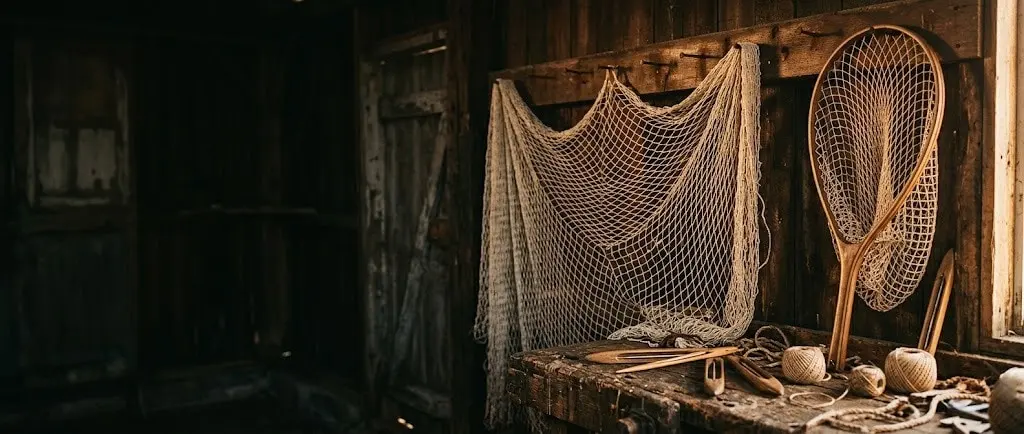
 AI illustration
Net making
Knot twine into mesh with a wooden needle and a gauge stick. A landing-net bag is the classic first piece, and mending is the skill that lasts.
What it is like
Netting is a single knot, the sheet bend, tied row after row. A flat needle carries the twine and a gauge stick sets the size of every mesh. That is all the equipment there is.
A landing-net bag is the usual first piece: small, coarse enough to see what you are doing, and a mistake costs three rows instead of thirty.
Mending is the more useful half of the craft. A torn net is cut back to whole meshes and filled in with the same knot, and a neat mend is hard to tell from the rest of the net.
The rhythm is simple once it clicks. The twine comes over the gauge, through the loop above, around behind itself and tight - one sheet bend, and the mesh is set to exactly the gauge’s size. Row after row the net grows downward, and because every knot locks its own mesh, a net can be cut, shaped and mended without unraveling.
That last point is why mending matters so much. A torn net is not thrown away: the damage is cut back to clean, whole meshes, and the hole is filled in with new knots that join the old ones. It is the most useful skill a netter can have.
- A session
- Half an hour to an hour at a time; netting is easy to pick up and put down.
- A week
- A landing-net bag over a weekend or a few evenings.
- Season
- All year, indoors or out.
Indoors or out · Solo, A club
Kinds and styles
A small bag of even mesh laced to a hoop - the classic first piece on this page.
Coarse mesh for peas, beans and climbing plants; quick to make and very forgiving.
Market and produce bags in cotton cord, using the same knot and a smaller gauge.
A large flat net with strong end loops; many hours of the same knot.
Round weighted nets thrown by hand; a bigger project, and heavily regulated on the water.
Cutting back damaged mesh and knitting it in again - the skill fishers and gardeners value most.
Is it for you?
You will probably love it if
- Repetitive hand work calms you
- You fish, garden or sail and can use a net
- You like crafts you can pick up for ten minutes
Maybe not, if
- Counting rows annoys you
- You want variety in every session
- You plan to use nets on the water without reading the rules
What to buy first
- 01Netting needles, set of plastic or wooden shuttlesHolds the twine and passes through the meshFind it on Amazon$10
- 02Nylon seine twine, size 18, 1 lbThick enough to see and strong enough for a landing netFind it on Amazon$11
- 03Steel ring or an old landing net hoop, about 14 inchThe frame the bag is laced toFind it on Amazon$3
- 04A mesh gauge cut from a ruler or scrap woodMakes every mesh the same sizeFree
- Everything you need to beginAbout $4 a month after that$24
Typical US prices for entry-level gear, rounded. Last checked October 2026. How we get the numbers
The Amazon links open a search for that type of item, not a product chosen for us, and the prices in the list are our typical figures, or the listing of the shop a line names, not Amazon's price for any listing. If you buy through one we may earn a commission at no extra cost to you; as an Amazon Associate we earn from qualifying purchases.
What to buy next
- 01Mesh gauges in several sizesEach mesh size needs its own gaugeFind it on Amazon Different projects
- 02Cotton cordSoft, natural cord for household netsFind it on Amazon String bags
- 03Larger netting needlesHold more twine for big piecesFind it on Amazon Garden nets and hammocks
- 04Landing net frame and handleA proper hoop and handle for a finished netFind it on Amazon Second landing net
- 05Braided nylon twineStrong, rot-proof twineFind it on Amazon Hard-wearing nets
No prices here on purpose: these are later buys, and what to spend depends on how far the hobby has taken you. The Amazon links work like the ones above: a search for the type of item, and a possible commission for us at no extra cost to you.
From a loaded needle to a landing-net bag, step by step
A net is meshes formed by knotting thin twine (Wikipedia), every knot sized on the same gauge. This guide goes from loading the needle and casting on to netting rows, closing a bag and mending, with the choices at each step. Using a net on the water is regulated; making one is not.
Warning: Before you start Making a net is legal almost everywhere; using one is not. Cast nets, seines, gill nets and even landing nets of certain sizes are regulated by state fishing rules, and some are banned outright. Check before a home-made net touches the water.
Wind twine onto the shuttle around its tongue, turning it over each pass.
Tie a row of loops onto a cord strung between two points, each loop sized on the gauge.
One knot, the sheet bend, into each loop of the row above, pulled down snug against the gauge. Work back and forth.
Join the two edges with a row of knots, then take two meshes together across the last rows to draw the bottom in.
Thread a cord through the top row of meshes and around the frame.
Netting a bag
Face on, the fifth row half done: three knots tied over the gauge.
- A Cast-on cord Loops on a cord Strung between two points. Step 4 →
- B Sheet bend At every node Pulled snug down against the gauge. Step 5 →
- C Mesh One gauge wide Every one the same size. Step 5 →
- D Mesh gauge A flat stick Every mesh is tied around it. Step 3 →
- E Netting needle Twine wound on Not too full. Step 2 →
Steps 1-3Set up
- Step 1 of 8 · Set up
Choose the twine
Early nets were grass, flax and cotton; hemp dominated big fishing gear until about 1900, and the first nylon nets appeared in Japan in 1949 (Wikipedia). Today most nets are nylon.
Most people: nylon seine twine, size 18 (a landing net).
Start here Nylon seine twine, size 18Best forA landing net
Thick enough to see, strong enough for fish.
Cotton cordBest forString bags
Soft and easy on the hands; rots if left wet.
- Step 2 of 8 · Set up
Load the netting needle
Wind twine onto the shuttle around its tongue, turning the needle over each pass.
Goes wrong: Overloading the needle. It jams in the mesh; wind less twine.
- Step 3 of 8 · Set up
Make a mesh gauge
A flat stick - cut from a ruler or scrap wood - that every mesh is tied around, so all meshes come out the same size.
Goes wrong: Netting without the gauge. Meshes drift in size.
Steps 4-6Netting
- Step 4 of 8 · Netting
Cast on
Tie a row of loops onto a cord strung between two points, each loop sized on the gauge.
- Step 5 of 8 · Netting
Net the rows with a sheet bend
Each mesh is joined with a sheet bend - the first knot in The Ashley Book of Knots, also called the weaver's knot, and the knot nets are made of (Wikipedia). Tie one into each loop of the row above, pulled snug down against the gauge, working back and forth.
Goes wrong: A slipping knot. Wikipedia notes the sheet bend tends to work loose when not under load; check each knot's shape and pull it firmly home.
- Step 6 of 8 · Netting
Choose the knot for the job
For most netting the plain sheet bend is enough; Ashley called it quite secure enough for ordinary purposes.
Most people: sheet bend (most netting).
Start here Sheet bendBest forMost netting
Quick and even.
Double sheet bendBest forSlippery or uneven twine
An extra round turn below the first; ends on the same side for strength.
Steps 7-8Finishing and next
- Step 7 of 8 · Finishing and next
Close the bag and lace it
Join the two edges with a row of knots, then take two meshes together across the last rows to draw the bottom in. Thread a cord through the top row of meshes and around the hoop.
- Step 8 of 8 · Finishing and next
Learn to mend, and choose a next net
Warning: NOTICE Cast nets, seines, gill nets and even some landing nets are regulated by state fishing rules, and some are banned. Check before a home-made net touches the water.
Mending - cutting back to whole meshes and netting the hole in again - is the skill fishers and gardeners value most.
Most people: garden nets (peas and beans).
Start here Garden netsBest forPeas and beans
Coarse mesh, quick and forgiving.
String bags and hammocksBest forHome use
The same knot, other gauges, many hours.
Cast netsBest forExperienced netters
Round, weighted nets up to about four metres across (Wikipedia) - and heavily regulated.
Not for a first try
In shortIf it goes wrong
- Overloading the needle.
- Step 2 · Load the netting needle
- Netting without the gauge.
- Step 3 · Make a mesh gauge
- A slipping knot.
- Step 5 · Net the rows with a sheet bend
How you get better
- First weekendA landing-net bag
Cast on, net rows with the gauge, close the bag and lace it to a hoop.
- First monthA flat net and a string bag
Even rows across a wider piece, and a smaller gauge in cotton.
- Months 2 to 3Mending
Cutting damaged mesh back to whole meshes and filling the hole.
- Months 3 to 6Garden nets and a hammock
Coarse garden nets, then the long project of a hammock.
- After thatShaped nets
Cast nets and shaped bags with increases and decreases, made where the rules allow their use.
- Loading a netting needle
- Choosing a mesh gauge
- Casting on
- The sheet bend netting knot
- Keeping even mesh
- Working back and forth
- Increasing and decreasing
- Joining into a tube
- Closing a bag
- Lacing to a frame
- Cutting out damage
- Mending
Small things that help
- Pull every knot down against the gauge.
- Keep the needle loaded but not overfull, or it will not pass through the mesh.
- Practice the sheet bend in thick cord first.
- Count meshes at the end of each row.
- Hang the work from a hook at chest height.
- Seal nylon ends with a flame.
Beginner mistakes
- 01Netting without the gaugeMeshes drift in size. Always use it.
- 02A slipping knotA sheet bend tied backwards slides. Check each knot's shape.
- 03Overloading the needleIt jams in the mesh. Wind less twine.
- 04Using a net without checking rulesMany nets are regulated or banned on the water. Check first.
- 05Mending into broken meshesCut back to whole meshes before filling a hole.
The same knot, other uses
| Piece | Mesh | Note |
|---|---|---|
| Landing-net bag | About 1 inch | Small and quick |
| Garden pea or bean net | 4 to 6 inch | Coarse and fast to make |
| Hammock | 2 inch | Many hours, the same knot |
| A mend | Matches the net | Cut back to whole meshes, then fill in |
Why people quit
- 01Uneven meshKnots tied without the gauge wander. Every knot is pulled down against the stick.
- 02Slipping knotsA sheet bend tied the wrong way round slides. Learn it slowly on thick cord first.
- 03Boredom at row sixIt is one knot. Put on something to listen to.
Words you will meet
- Mesh
- One opening of a net, usually measured across.
- Netting needle
- A flat shuttle that holds and passes the twine.
- Gauge
- A flat stick that sets the size of each mesh.
- Sheet bend
- The knot used for netting; also called the weaver's knot.
- Cast on
- Making the first row of loops.
- Seine
- A long net drawn through the water.
- Cast net
- A round net thrown by hand.
- Twine
- The cord nets are made of.
- Mending
- Repairing a damaged net with new meshes.
Questions people ask
What knot is used for netting?
The sheet bend, also called the weaver's knot, tied around the gauge.
What do I need to start?
A netting needle, a gauge, twine and a hook or cord to work from.
How long does a landing net take?
A small bag can be done over a weekend once the knot is comfortable.
Can I use my homemade net for fishing?
Only where state rules allow that type and size of net; many are regulated or banned.
Is netting like knitting?
It is knotted, not looped, so a cut mesh does not run.
Where to go next
- 01Decorative knotsThe ornamental side of the same skill. $11 to start
- 02Fly fishingA landing net of your own for the fish you catch. $289 to start
How it compares
| Net making | Decorative knots | Basket weaving | Fly fishing | |
|---|---|---|---|---|
| Start cost | $24 | $11 | $45 | $289 |
| Each month | $4 | $3 | $10 | $20 |
| Space | A chair and a hook | Your lap | A table | A river or pond |
| Noise | Quiet | Quiet | Quiet | Quiet |
| First result | 1 weekend | 1 evening | 1 weekend | A few trips |
| Mess | Twine ends | None | Water and offcuts | Wet boots |
Sources: Wikipedia, Fishing net (history) · Wikipedia, Antrea Net · Wikipedia, Sheet bend
Researched and written by the Fjords Team.