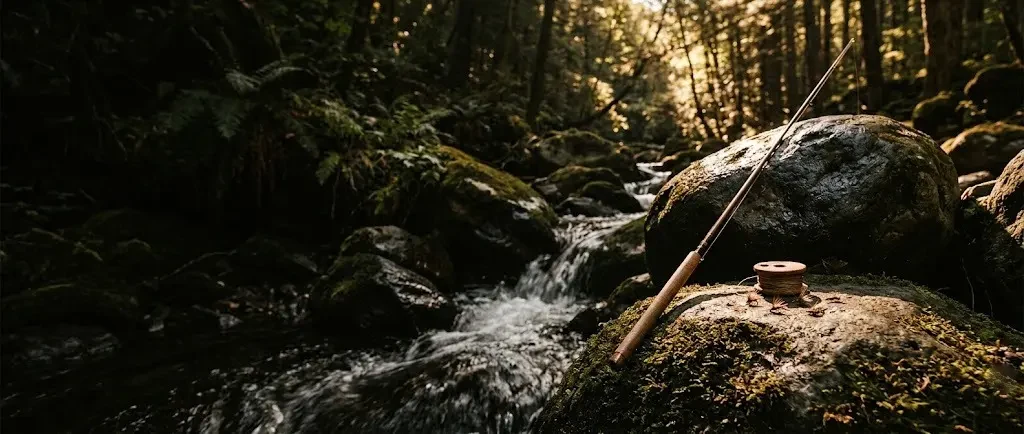
 AI illustration
Tenkara
A long telescopic rod, a fixed line and one fly. Japanese stream fishing that a beginner can start casting the first afternoon.
What it is like
Tenkara is the Japanese method of fly fishing small mountain streams: a long telescopic rod, a line fixed to its tip, and a single fly. There is no reel because there is no need for one. The rod reaches over the current, the line stays off the water, and the fly drifts where the fish are. A beginner can start casting in an afternoon because there is so little gear to master.
It is the cheaper, simpler cousin of western fly fishing and a good first fishing hobby for anyone near creeks. The whole kit fits in a jacket; a walk up a stream with a tenkara rod is as much a hike as a fishing trip. People who already fly fish often keep one for the days when the big rod stays home.
The long rod is the secret. At around twelve feet it lets you hold the line above the water, so the current cannot drag it, and place a fly precisely in a small pool or on the far side of a seam. Because the line is fixed and roughly the length of the rod, the cast is a short, crisp flick rather than the long loops of western fly fishing, and most of the skill goes into reading the stream and moving quietly.
Tenkara also asks you to think differently about flies. Instead of carrying boxes of patterns, tenkara anglers often use one simple kebari all day and change how it moves - letting it drift, pulsing it, holding it still in the current. Many find it pares fishing back to the stream, the fish and a single rod, which is a large part of its appeal.
- A session
- Half a day walking up a stream, or an hour on a pond.
- A week
- A trip whenever the season and water allow.
- Season
- Spring to autumn on most streams, within local seasons and rules.
Outdoors · Solo, For two, With kids
Kinds and styles
Small, clear creeks with pools and riffles - the water tenkara was made for.
One or two simple Japanese flies, fished by changing how they move rather than which fly is on.
Tapered furled lines are easier to cast; light level lines stay off the water more easily.
Bluegill and small bass from the bank, a gentle place to practice the cast.
A telescopic rod in the pack for fishing on long hikes into the hills.
The historic Japanese form, which mostly used real insects as bait.
Is it for you?
You will probably love it if
- You want to fish moving water without a season of learning to cast
- You like gear that fits in a jacket pocket
- There is a small stream with trout or panfish within an hour of you
Maybe not, if
- You want to fish big rivers, lakes or the sea; a fixed line has a short reach
- You want to cast far; twenty feet is the whole game
- A fishing license and the local rules are more admin than you want
What to buy first
- 01Tenkara rod, about 12 feetTelescopes to 20 inches; one rod covers most small streamsFind it on Amazon$105
- 02Level line, one spoolA fluorocarbon line the length of the rod; it is the whole casting systemFind it on Amazon$20
- 03Tippet, 5XThree feet of fine line between the level line and the flyFind it on Amazon$8
- 04A dozen kebari fliesOne or two traditional patterns; tenkara anglers change how they fish the fly, not the flyFind it on Amazon$15
- 05Fishing licenseRequired nearly everywhere; the price varies by state and residency$30
- Everything you need to beginAbout $5 a month after that$178
Typical US prices for entry-level gear, rounded. Last checked October 2026. How we get the numbers
The Amazon links open a search for that type of item, not a product chosen for us, and the prices in the list are our typical figures, or the listing of the shop a line names, not Amazon's price for any listing. If you buy through one we may earn a commission at no extra cost to you; as an Amazon Associate we earn from qualifying purchases.
What to buy next
- 01Furled tenkara lineA tapered line that turns over smoothlyFind it on Amazon Easier casting
- 02Line holder or spoolKeeps line tidy on the rodFind it on Amazon Moving between pools
- 03Small netGentler handling for releaseFind it on Amazon Landing trout
- 04Wading shoesGrip on slippery stonesFind it on Amazon Rocky streams
- 05Fly tying kit for kebariTie the simple flies tenkara usesFind it on Amazon Second season
- 06Polarized glassesProtect eyes and see into the waterFind it on Amazon Every trip
No prices here on purpose: these are later buys, and what to spend depends on how far the hobby has taken you. The Amazon links work like the ones above: a search for the type of item, and a possible commission for us at no extra cost to you.
From rigging at home to a fish from a small stream, step by step
Tenkara is fly fishing with a long rod, a fixed line and no reel, developed over 400 years ago by fishermen in Japan's mountain streams (Wikipedia). This guide goes from the rod and line to the cast, the approach and landing a fish, with the choices at each step. Licences and rules come from your state's fish and wildlife agency.
Warning: Before you start A fishing license is required almost everywhere and seasons, limits and barbless rules vary by water; check your state fish and wildlife agency first. Wear glasses when casting, pinch the barbs, and wade only where you can see the bottom, with a stick in fast water. A twelve-foot carbon rod conducts electricity: collapse it and leave the water at the first thunder, and keep it away from power lines.
Tie the level line to the rod tip with a girth hitch, add the tippet with a simple knot, tie on a kebari. Practice the cast on the lawn: a short flick, stop the rod high, let the line unroll.
A creek you could step across in places, with pools below riffles. Ask the local fly shop; they will point you at it.
Fish face upstream. Walk up the bank quietly, stay low, and cast to the head of each pool from downstream.
Hold the rod high so only the tippet and fly touch the surface. The fly drifts naturally and the strike shows as a stop or a twitch.
Lift the rod to bring the fish to your hand, wet your palm, slip the barbless hook out and let it go.
The rig over a pool
From the side: the rod held high from the bank, the line clear of the water, the fly magnified.
- A Rod 11-15 ft 12 ft is common; telescopic. Step 1 →
- B Line About rod length Level fluorocarbon or furled. Step 2 →
- C Tippet 30 cm to 1 m Fine. Step 3 →
- D Kebari Hackle forward One or two patterns. Step 3 →
Steps 1-3Rig
- Step 1 of 8 · Rig
Choose the rod
Tenkara rods are usually 11 to 15 ft (3.3-4.5 m), with 12 ft (3.6 m) the most common; they telescope down to a short tube and are made of carbon fibre or fibreglass (Wikipedia).
Most people: about 12 ft (most small streams).
Start here About 12 ftBest forMost small streams
One rod covers most creeks you can step across.
Shorter, about 11 ftBest forBrushy little creeks
Easier under overhanging branches.
Longer, 13-15 ftBest forWider streams
More reach to keep the line off the water.
- Step 2 of 8 · Rig
Choose the line
The line is the whole casting system, roughly the length of the rod or a little shorter (Wikipedia). Tie it to the rod tip with a girth hitch.
Most people: level fluorocarbon line (keeping line off the water).
Start here Level fluorocarbon lineBest forKeeping line off the water
A single-diameter line cut to length; Wikipedia notes it can be kept off the water more easily.
Furled tapered lineBest forEasier casting
Twisted monofilament that tapers, the traditional line.
- Step 3 of 8 · Rig
Add tippet and a kebari
Add about 30 cm to 1 m of fine tippet (Wikipedia gives this range) and tie on a kebari - a traditional Japanese fly whose hackle faces forward, unlike most Western flies; the sakasa kebari is the best known.
Goes wrong: A heavy tippet. Thick line looks unnatural; fine tippet does not.
Steps 4-7On the stream
- Step 4 of 8 · On the stream
Practise the cast on the lawn
Warning: CAUTION Wear glasses when casting, and collapse the rod and leave the water at the first thunder: a long carbon rod conducts electricity. Keep it away from power lines.
A short flick back, a flick forward, stop the rod high and let the line unroll in front of you.
- Step 5 of 8 · On the stream
Find small water
A creek you could step across in places, with pools below riffles - the mountain-stream water tenkara was made for. A local fly shop will point you at one.
Goes wrong: Fishing big water. A fixed line has a short reach; small streams are where it works.
- Step 6 of 8 · On the stream
Approach from below
Fish face upstream. Walk up the bank quietly, stay low and cast to the head of each pool from downstream.
Goes wrong: Stomping the bank. Vibration and shadows spook fish.
- Step 7 of 8 · On the stream
Keep the line in the air
Hold the rod high so only the tippet and fly touch the water. The long rod lets you place the fly precisely, hold it in one spot across a current and control how it moves (Wikipedia). A strike shows as a stop or a twitch in the line.
Most people: a dead drift (rising fish).
Start here A dead driftBest forRising fish
The fly drifts with the current, line off the water.
Moving the flyBest forSearching a pool
Small pulses of the rod tip make the kebari's hackle open and close.
Goes wrong: Line on the water. Drag spoils the drift; lift the rod.
Step 8After a season
- Step 8 of 8 · After a season
Land it by hand, then branch out
Lift the rod to bring the fish to your hand, wet your palm, slip the barbless hook out and let it go. After a season, many anglers try tenkara on ponds for bluegill or carry the rod on long hikes.
In shortIf it goes wrong
- A heavy tippet.
- Step 3 · Add tippet and a kebari
- Fishing big water.
- Step 5 · Find small water
- Stomping the bank.
- Step 6 · Approach from below
- Line on the water.
- Step 7 · Keep the line in the air
How you get better
- First afternoonCasting on the lawn
Rig at home and practice a short flick and high stop with yarn.
- First tripA fish from a small stream
Upstream, low and quiet, fly at the head of each pool.
- First seasonReading water
Pockets, seams and pools on several streams, and learning to move the fly.
- Year 2Lines and rods
Furled and level lines, a longer or shorter rod for different streams, and tying your own kebari.
- After thatWilder water
Backpacking to remote creeks, and perhaps western fly fishing for bigger water.
- Rigging the line
- Tying tippet and fly
- The basic cast
- Keeping line off the water
- Reading small streams
- Approaching quietly from downstream
- Drifting the fly
- Manipulating the kebari
- Detecting strikes
- Landing by hand
- Catch and release
- Safe wading
Small things that help
- Fish upstream so fish face away from you.
- Keep low and move slowly along the bank.
- Hold the rod high so only tippet touches the water.
- Fish the head of each pool first.
- Change how you move the fly before you change the fly.
- Collapse the rod and leave at the first thunder.
Beginner mistakes
- 01Fishing big waterA fixed line has a short reach. Small streams are where tenkara works.
- 02Line on the waterDrag spoils the drift. Lift the rod and keep line in the air.
- 03Stomping the bankVibration and shadows spook fish. Quiet, low, from downstream.
- 04A heavy tippetThick line looks unnatural. Use fine tippet.
- 05Ignoring rulesLicenses, seasons and barbless rules vary. Check first.
Tenkara and western fly fishing
| Tenkara | Western fly fishing | |
|---|---|---|
| Rod | 11 to 13 ft, telescopic, no reel seat | 9 ft, with a reel |
| Line | A fixed 10 to 13 ft level line | 90 ft of fly line on a reel |
| Flies | One or two kebari patterns | Boxes of patterns matched to the hatch |
| Reach | About two rod lengths | As far as you can cast |
| Water | Small to medium streams | Anything from creeks to the sea |
| Learning to cast | Quick to pick up | Takes longer practice |
| Gear | Rod, line, tippet and a few flies | Rod, reel, fly line, leaders and many flies |
Why people quit
- 01Fishing water that is too bigOn a wide river the fixed line is a toy. Tenkara shines on streams; take it there.
- 02Spooking the poolStanding tall on the bank in a bright jacket sends every fish under the rocks. Low, slow and from downstream.
- 03Changing fliesWestern habits say match the hatch; tenkara says fish the same fly differently. Tie on one kebari and leave it on.
Words you will meet
- Tenkara
- Japanese reel-less fly fishing with a long rod and fixed line.
- Kebari
- A simple Japanese fly used in tenkara.
- Level line
- A fluorocarbon line of the same thickness throughout.
- Furled line
- A tapered line made of twisted strands.
- Tippet
- The fine final section between line and fly.
- Lillian
- The short cord at the rod tip the line is attached to.
- Girth hitch
- The simple knot that attaches the line to the lillian.
- Yamame, iwana, amago
- Japanese stream trout and char tenkara was developed to catch.
- Drift
- The fly's path as it moves with the current.
Questions people ask
Is tenkara easier than fly fishing?
There is much less gear and the basic cast is quick to pick up, which makes it a gentle start on small streams.
What can I catch with tenkara?
Mostly stream trout and panfish; it is made for small to medium streams rather than big rivers or lakes.
What rod length should I buy?
About 12 feet is the common all-round length; tenkara rods usually range from 11 to 15 feet.
Do I need waders?
Not in summer on small streams; wet wading in old shoes works where it is safe.
Can I use western flies?
Yes, but tenkara anglers often fish one simple kebari and change its movement instead of the pattern.
Where to go next
- 01Fly fishingThe same flies and streams with a reel and a long cast, for bigger water. $289 to start
- 02Fly tyingA kebari is one of the simplest flies to tie - a good first pattern. $128 to start
How it compares
| Tenkara | Fly fishing | Fly tying | Backpacking | |
|---|---|---|---|---|
| Start cost | $178 | $289 | $128 | $660 |
| Each month | $5 | $20 | $15 | $10 |
| Space | A small stream | A river or pond | A desk corner | Trails, and a closet for gear |
| Noise | Quiet | Quiet | Quiet | Quiet |
| First result | 1 weekend, usually | A few trips | 1 evening | 1 weekend |
| Mess | Wet boots | Wet boots | Feather fluff | None |
Where to learn more
- 01Tenkara USAThe company that introduced tenkara outside Japan, with guides and videos.
Sources: Tenkara USA · Wikipedia, Tenkara fishing (origins and equipment)
Researched and written by the Fjords Team.