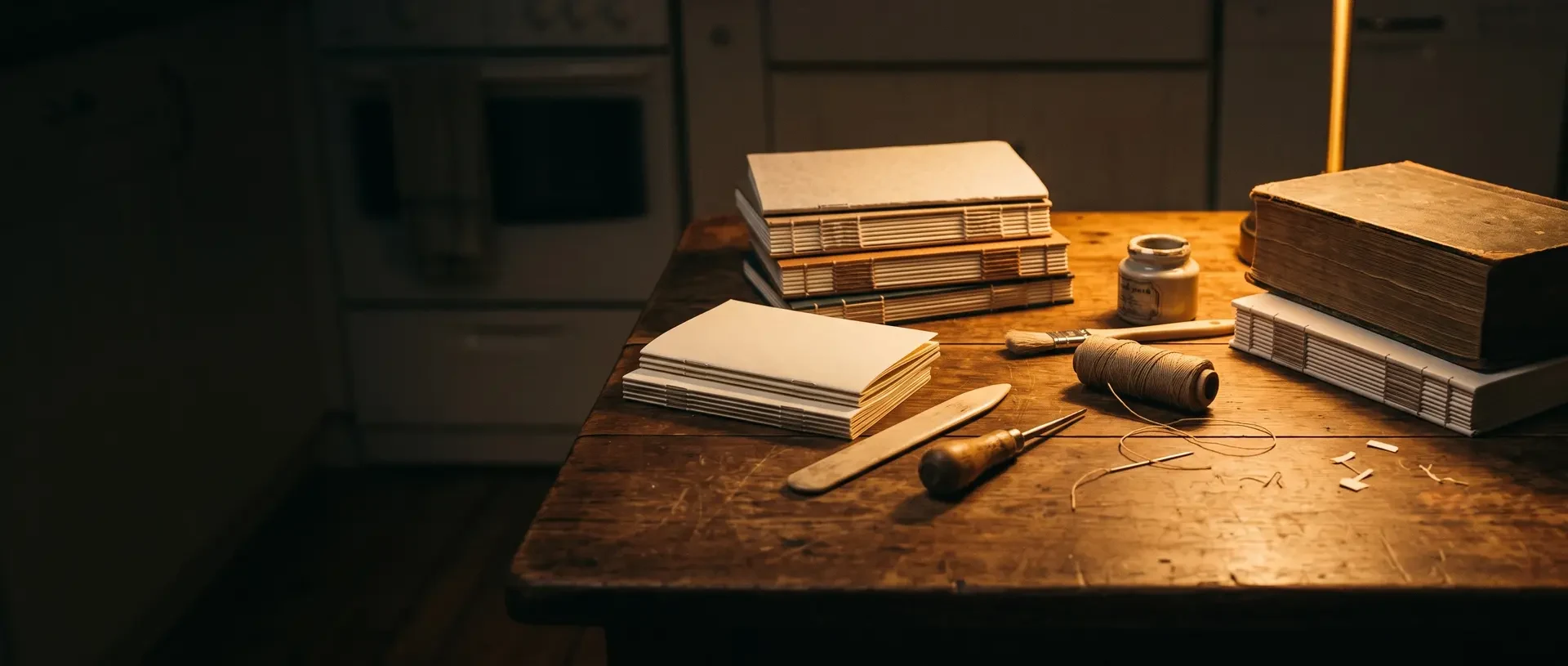
 AI illustration
Bookbinding
Fold a stack of sheets, sew them through the spine, and you are holding a notebook nobody can buy. The first one takes an afternoon.
What it is like
Bookbinding at the kitchen table is mostly folding and sewing. Fold sheets into a signature, pierce the fold, sew through the holes, and you have a notebook. Everything beyond that - hard covers, cloth, several signatures, decorated endpapers - is the same idea with more steps.
The appeal is practical. A sketchbook in exactly the paper you like, a pocket notebook in a size no shop sells, a book of a child’s drawings that will outlast them all. The materials are cheap and the tools fit in a pencil case, which makes this one of the few crafts you can set up and clear away in five minutes.
The core vocabulary is small. Sheets are folded into signatures; signatures are pierced at measured stations along the fold; thread runs through the stations to hold the pages; and a cover, soft or hard, protects the result. Different bindings are different answers to the same questions - how the signatures are joined to each other, and how they are joined to the cover - which is why one evening of pamphlet stitching makes the more complex structures much easier to follow.
The other quiet lesson is paper itself. Grain direction decides whether a book opens easily or fights you, weight decides whether ink shows through, and the right glue decides whether a cover lies flat or warps. Bookbinders become choosy about paper, and many end up making books for specific uses - a sketchbook for watercolor, a field notebook, a recipe book - that no shop sells.
- A session
- An hour for a pamphlet notebook; an evening or two for a multi-signature book.
- A week
- A few hours a week; glue and pressing times spread projects over days.
- Season
- All year.
Indoors · Solo, With kids
Kinds and styles
One signature sewn through the fold with three or five holes. Notebooks, zines and booklets in an evening.
Several signatures sewn with a chain stitch across an exposed spine, so the book opens completely flat. Popular for sketchbooks.
Loose sheets sewn through holes along one edge with decorative patterns on the cover; no folding into signatures.
Signatures sewn together, glued, and set into a hard cover of board and cloth - the way most hardback books are built.
Signatures sewn straight through a soft leather or card cover, with the stitching on show; rustic journals.
Mending torn pages, loose spines and broken covers on books you already own.
Is it for you?
You will probably love it if
- You use notebooks and would like them to be exactly your size and paper
- You enjoy neat, patient handwork
- You want a cheap hobby with a useful result every time
Maybe not, if
- You want quick visual drama; a plain book is quiet
- Measuring and folding precisely is not your idea of fun
- You are hoping to sell them; handmade books are slow to make and hard to price
What to buy first
- 01Bookbinding starter kit: needles, waxed linen thread, bone folder and awlThe four tools every stitch needs, sold together for less than the bone folder alone from a fine supplierFind it on Amazon$16
- 02Cover card, a pack of heavy cardstock110 lb card for the covers; the text pages are plain printer paperFind it on Amazon$12
- 03PVA glue, a small bottleNeutral pH bookbinding adhesive for spines and covers; flexible when dryFind it on Amazon$9
- Everything you need to beginAbout $5 a month after that$37
Typical US prices for entry-level gear, rounded. Last checked October 2026. How we get the numbers
The Amazon links open a search for that type of item, not a product chosen for us, and the prices in the list are our typical figures, or the listing of the shop a line names, not Amazon's price for any listing. If you buy through one we may earn a commission at no extra cost to you; as an Amazon Associate we earn from qualifying purchases.
What to buy next
- 01Book clothPaper-backed cloth for covering boardsFind it on Amazon First hardcover
- 02Binder's boardDense, flat board for covers that do not warpFind it on Amazon First hardcover
- 03Bookbinding press or two boards and clampsEven pressure while glue dries keeps covers flatFind it on Amazon Glued bindings
- 04Steel rule and cutting matStraight, safe cuts with a knifeFind it on Amazon Cutting board and paper
- 05Decorative endpapersThe pages glued inside the covers; easy to make look specialFind it on Amazon Finishing touches
No prices here on purpose: these are later buys, and what to spend depends on how far the hobby has taken you. The Amazon links work like the ones above: a search for the type of item, and a possible commission for us at no extra cost to you.
Bookbinding kits and tools compared
Two complete kits and two tools from one US supplier, Hollander's, with what each contains by its own list: a hardback to build and a sewn book of single sheets, then the needles and bone folder every binding uses.
| Model | Type | Specs | Who it suits | Links |
|---|---|---|---|---|
| Hollander's Complete Flat Back Bookbinding Kit | Hardback kit | Pre-cut boards for a 5.5 x 7 in book, decorative paper and book cloth, text pages for a 100-page book, thread, needle, headbands, super for the spine, two PVA glues, a bone folder and an instruction booklet; you add a brush and scissors | A first hard cover, after a few pamphlets | Find it on AmazonMaker's page |
| Hollander's Complete Single Sheet Sewing Kit | Sewing kit | 2 cover sheets, 20 deckle-edged text pages, 6 yards of waxed thread, 4 needles, an awl, a sewing template and a booklet; a 6 1/4 x 8 1/2 x 1 in book whose single sheets lie flat when open | Binding loose artwork or prints | Find it on AmazonMaker's page |
| John James bookbinder's needles, size 18 (25) | Needles | Nickel-plated steel, 2 1/2 in long, for unwaxed threads; for waxed thread Hollander's recommends its #1 needles with a larger eye | Every sewn binding | Find it on AmazonMaker's page |
| Hollander's Bone Folder, 6 in | Bone folder | Genuine bone, 6 x 1 in, for creasing folds in bookbinding, box making and origami | Sharp folds on every signature | Find it on AmazonMaker's page |
How we put this together. All contents come from Hollander's own product pages, read on 26 October 2026; no prices, because they change. We have not tested these side by side. Checked on 26 October 2026. There are no prices in this table: the Amazon link searches for the exact model, and we may earn a commission if you buy through it.
From folded sheets to a sewn notebook, step by step
A book is folded sheets sewn together and covered. This guide goes from folding sections to piercing, sewing, pressing and trimming a first notebook, then to the bindings that come after, with the choices at each step. Terms follow Wikipedia's article on bookbinding.
Warning: Before you start The awl and the trimming knife are sharp; keep fingers behind the blade and use a cutting mat. Otherwise this is one of the safest crafts on the site.
Fold eight sheets of letter paper in half, one at a time, pressing each fold with the bone folder. Nest them into one signature.
Fold a sheet of cover card the same way and wrap it around the signature.
Mark three points along the inside fold: the middle and about an inch from each end. Pierce through all the layers with the awl.
In through the middle hole from outside, out the top, back in through the bottom, out the middle on the other side of the long stitch. Tie off around the long stitch.
Press under a heavy book for an hour, then trim the fore-edge with a ruler and knife if the pages stick out unevenly.
The pamphlet stitch
The open section from inside the fold, and the spine from outside; the numbers are the order of the thread.
- A Section 8 sheets Creased with the bone folder. Step 2 →
- B Cover Folded card Wrapped round the section. Step 3 →
- C Long stitch Top to bottom, outside Over the middle hole. Step 4 →
- D Knot Round the long stitch The two ends, one either side of it. Step 4 →
- E Holes 3, from a template The middle and about an inch from each end. Step 3 →
Steps 1-3Prepare
- Step 1 of 8 · Prepare
Gather the tools
A bone folder - in Wikipedia's words a flat, tapered, polished piece of bone used to crease paper and apply pressure - an awl, a bookbinding needle and waxed linen thread; card for the cover and plain printer paper for the pages.
- Step 2 of 8 · Prepare
Fold a section
A sheet folded in half makes a bifolium of two leaves; several nested together make a section, or gathering, which is sewn through its fold (Wikipedia). Fold eight sheets one at a time, creasing each with the bone folder, and nest them.
Goes wrong: Ignoring grain direction. Paper folded against the grain cracks and stands up; check the grain first.
- Step 3 of 8 · Prepare
Add the cover and pierce
Fold the cover card the same way and wrap it round the section. Mark the holes on a strip of paper as a template - the middle and about an inch from each end - and pierce through all the layers with the awl.
Goes wrong: Holes pierced by eye. They do not line up; use a template.
Steps 4-6Sew and finish
- Step 4 of 8 · Sew and finish
Sew the pamphlet stitch
In through the middle hole from outside, out through the top, back in through the bottom, out through the middle on the other side of the long stitch; tie off around it.
Most people: three-hole pamphlet (small notebooks).
Start here Three-hole pamphletBest forSmall notebooks
The quickest binding; one section.
Five-hole pamphletBest forTaller books
The same pattern with more stations.
Goes wrong: Thread too tight. Over-tightened stitches tear through the fold; snug is enough.
- Step 5 of 8 · Sew and finish
Press it
Press the finished book under a heavy book for an hour so the fold sets flat.
- Step 6 of 8 · Sew and finish
Trim the fore-edge
Warning: NOTICE The awl and the knife are sharp: keep fingers behind the blade.
If the inner pages stick out unevenly, trim the fore-edge with a ruler and knife on a cutting mat.
Steps 7-8Next bindings
- Step 7 of 8 · Next bindings
Glue sparingly
Later bindings use glue on spines and covers: a thin, even layer of a flexible, neutral-pH PVA.
Goes wrong: Too much glue. Excess squeezes out and warps the paper.
- Step 8 of 8 · Next bindings
Choose the next binding
Wikipedia describes several ways of holding sections or loose leaves together.
Most people: coptic stitch (sketchbooks that open flat).
Start here Coptic stitchBest forSketchbooks that open flat
Several sections sewn with a chain stitch across an exposed spine.
Japanese stab bindingBest forLoose sheets
Sheets sewn through holes along one edge, the stitching part of the design.
Case bindingBest forHardbacks
Sections sewn and glued into a text block, then attached to a case of board covered in cloth, paper or leather.
Long stitchBest forRustic journals
Sections sewn straight through a soft cover, stitching on show.
In shortIf it goes wrong
- Ignoring grain direction.
- Step 2 · Fold a section
- Holes pierced by eye.
- Step 3 · Add the cover and pierce
- Thread too tight.
- Step 4 · Sew the pamphlet stitch
- Too much glue.
- Step 7 · Glue sparingly
How you get better
- First eveningA pamphlet notebook
Fold, pierce and sew a single signature into a card cover.
- Weeks 2 to 4Several signatures
A Coptic-stitched sketchbook that opens flat, and learning about paper grain.
- Months 2 to 3A first hardcover
Board, book cloth and endpapers around sewn signatures: a case-bound notebook.
- Months 3 to 6Other structures
Japanese stab binding, long stitch in leather, and simple boxes and portfolios.
- After thatFine binding and repair
Leather, decorated papers, rounding and backing spines, or repairing old books.
- Folding signatures
- Paper grain direction
- Measuring and marking stations
- Piercing holes
- Pamphlet stitch
- Kettle stitch
- Coptic chain stitch
- Gluing and pressing
- Cutting board and cloth
- Covering boards
- Endpapers
- Trimming the fore-edge
Small things that help
- Fold and cut with the paper grain running parallel to the spine, so pages turn easily and covers do not warp.
- Make a hole-punching template from a strip of card so every signature matches.
- Wax the thread if it is not pre-waxed; it tangles less and grips better.
- Keep the thread tension snug but not tight enough to tear the paper.
- Press glued work under weight overnight, with waxed paper between wet surfaces.
- Start with cheap printer paper; save good paper for when the structure is familiar.
Beginner mistakes
- 01Ignoring grain directionPaper folded against the grain cracks and pages stand up; covers warp. Check the grain first.
- 02Too much glueExcess glue squeezes out and warps paper. Use a thin, even layer.
- 03Holes in different placesSignatures pierced by eye do not line up. Use a template.
- 04Thread too tightOver-tightened stitches tear through the fold. Snug is enough.
Four stitches, in order of difficulty
| Structure | Time | Holds | Opens |
|---|---|---|---|
| Pamphlet stitch | 20 minutes | One signature, up to about 32 pages | Flat |
| Japanese stab binding | 1 hour | A stack of loose sheets | Not flat; wide inner margin needed |
| Long stitch through a cover | 2 hours | Several signatures, soft cover | Flat |
| Coptic stitch | An afternoon | Several signatures, hard covers | Completely flat, spine exposed |
Why people quit
- 01Fighting the grainPaper has a grain like wood. Folded against it, pages cockle and the book will not close. Fold a test sheet both ways and use the direction that folds cleanly.
- 02Loose sewingThread that is not pulled snug at every station makes a floppy spine. Tension is the craft.
- 03Starting with a hardbackCase binding has a dozen steps that each need to be right. Ten pamphlets first, then a long stitch, then the covers.
Words you will meet
- Signature
- A group of sheets folded together and sewn as one unit.
- Codex
- The book form: pages bound along one edge.
- Grain
- The direction most paper fibers lie; paper folds and bends more easily along it.
- Stations
- The sewing holes along the fold.
- Kettle stitch
- The stitch that links signatures together at the head and tail.
- Fore-edge
- The edge of the book opposite the spine.
- Endpapers
- The sheets glued to the inside of the covers.
- Book cloth
- Fabric backed with paper so it can be glued to boards.
- PVA
- Polyvinyl acetate glue, flexible when dry, widely used in bookbinding.
- Bone folder
- A smooth tool for creasing and burnishing folds.
Questions people ask
What are the main bookbinding stitches?
Coptic sewing, used by early Christians in Egypt from as early as the 2nd century AD, sews sections through their folds and links them with chain stitches across an exposed spine (Wikipedia). Saddle stitch uses two threads in alternating running stitches through a single line of holes, and is used in bookbinding as well as leathercraft; if one side breaks, only that side loosens (Wikipedia). Stab binding sews loose sheets through holes along one edge, the stitched binding used in China, Korea, Japan and Vietnam before the codex form (Wikipedia). The pamphlet stitch above sews one folded section.
What paper should I use?
Ordinary printer paper is fine for learning; drawing or writing paper later. Fold with the grain parallel to the spine.
Do I need a press?
Not for sewn notebooks. For glued hardcovers, two boards and some heavy books or clamps work at first.
What is the easiest binding?
The pamphlet stitch: one folded signature sewn through three holes.
Can I rebind an old book?
Simple repairs, yes; valuable or rare books are better left to a conservator.
Which thread?
Waxed linen thread is the bookbinder's standard: strong and it grips the paper.
Where to go next
- 01PapermakingMaking the paper for the pages. $44 to start
- 02LeathercraftLeather covers for long-stitch journals. $119 to start
How it compares
| Bookbinding | Papermaking | Leathercraft | Linocut printing | |
|---|---|---|---|---|
| Start cost | $37 | $44 | $119 | $56 |
| Each month | $5 | $3 | $20 | $8 |
| Space | A kitchen table | A kitchen counter | A desk | An inky desk |
| Noise | Quiet | Low | Low | Quiet |
| First result | 1 afternoon | 1 weekend | 1 weekend | 1 evening |
| Mess | Paper trimmings | Water and pulp | Scraps and dye | Ink |
Where to learn more
- 01Guild of Book WorkersA US organization for the book arts with regional chapters, exhibitions and workshops.
Sources: Guild of Book Workers · Wikipedia, Bookbinding (history) · Wikipedia, Coptic binding · Wikipedia, Saddle stitch · Wikipedia, Traditional Chinese bookbinding · Hollander's, bookbinding kits
Researched and written by the Fjords Team.