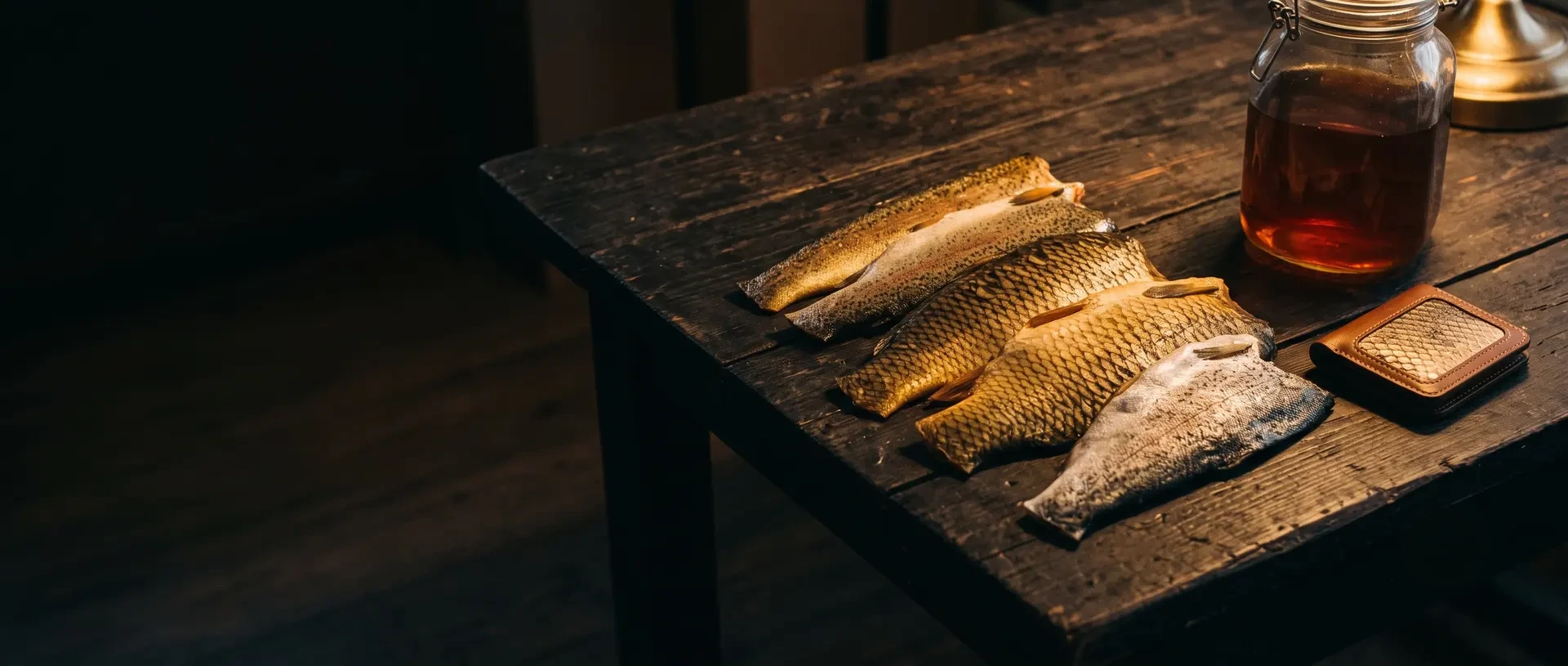
 AI illustration
Fish leather
Tan salmon or carp skin in strong tea and work it soft. Two weeks in a jar gives a thin, tough leather with a pattern no cow has.
What it is like
Fish skin tans like any other hide, only faster and on a kitchen scale. The tannin in strong black tea binds to the skin’s protein over a week or two and leaves a thin leather that is surprisingly hard to tear.
The surface carries the pattern of the scale pockets, a diamond grid different for every species. Northern peoples made clothing from it: Yup’ik sewers in Alaska made salmon-skin parkas and boots, and the Nanai of the Amur River were once called the Fish-skin Tartars for their fish-skin clothes.
A skin is small, so the projects are small: a card sleeve, a key fob, an inlay on a wallet. It joins naturally with leathercraft once you have a few skins in the drawer.
The work is mostly cleaning. A fish skin carries meat, membrane, scales and oil, and every bit left on is a future smell or a weak spot. Scraping with a spoon, pushing off the scales under cold water and washing until the skin feels silky takes longer than any other step, but it decides how good the leather will be.
Tanning itself is patient and hands-off. The skin sits in a jar of strong tea, swirled each day, while the tannins slowly bind to it from both sides; the liquor is strengthened bit by bit so the surface does not seal before the middle is done. Then comes the last trick, which is the same for every leather: rubbing in a dressing and pulling and flexing the skin as it dries, so it ends up soft instead of crisp.
- A session
- An hour to scrape and clean a skin; a minute a day to swirl the jar.
- A week
- Ten days to two weeks of tanning, then a few days of working it soft.
- Season
- All year; skins can wait in the freezer until there are enough for a batch.
Indoors · Solo
Kinds and styles
Black tea as the tannin, in a jar on the counter - the method on this page and the easiest start.
Oak, willow or other barks steeped into a tanning liquor; darker colors and the classic vegetable tan.
Tanned skins colored with natural dyes or leather dyes after tanning.
Card sleeves, key fobs, bracelets and inlays on wallets or notebook covers.
Several skins stitched into panels for pouches and bags, in the spirit of the northern traditions.
Thin offcuts for earrings, pendants and spines or corners on hand-bound books.
Is it for you?
You will probably love it if
- You fish, or buy whole fish with the skin on
- You like slow processes that need a minute a day
- You want material for small leather goods
Maybe not, if
- Raw fish skin and its smell bother you
- You expect large pieces: a skin is the size of a hand or two
- You will forget the jar for a week
What to buy first
- 01Black tea, 100 bagsThe tannin that turns skin into leatherFind it on Amazon$5
- 02Vegetable glycerin, small bottleMixed half and half with water, it keeps the leather suppleFind it on Amazon$8
- 03Half-gallon wide-mouth glass jars, pack of 6One is the tanning bath, kept for this only; they are sold by the caseFind it on Amazon$15
- 04Skins from two or three fishSalmon, carp and pike all work; ask a fish counter for trimmingsFree
- Everything you need to beginAbout $2 a month after that$28
Typical US prices for entry-level gear, rounded. Last checked October 2026. How we get the numbers
The Amazon links open a search for that type of item, not a product chosen for us, and the prices in the list are our typical figures, or the listing of the shop a line names, not Amazon's price for any listing. If you buy through one we may earn a commission at no extra cost to you; as an Amazon Associate we earn from qualifying purchases.
What to buy next
- 01Leather needles and waxed threadFine stitching that does not tear thin skinFind it on Amazon First projects
- 02Rotary cutter and cutting matClean, straight cuts in thin leatherFind it on Amazon Cutting pieces
- 03Neatsfoot or leather oilAn alternative to glycerin for a softer, oiled finishFind it on Amazon Dressing
- 04Leather dyeEven colors on tanned skinsFind it on Amazon Coloring
- 05Fleshing toolFaster, cleaner scraping than a spoonFind it on Amazon Many skins
No prices here on purpose: these are later buys, and what to spend depends on how far the hobby has taken you. The Amazon links work like the ones above: a search for the type of item, and a possible commission for us at no extra cost to you.
From a salmon skin to soft fish leather, step by step
Fish leather is thin but strong for its thickness - Wikipedia puts that down to its criss-crossed fibres. This guide goes from cleaning the skin to tanning, softening and drying it, with the choices at each step. The tea method follows the University of Arkansas Libraries' preservation blog's experiment; the glycerine method is the Textile Academy recipe.
Warning: Before you start Keep the jar, spoon and brush for tanning only and store the jar labeled, away from food. Wash hands and surfaces after handling raw fish skin, and keep skins cold or salted until they go into the tan. Finished fish leather is not for contact with food.
Take the skin off in one sheet. Lay it scale side down and scrape away every trace of meat and membrane with a spoon.
Push the scales off against the grain under cold water, then wash the skin in cool water with a little dish soap until it feels like wet silk.
Strong, cooled tea in the jar, skin weighted under. Swirl daily. Every two or three days replace half the liquor with a fresh, stronger brew.
Snip an edge. Even tan color through the whole thickness means done; a pale line in the middle means wait.
Rub in the glycerin and water mix, then pull the skin in every direction and over a table edge as it dries.
Tanning, and the test
The skin in its jar of tea, and a snipped edge seen end-on, twice.
- A In the jar Weighted under Swirled daily; the tea refreshed as it weakens. Step 5 →
- B Pale middle Not tanned through Wait. Step 6 →
- C Even colour Through the whole thickness Done: take it out, then soften it. Step 6 →
Steps 1-3Prepare the skin
- Step 1 of 8 · Prepare the skin
Get skins and keep them cold
Warning: NOTICE Keep the jar, spoon and brush for tanning only, labelled and away from food, and wash hands and surfaces after handling raw skin. Finished fish leather is not for contact with food.
Salmon is the usual first skin; ask a fish counter for trimmings. Keep skins cold or salted until they go into the tan.
- Step 2 of 8 · Prepare the skin
Scrape off the flesh
Lay the skin scale side down and scrape away every trace of meat, fat and membrane with the blunt edge of a knife or a spoon; the Textile Academy recipe notes the skin can take firm handling.
Goes wrong: Leaving fat on. Oily skins like salmon go rancid; degrease twice.
- Step 3 of 8 · Prepare the skin
Descale and wash cold
Scrape the scales off against their direction and wash the skin in cold, soapy water - cold, the Arkansas blog explains, keeps the skin's fibres intact. Do not put the scales down the sink.
Steps 4-6Tan
- Step 4 of 8 · Tan
Choose the tanning method
Two well-documented home methods.
Most people: black tea (a first skin).
Start here Black teaBest forA first skin
The Arkansas experiment: about 5 tea bags per 2 cups, cooled, with 3-5 more bags every other day; after 10 days, a stronger bath of 10 bags in 3 cups for 4 more days.
Alcohol and glycerineBest forQuick, translucent skins
Textile Academy: 200 ml denatured alcohol and 200 ml glycerine in a glass jar, the skin shaken in it daily for 3 days.
Goes wrong: Too strong too soon. A strong first bath tans the surface and seals the middle; start weaker.
- Step 5 of 8 · Tan
Tend the jar
Keep the skin weighted under the liquid and swirl or shake it daily; refresh the tea as it weakens.
- Step 6 of 8 · Tan
Test before taking it out
Snip an edge: an even tan colour through the whole thickness means done; a pale line in the middle means wait.
Goes wrong: Taking it out early. An untanned core goes hard or rots.
Steps 7-8Soften and use
- Step 7 of 8 · Soften and use
Soften and dry it
After tanning the skin wants to dry stiff, so it is fed and worked while it dries.
Most people: egg yolk, then work by hand (tea-tanned skins).
Start here Egg yolk, then work by handBest forTea-tanned skins
The Arkansas blog soaked it 20 minutes in 2 egg yolks, a teaspoon of liquid soap and a cup of cold water, dried it pressed to a window, then stretched it soft with a little oil.
Glycerine and a boardBest forGlycerine-tanned skins
Rub glycerine on both sides and pin the skin loosely to a board to dry, scales down for a smoother face; final form after about a week (Textile Academy).
Goes wrong: Drying flat and untouched. The skin dries to a hard sheet; stretch and work it as it dries.
- Step 8 of 8 · Soften and use
Choose a first project
Thin, strong and patterned, fish leather suits small pieces.
Most people: small leather goods (card sleeves, key fobs).
Start here Small leather goodsBest forCard sleeves, key fobs
One skin is enough.
Inlays and bookbindingBest forAccents
Spines, corners and panels on hand-bound books.
JewelleryBest forOffcuts
Earrings and pendants.
In shortIf it goes wrong
- Leaving fat on.
- Step 2 · Scrape off the flesh
- Too strong too soon.
- Step 4 · Choose the tanning method
- Taking it out early.
- Step 6 · Test before taking it out
- Drying flat and untouched.
- Step 7 · Soften and dry it
How you get better
- First skinOne salmon skin in tea
Scrape, descale, degrease, tan in tea, test the cut edge and work it soft.
- Skins 2 to 5Different fish
Carp, pike and trout for different textures, thicknesses and scale patterns.
- Months 2 to 3First projects
A card sleeve, a key fob or a bracelet, stitched with a fine needle.
- Months 3 to 6Other tans and colors
Bark liquors and natural dyes for darker and colored leathers.
- After thatLarger work
Several skins sewn into panels, and inlays on leathercraft and bookbinding projects.
- Skinning in one sheet
- Fleshing and scraping
- Descaling
- Degreasing
- Mixing a tanning liquor
- Strengthening the bath gradually
- Testing tan penetration
- Dressing with glycerin or oil
- Softening by stretching
- Dyeing
- Cutting and stitching thin leather
- Choosing species for texture
Small things that help
- Freeze or salt skins until you are ready to tan.
- Scrape more than seems necessary; leftover meat and fat cause smell.
- Start the tea weak and strengthen it over the days.
- Swirl the jar daily so the tan reaches every part.
- Test a snipped edge before taking the skin out.
- Keep working the skin as it dries; softness comes from movement.
Beginner mistakes
- 01Leaving fat onOily skins like salmon go rancid. Degrease twice.
- 02Too strong too soonA strong liquor at first tans the surface and seals the middle. Begin weak.
- 03Drying flat and untouchedThe skin dries to a hard sheet. Stretch and work it while it dries.
- 04Taking it out earlyA pale line in the cut edge means it is not done. Wait.
- 05Using food jars and spoonsKeep tanning tools separate and labeled.
Skins that work
| Fish | Leather | Note |
|---|---|---|
| Salmon | Fine diamond pattern, strong | Oily: degrease twice |
| Carp | Large scale pockets, bold texture | Thick and forgiving |
| Pike | Thick, striking | Needs up to two weeks in the tan |
| Trout | Thin and delicate | Tears easily when scraping |
Why people quit
- 01A smell that never leftGrease or meat left on the skin. Scrape and wash more than seems needed.
- 02A fish-shaped crackerA skin left to dry flat goes stiff. Softness comes from working it while it dries.
- 03Raw in the middleStarting at full strength hardens the surface and blocks the tan. Begin weak and strengthen.
Words you will meet
- Tannin
- Plant compounds that bind to skin protein and turn it into leather.
- Liquor
- The tanning bath.
- Fleshing
- Scraping meat and membrane from the inside of a skin.
- Scale pockets
- The small hollows where scales sat; they make the pattern.
- Grain side
- The outer, patterned side of the skin.
- Flesh side
- The inside of the skin.
- Degreasing
- Washing out natural oils.
- Dressing
- Rubbing in glycerin or oil to keep leather supple.
- Vegetable tanning
- Tanning with plant tannins, the oldest known method.
- Penetration
- How far the tan has reached through the skin.
Questions people ask
Which fish skins are best for a first try?
Salmon and carp: easy to find, strong and with clear patterns. Thin trout skin tears more easily.
Does fish leather smell?
Not when it is properly scraped, degreased and tanned. Smell means fat or meat was left on.
How strong is fish leather?
For its thickness it is typically much stronger than other leathers, because of its criss-crossed fibers.
Can I use any tea?
Strong black tea is the usual choice for its tannins; it also colors the skin brown.
What can I make from it?
Small leather goods, jewelry and inlays; larger items need several skins sewn together.
Where to go next
- 01LeathercraftCutting and stitching what you tanned. $119 to start
- 02Hide tanningTanning larger skins from deer and other game. $49 to start
How it compares
| Fish leather | Leathercraft | Hide tanning | Gyotaku | |
|---|---|---|---|---|
| Start cost | $28 | $119 | $49 | $40 |
| Each month | $2 | $20 | $5 | $8 |
| Space | A jar and a table edge | A desk | A yard | A table |
| Noise | Quiet | Low | Quiet | Quiet |
| First result | About 2 weeks | 1 weekend | 2 hard weekends | 1 afternoon |
| Mess | Fishy water | Scraps and dye | Hair, fat and water | Ink |
Sources: Wikipedia, Leather (fish leather strength, vegetable tanning) · Wikipedia, Yup'ik clothing (fish skin parkas) · Wikipedia, Nanai people · University of Arkansas Libraries, Experimental archaeology: fish leather · Textile Academy, Tanned fish skin recipe
Researched and written by the Fjords Team.