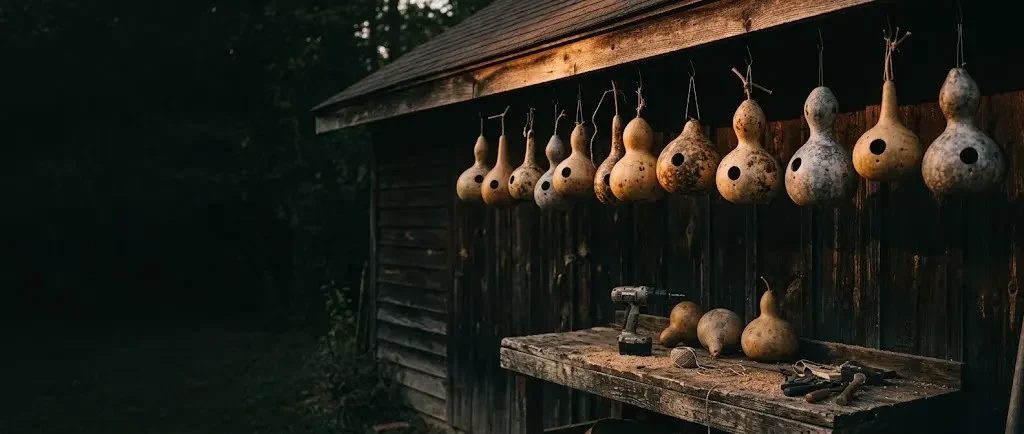
 AI illustration
Gourd crafting
A hard-shelled gourd cures into a light, woody bottle. Clean it, cut it, and it becomes a birdhouse, a bowl or a rattle.
What it is like
The craft gourd is the bottle gourd, Lagenaria siceraria. It is grown for the shell, not the flesh: left on the vine until the stem browns, then dried for months in moving air until it is light, hard and rattles with loose seed.
That cured shell works like thin hardwood. It can be sawn, drilled, sanded, burned with a pyrography pen, dyed and waxed. It was one of the world’s first plants cultivated mainly for use as containers, made into bottles, ladles, bowls and instruments wherever it grows, and in North America Cherokee people hung hollowed gourds for purple martins before colonial times.
Start with a bought, cured gourd and one birdhouse. Growing your own comes later: a full warm season on a fence, then a winter of curing, and a single vine gives more gourds than one garden can hang.
Each gourd is a different shape, and that is half the appeal. Round ones become bowls and birdhouses, long-necked ones dippers and bottles, small ones rattles and ornaments, and the shape often suggests the project before any tool comes out. Because the shell behaves like thin wood, the same skills carry over from woodworking and pyrography - saw, drill, sand, burn, dye, wax - only on a curved surface that has to be held steady.
- A session
- An afternoon for a birdhouse; decorated pieces take several sessions.
- A week
- A weekend project; curing a homegrown gourd takes months.
- Season
- Grow in a long warm summer, cure over winter, craft any time.
Indoors or out · Solo, With kids
Kinds and styles
A cleaned gourd with an entrance hole sized for the bird you want - the project on this page.
Cut open across the top, cleaned inside and sealed, for keys, fruit or dried flowers.
Shakers with the seeds left in, and larger gourds as resonators for drums and stringed instruments.
Long-handled gourds split lengthwise, the classic shape for scooping water.
Patterns burned with a pyrography pen or carved through the shell, then dyed and waxed.
Shells drilled with many small holes and lit from inside with a safe low-heat bulb.
Is it for you?
You will probably love it if
- You like making things that end up outdoors
- You have a drill and somewhere to make dust outside
- You enjoy slow crafts with a long wait built in
Maybe not, if
- You want to grow your own and finish it the same year
- Dust and a dust mask bother you
- You want fine, precise work rather than rustic shapes
What to buy first
- 01Dried birdhouse gourd, curedBuying one cured skips a full season of growing and months of dryingFind it on Amazon$10
- 02Hole saw, 1 1/8 inchThe entrance hole decides which bird moves inFind it on Amazon$11
- 03N95 dust masks, 10 packGourd dust and the mold on the cured skin irritate lungsFind it on Amazon$15
- 04220-grit sandpaperSmooths every cut edge so nothing snags a featherFind it on Amazon$5
- 05Exterior spray paint or outdoor varnishA sealed shell lasts several seasons; white keeps the inside coolerFind it on Amazon$7
- Everything you need to beginAbout $5 a month after that$48
Typical US prices for entry-level gear, rounded. Last checked October 2026. How we get the numbers
The Amazon links open a search for that type of item, not a product chosen for us, and the prices in the list are our typical figures, or the listing of the shop a line names, not Amazon's price for any listing. If you buy through one we may earn a commission at no extra cost to you; as an Amazon Associate we earn from qualifying purchases.
What to buy next
- 01Wood burning penBurns patterns into the shellFind it on Amazon Decorating
- 02Leather dyes or alcohol inksSoak into the shell for rich, even colorFind it on Amazon Coloring
- 03Small saw or craft knifeCuts clean rims through a cured shellFind it on Amazon Bowls and containers
- 04Gourd seedsBirdhouse and bottle gourds to grow your ownFind it on Amazon Planning a long warm summer
- 05Respirator with dust filtersBetter protection than disposable masks for long sessionsFind it on Amazon Regular cutting and sanding
No prices here on purpose: these are later buys, and what to spend depends on how far the hobby has taken you. The Amazon links work like the ones above: a search for the type of item, and a possible commission for us at no extra cost to you.
From a cured gourd to a birdhouse that birds use, step by step
The bottle gourd was among the world's earliest cultivated plants, grown mainly for containers rather than food (Wikipedia). This guide goes from getting a cured gourd to cleaning, cutting and finishing a birdhouse built to the Cornell Lab's NestWatch standards, then to bowls, rattles and burned designs, with the choices at each step.
Warning: Before you start Dust from cutting and sanding gourds, and the mold spores on the cured skin, irritate the lungs. Work outdoors and wear a dust mask or respirator for every cutting, cleaning and sanding step. Clamp the gourd before drilling: a round shell spins.
Soak the cured gourd in warm water with a splash of vinegar, then scrub off the waxy skin and the mold with steel wool. Let it dry fully.
Mask on, outdoors. Cut the hole in the fat lower belly, a little above center, at slow speed. No perch: it helps predators, not tenants.
Break up the dried pulp through the hole with a bent wire and shake out the seeds. Take what comes willingly.
Three or four 1/4 inch holes in the bottom, and two through the top of the neck for the wire.
Paint or varnish the outside only, let it cure, and hang it facing away from the weather.
A gourd birdhouse, cut in half
Seen from the side, after the Cornell Lab of Ornithology NestWatch features of a good birdhouse.
- A Drainage holes At least four in the floor, 3/8-1/2 in wide (NestWatch). Step 5 →
- B Sealed outside Seal or paint the outside only; birds should not live in paint. Step 6 →
- C Entrance, no perch Sized for the species you want; no perch. Step 3 →
- D Ventilation holes Near the top, so the cavity does not overheat. Step 5 →
- E Hanging wire Through two holes in the neck. Step 5 →
- F Baffle Keeps climbing predators from the nest. Step 7 →
Steps 1-2The gourd
- Step 1 of 8 · The gourd
Get a cured gourd
Bottle gourd vines grow fast - up to 9 m in a summer - in warm, sunny, sheltered spots with moist, rich soil (Wikipedia), and the fruit then needs months to dry.
Most people: buy one cured (a first project).
Start here Buy one curedBest forA first project
Skips a season of growing and months of drying.
Grow your ownBest forNext year's gourds
Needs a long warm season and strong support.
- Step 2 of 8 · The gourd
Clean the shell
Warning: CAUTION Gourd dust and the mould spores on cured skin irritate the lungs: work outdoors with a dust mask or respirator for every cleaning, cutting and sanding step.
Soak the cured gourd in warm water with a splash of vinegar, then scrub off the waxy skin and mould with steel wool, and let it dry fully.
Goes wrong: Throwing out mouldy gourds. Mould on the skin of a curing gourd scrubs off; only soft, collapsing shells are lost.
Steps 3-7The birdhouse
- Step 3 of 8 · The birdhouse
Choose the entrance size
NestWatch matches the entrance hole to the species you want; a smaller hole keeps out starlings and house sparrows. Cut it in the fat lower belly, a little above centre, at slow speed, with the gourd clamped - a round shell spins.
Most people: a small hole, about 1 1/8 in (small cavity nesters).
Start here A small hole, about 1 1/8 inBest forSmall cavity nesters
Look up your target species on NestWatch's plans first.
Purple martin gourdsBest forMartin colonies
Purple martins are known for nesting in hung gourds (Wikipedia); they need their own hole size and a colony setup.
Goes wrong: Adding a perch. NestWatch: a perch is unnecessary and helps predators reach the nest.
- Step 4 of 8 · The birdhouse
Empty it
Break up the dried pulp through the hole with a bent wire and shake out the seeds; take what comes willingly.
- Step 5 of 8 · The birdhouse
Drill drainage and ventilation
NestWatch's standard for a nest box: at least four drainage holes 3/8-1/2 in wide in the floor, and ventilation holes near the top. Drill two more holes through the neck for the hanging wire.
Goes wrong: No drainage. Rain that gets in has to get out.
- Step 6 of 8 · The birdhouse
Finish the outside only
NestWatch builds boxes of untreated, unpainted wood; on a gourd, seal or paint the outside only and let it cure. Smooth every cut edge so nothing snags a feather.
Goes wrong: Painting inside. Birds should not live in paint.
- Step 7 of 8 · The birdhouse
Hang it and guard it
Hang it facing away from the prevailing weather. NestWatch adds a baffle to keep climbing predators from nestlings and adults.
Step 8Next
- Step 8 of 8 · Next
Choose another gourd project
Dried gourds have been ladles, bowls, bottles and instrument resonators for thousands of years (Wikipedia).
Most people: bowls and containers (indoor pieces).
Start here Bowls and containersBest forIndoor pieces
Cut across the top, cleaned and sealed inside.
Rattles and instrumentsBest forMusic
Shakers with the seeds left in; larger gourds as resonators.
Burned and carved gourdsBest forDecoration
Patterns burned with a pyrography pen or carved through the shell.
In shortIf it goes wrong
- Throwing out mouldy gourds.
- Step 2 · Clean the shell
- Adding a perch.
- Step 3 · Choose the entrance size
- No drainage.
- Step 5 · Drill drainage and ventilation
- Painting inside.
- Step 6 · Finish the outside only
How you get better
- First weekendA birdhouse from a cured gourd
Clean, drill, empty, add drainage and hang.
- First seasonBowls and rattles
Cutting a clean rim, cleaning the inside, and sealing.
- Months 3 to 6Decoration
Wood burning, dyes and wax for patterned pieces.
- Next summerGrowing your own
Vines on a strong fence or trellis, then gourds left on the vine until the stems brown.
- After thatMartin gourds and larger work
Groups of purple martin gourds, instruments, lamps and carved pieces.
- Choosing a sound cured gourd
- Cleaning the skin
- Cutting and drilling safely
- Removing pulp and seeds
- Sizing entrance holes
- Sanding edges
- Sealing inside and out
- Wood burning
- Dyeing and waxing
- Carving through the shell
- Growing gourds on a trellis
- Curing gourds
Small things that help
- Pick a cured gourd that is hard, light and free of soft spots.
- Work outdoors and wear a mask for every dusty step.
- Clamp or cradle the gourd before drilling; round shells roll.
- Size the entrance hole for the bird you want, not the bird you fear.
- Leave the inside unpainted on birdhouses.
- Clean out birdhouses after the nesting season.
Beginner mistakes
- 01Throwing out moldy gourdsMold on a curing gourd's skin is normal and scrubs off. Only soft, collapsing shells are lost.
- 02Adding a perchIt helps predators and competitors, not nesting birds. Leave it off.
- 03Painting insideBirds should not live in paint. Finish the outside only.
- 04No drainageRain that gets in has to get out. Drill drainage holes in the bottom.
- 05Sanding indoorsGourd dust and mold spores irritate lungs. Take it outside, with a mask.
Entrance hole by bird
Hole diameters from the Cornell Lab's NestWatch plans; the bluebird size is the North American Bluebird Society's. The smallest hole that fits your bird keeps larger competitors out.
| Hole | Who uses it | Note |
|---|---|---|
| 1 in (25 mm) | House wrens | Wrens need nothing larger |
| 1 1/8 in (29 mm) | Chickadees, Bewick's wren | Too small for house sparrows |
| 1 1/4 in (32 mm) | Titmice, nuthatches | House sparrows can enter from this size up |
| 1 1/2 in (38 mm) | Eastern bluebird | 1 9/16 in where western or mountain bluebirds nest; still too small for starlings |
Why people quit
- 01Mold during curingA curing gourd goes blotchy gray and black on the outside. That is normal and scrubs off. Soft, collapsing shells are the real failures.
- 02A short summerThe vines need a long warm season. In a cool climate buy cured gourds and skip the growing.
- 03DustCutting and sanding indoors without a mask is how people give this up. Take it outside.
Words you will meet
- Hard-shell gourd
- Lagenaria siceraria, the gourd that dries to a woody shell.
- Curing
- Drying a gourd for months until it is light and hard.
- Calabash
- Another name for the bottle gourd and its vessels.
- Pulp
- The dried spongy interior with the seeds.
- Entrance hole
- The doorway of a birdhouse, sized to the species.
- Martin gourd
- A gourd hung for purple martins, often in groups.
- Pyrography
- Decorating by burning with a hot pen.
- Skin
- The thin waxy outer layer scrubbed off before crafting.
Questions people ask
Where do I get a gourd?
Craft suppliers and gourd farms sell cured gourds; growing your own takes a long warm summer and months of curing.
Why is my gourd moldy?
Mold on the skin is a normal part of curing and scrubs off. A soft or collapsing shell has rotted.
What size hole should a birdhouse have?
It depends on the bird; the table on this page gives sizes from the Cornell Lab's NestWatch and the North American Bluebird Society.
How long will a gourd birdhouse last?
A sealed shell lasts several seasons outdoors; taking it in over winter helps it last longer.
Is gourd dust harmful?
It and the mold spores on cured skins irritate the lungs. Work outside with a mask.
Where to go next
- 01BirdwatchingWatching who moves into the gourd you hung. $161 to start
- 02PyrographyBurning designs into the shell of a dried gourd. $54 to start
How it compares
| Gourd crafting | Whittling | Pyrography | Birdwatching | |
|---|---|---|---|---|
| Start cost | $48 | $52 | $54 | $161 |
| Each month | $5 | $5 | $5 | Free |
| Space | A table outdoors | A chair | A desk by a window | Anywhere outside |
| Noise | Low | Quiet | Quiet | Quiet |
| First result | 1 weekend | 1 evening | 1 evening | Same day |
| Mess | Dust | Shavings | Smoke and ash | None |
Where to learn more
- 01Cornell Lab of Ornithology, NestWatchNest box plans and hole sizes by species.
Sources: Cornell Lab of Ornithology, NestWatch: nest box plans and entrance hole sizes by species · North American Bluebird Society: fact sheets and nest box plans (Nestbox Recommendations) · Wikipedia, Calabash (history) · Wikipedia, Purple martin (gourd nesting) · Cornell Lab of Ornithology NestWatch, Features of a good birdhouse
Researched and written by the Fjords Team.