 AI illustration
Lavender wands
Fold fresh lavender stems back over their own flowers and weave them shut with ribbon. One evening, and the scent lasts long after summer.
What it is like
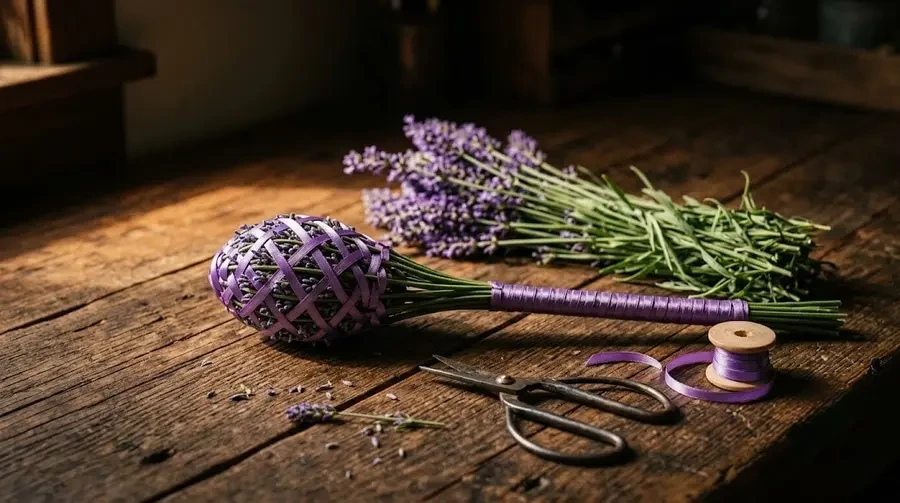
A lavender wand, or lavender bottle, is a bundle of fresh stems folded back over their own flower heads and woven shut with ribbon. The flowers dry sealed inside the cage, so nothing sheds, and the scent breathes out through the weave.
It needs fresh lavender, which limits it to a few weeks in early summer. Inside that window it is one of the cheapest crafts there is: one plant, one ribbon, one evening.
When a wand starts to fade, squeeze it gently. Crushing the buds inside releases more of their scent.
The weave is the whole trick. With an odd number of stems folded down around the heads, a single ribbon passing over one and under the next lands on the opposite side each round, so a basket pattern builds itself. Fresh stems bend without breaking and then shrink as they dry, which is why wands are woven the day the lavender is cut and pulled tighter than looks necessary.
Because fresh stems only exist for a few weeks, many makers treat lavender as a seasonal ritual: a batch of wands in early summer, the rest of the harvest dried for sachets, and the clove oranges and potpourri bowls of winter rounding out the year. Small, quick and fragrant, they make some of the most welcome homemade gifts.
- A session
- Half an hour to an hour per wand once you know the weave.
- A week
- A few evenings during the weeks of fresh lavender.
- Season
- Early to mid summer for fresh stems; sachets and potpourri all year from dried buds.
Indoors or out · Solo, For two, With kids
Kinds and styles
Stems folded over the flower heads and woven shut with ribbon, also called lavender bottles. The project on this page.
Two ribbons or wider and narrower ribbons woven together for stripes and checks.
Simple bunches tied at the stem and hung or laid in drawers; the quickest gift.
Dried buds sewn into small cotton, linen or organza bags for drawers and wardrobes.
Oranges studded with whole cloves and left to dry; a winter companion to summer lavender.
Dried petals, buds and spices mixed in a bowl, often with a fixative to hold the scent.
Is it for you?
You will probably love it if
- You grow lavender or can buy it fresh in summer
- You like small, repeatable hand work
- You want gifts that cost a ribbon
Maybe not, if
- You want a hobby for every month: fresh stems exist for a few weeks a year
- Strong floral scent bothers you
- You want a big finished object
What to buy first
- 01English lavender plant, 1 gallon potOne established plant gives stems for several wands every summerFind it on Amazon$19
- 02Satin ribbon, 1/4 inch, 2 spoolsA wand takes about 1.5 m; narrow ribbon weaves cleanlyFind it on Amazon$7
- 03Floral snipsLong clean cuts without crushing the stemFind it on Amazon$15
- Everything you need to beginAbout $3 a month after that$41
Typical US prices for entry-level gear, rounded. Last checked October 2026. How we get the numbers
The Amazon links open a search for that type of item, not a product chosen for us, and the prices in the list are our typical figures, or the listing of the shop a line names, not Amazon's price for any listing. If you buy through one we may earn a commission at no extra cost to you; as an Amazon Associate we earn from qualifying purchases.
What to buy next
- 01More lavender plantsEnough stems for many wands and sachetsFind it on Amazon After the first summer
- 02Organza or cotton sachet bagsQuick sachets without sewingFind it on Amazon Drying buds
- 03Ribbon in several colorsTwo-color weaves and gift setsFind it on Amazon Patterned wands
- 04Whole clovesFor studding orangesFind it on Amazon Pomanders
- 05Drying rackDries bunches in an airy placeFind it on Amazon Harvest
No prices here on purpose: these are later buys, and what to spend depends on how far the hobby has taken you. The Amazon links work like the ones above: a search for the type of item, and a possible commission for us at no extra cost to you.
From a lavender plant to a woven wand, step by step
A lavender wand - also called a lavender bottle - is fresh stems folded back over their own flowers and woven shut with ribbon. This guide goes from growing and cutting the lavender to folding, weaving, drying and the other things made from the same harvest, with the choices at each step.
Warning: Before you start Wands, sachets and potpourri are for scenting drawers and rooms, not for skin and not for eating. Keep clove pomanders, orris root and loose dried flowers away from pets and small children.
Dry day, mid-morning, bottom flowers open and top ones in bud. Cut 15 long stems, strip the leaves, stand them in water.
Bundle 13 stems with the heads level and tie the ribbon tight just under the flowers. The count must be odd or the weave does not alternate.
Flowers down. Bend each stem back over the tie, one at a time, until the heads sit inside a cage of their own stalks.
Over one stem, under the next, round and round, ribbon flat and snug. The basket pattern appears by itself after three rounds.
Spiral the ribbon down the handle, tie off, trim the ends. Leave it somewhere airy for two weeks before it goes in a drawer.
The finished wand
Handle down: the stems bent back over the tie make a cage round the flower heads.
- A Bend Over the tie Flowers down, one stem at a time. Step 4 →
- B Cage 13 stems An odd number; the heads inside. Step 4 →
- C Ribbon Over one, under one Snug every round. Step 5 →
- D Handle Ribbon spiralled down Tied off and trimmed; then two weeks to dry. Step 6 →
Steps 1-2The lavender
- Step 1 of 7 · The lavender
Grow the lavender
English lavender (Lavandula angustifolia) is hardy to about USDA zone 5 and prefers neutral to alkaline soil; Wikipedia notes it does not grow well in continuously damp soil and may need better drainage. One established plant gives stems for several wands each summer.
Most people: english lavender (long, flexible stems).
Start here English lavenderBest forLong, flexible stems
The classic wand lavender.
Lavandin hybridsBest forLater flowering
Bloom later than English lavender (Wikipedia).
Goes wrong: Missing the season. Lavender blooms for only a few weeks; plan ahead.
- Step 2 of 7 · The lavender
Cut the stems the same morning
On a dry day, mid-morning, with the bottom flowers open and the top ones still in bud, cut about 15 long stems, strip the leaves and stand them in water.
Goes wrong: Using dry stems. They snap at the fold; fresh stems only.
Steps 3-6The wand
- Step 3 of 7 · The wand
Tie an odd number
Bundle 13 stems with the heads level and tie the ribbon tight just under the flowers.
Goes wrong: An even number of stems. The weave stops alternating; it must be odd.
- Step 4 of 7 · The wand
Fold the cage
Flowers down. Bend each stem back over the tie, one at a time, until the heads sit inside a cage of their own stalks. Keep a spare stem or two for the one that breaks.
- Step 5 of 7 · The wand
Weave the ribbon
Over one stem, under the next, round and round, the ribbon flat and snug; the basket pattern appears after a few rounds.
Most people: one narrow ribbon (a first wand).
Start here One narrow ribbonBest forA first wand
A quarter-inch satin ribbon weaves cleanly; a wand takes about 1.5 m.
Two ribbonsBest forStripes and checks
A wide and a narrow ribbon woven together.
Goes wrong: A loose weave. Stems shrink as they dry and gaps appear; pull each round snug.
- Step 6 of 7 · The wand
Finish and dry
Warning: NOTICE Wands, sachets and potpourri are for scenting drawers and rooms, not for skin or eating; keep loose dried flowers away from pets and small children.
Spiral the ribbon down the handle, tie off and trim. Leave the wand somewhere airy for two weeks before it goes into a drawer.
Goes wrong: Storing it damp. A wet wand can mould in a closed drawer.
Step 7Next
- Step 7 of 7 · Next
Use the rest of the harvest
The same summer's lavender makes other scented pieces.
Most people: tied bundles (quick gifts).
Start here Tied bundlesBest forQuick gifts
Simple bunches tied at the stem.
SachetsBest forDrawers and wardrobes
Dried buds sewn into small cloth bags.
PotpourriBest forA bowl of scent
Dried petals, buds and spices mixed together.
In shortIf it goes wrong
- Missing the season.
- Step 1 · Grow the lavender
- Using dry stems.
- Step 2 · Cut the stems the same morning
- An even number of stems.
- Step 3 · Tie an odd number
- A loose weave.
- Step 5 · Weave the ribbon
- Storing it damp.
- Step 6 · Finish and dry
How you get better
- First eveningOne ribbon wand
Thirteen fresh stems, one ribbon, an over-under weave and two weeks of drying.
- First summerNeater weaves
Even tension, tight rounds and tidy handles; a few wands as gifts.
- Late summerSachets and bundles
Drying the remaining stems and sewing small bags of buds.
- WinterPomanders and potpourri
Clove oranges and bowls of dried petals and spices.
- Next summerPatterns and your own plants
Two-ribbon wands, more lavender plants, and a stock of buds for the year.
- Choosing and cutting stems
- Stripping leaves
- Counting an odd number
- Tying under the heads
- Folding without snapping
- Over-under weaving
- Keeping the ribbon flat
- Tightening each round
- Wrapping the handle
- Drying
- Sewing sachets
- Mixing potpourri
Small things that help
- Cut on a dry morning, after the dew has gone.
- Choose stems where the lowest flowers have just opened.
- Weave the same day you cut, while stems are supple.
- Always use an odd number of stems.
- Weave tighter than seems necessary; stems shrink as they dry.
- Crease each stem over a thumbnail before folding it.
Beginner mistakes
- 01Using dry stemsThey snap at the fold. Fresh stems only.
- 02An even number of stemsThe weave stops alternating. Count an odd number.
- 03A loose weaveGaps appear as stems shrink. Pull each round snug.
- 04Storing it dampWet wands can mold in a closed drawer. Dry them for two weeks first.
- 05Missing the seasonLavender blooms for a few weeks. Plan ahead.
The rest of the scent shelf
The same harvest feeds four other old household crafts.
| Craft | What it is | Keeps |
|---|---|---|
| Sachet | Dried buds in a loose-weave cloth bag | A year, longer if squeezed |
| Potpourri | Petals plus a fixative such as orris root, matured in a closed jar | Months |
| Herb wreath | Fresh rosemary, bay and sage wired tight to a ring | Months |
| Clove pomander | An orange studded densely with whole cloves and dried | Years |
Why people quit
- 01Snapping stemsStems cut yesterday break at the fold. Cut and weave the same day, and crease each stem over a thumbnail.
- 02A gappy weaveStems shrink as they dry. Weave tighter than looks necessary and push each round up against the last.
- 03Waiting a yearMiss the two or three weeks of bloom and the next chance is next summer. Mark the calendar.
Words you will meet
- Lavender wand
- Stems folded over their flowers and woven shut with ribbon.
- Lavender bottle
- Another name for a lavender wand.
- English lavender
- Lavandula angustifolia, the common garden lavender.
- Sachet
- A small cloth bag of scented dried herbs.
- Potpourri
- A mixture of dried fragrant plant materials.
- Pomander
- A scented ball; today often a clove-studded orange.
- Fixative
- A material such as orris root that helps potpourri hold its scent.
- Buds
- The small dried flowers of lavender.
Questions people ask
Can I use dried lavender for a wand?
No. Dry stems snap when folded; use stems cut the same day.
How many stems do I need?
An odd number - around 13 to 21, depending on how full you want the wand.
Which lavender works best?
Long-stemmed English lavender types are the usual choice for wands.
How long will the scent last?
A good while in a closed drawer; when it fades, squeeze the wand gently to release more.
Do lavender sachets keep moths away?
Dried lavender is traditionally placed among clothes to scent them and deter moths.
Where to go next
- 01Dried flower wreathsLavender bundles wired into a fragrant kitchen wreath. $45 to start
- 02Basket weavingThe same over-one, under-one weave at a larger scale. $45 to start
How it compares
| Lavender wands | Dried flower wreaths | Basket weaving | Natural dyeing | |
|---|---|---|---|---|
| Start cost | $41 | $45 | $45 | $65 |
| Each month | $3 | $10 | $10 | $12 |
| Space | A chair | A table | A table | A kitchen counter |
| Noise | Quiet | Quiet | Quiet | Quiet |
| First result | 1 evening | 1 afternoon | 1 weekend | 1 weekend |
| Mess | Stray buds | Dropped petals | Water and offcuts | Pots and splashes |
Sources: Wikipedia, Lavandula (uses) · Wikipedia, Lavandula angustifolia · Wikipedia, Sachet (scented bag) · Wikipedia, Pomander
Researched and written by the Fjords Team.