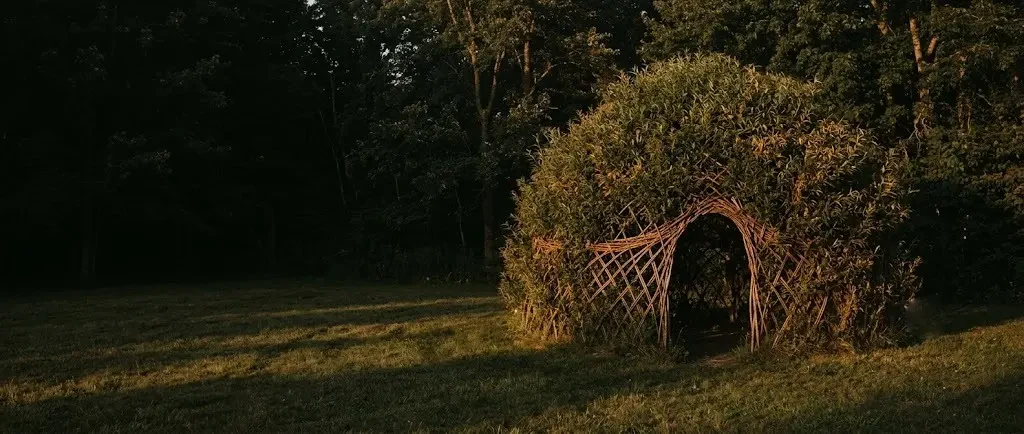
 AI illustration
Living willow
Push willow rods into damp ground in winter, weave them into a dome or an arch, and the structure roots and leafs out in spring.
What it is like
A willow rod is a long cutting. Pushed into moist ground while the tree is dormant, it roots from bare wood and leafs out in spring. Plant a ring of rods, weave them into a lattice, and the structure is alive.
Where rods are tied together they often graft into one another over a season or two, so the lattice slowly becomes a single living net. The common forms are the dome, the tunnel, the arch and the fedge, a woven fence that is also a hedge.
The building is one winter afternoon. The hobby is the upkeep: watering in year one, then weaving and trimming every summer. The winter prunings are next year’s weaving rods and planting stock.
A living structure is planted, not built. Each rod pushed into damp winter ground grows roots from its buried end and shoots along its length, and where rods cross and are tied together they can graft into each other over time. That is why siting matters more than any weaving technique: full sun, moisture, no competing grass at the base, and enough distance from drains and buildings for roots that go looking for water.
After the first summer the work becomes gardening with a shape in mind. New shoots that run along the structure are woven in while they are pliable; shoots pointing out are cut; the whole thing gets a trim a few times a year so it stays a tunnel or a dome rather than a bush. The prunings root just as readily, so one structure quietly supplies the rods for the next.
- A session
- One winter afternoon to build; an hour or two of trimming and weaving a few times a year.
- A week
- Watering once or twice a week in dry weather during the first summer.
- Season
- Plant and weave from winter to early spring; trim in summer and winter.
Outdoors · Solo, For two, With kids
Kinds and styles
Two rows of uprights bent into arches and woven together - the project on this page.
A ring of rods drawn together at the top, with a gap for a doorway; a favorite with children.
A cross between a fence and a hedge: a diagonal lattice of rods that grows into a living screen.
A single arch over a path, or a bower with a seat inside.
Animals, spirals and figures woven from living rods; more ambitious once the basics work.
Challenging living furniture and pointed tents, for the more adventurous.
Is it for you?
You will probably love it if
- You have open ground in full sun that stays moist
- You like projects measured in years
- You will trim and weave it a few times every summer
Maybe not, if
- Your only space is near the house, drains or a septic field
- You want it finished this month
- You cannot water it through the first summer
What to buy first
- 01Living willow rods, 7 ft, a kit of 30Enough for a 5 ft play tunnel. Delivery is most of the price; rods you prune yourself in winter are free$390
- 02Soft garden tie, 1 rollHolds the crossings without biting into swelling woodFind it on Amazon$6
- 03Bark mulch, 2 bagsGrass competing at the base kills more first-year willow than anything elseFind it on Amazon$7
- 04A crowbar or a length of rebar you already ownPunches the 30 cm planting holesFree
- Everything you need to beginNothing to pay each month after that$403
Typical US prices for entry-level gear, rounded. Last checked October 2026. How we get the numbers
The Amazon links open a search for that type of item, not a product chosen for us, and the prices in the list are our typical figures, or the listing of the shop a line names, not Amazon's price for any listing. If you buy through one we may earn a commission at no extra cost to you; as an Amazon Associate we earn from qualifying purchases.
What to buy next
- 01Weed control membraneKeeps grass and weeds off the base while rods rootFind it on Amazon Before planting
- 02Loppers and secateursClean cuts on fast-growing shootsFind it on Amazon Summer trimming
- 03Rabbit guards or fencingYoung willow is a favorite foodFind it on Amazon Where rabbits or deer visit
- 04Soaker hoseWaters the whole base slowly in dry spellsFind it on Amazon First summer
- 05Living willow bookPatterns and step-by-step designsFind it on Amazon More ambitious shapes
No prices here on purpose: these are later buys, and what to spend depends on how far the hobby has taken you. The Amazon links work like the ones above: a search for the type of item, and a possible commission for us at no extra cost to you.
Building a living willow structure, step by step
From choosing what to build to keeping it in shape for years, in the order the work comes round. At each step: what to do, what you can choose between and how the choices differ, and what tends to go wrong. The source is the RHS guide to living willow; the measurements of the tunnel come from the short version above.
Warning: Before you start Willow roots travel to water. Keep living structures at least 10 m (33 ft) from drains, septic fields and foundations, and ask before planting near a boundary. Buy rods of a willow that is not listed as invasive where you live, and never cut rods from land that is not yours without permission.
Full sun, moist ground, and at least 10 m from drains, septic fields and house walls. Mark two parallel lines 1.5 m long and about 1 m apart, and clear a half-meter strip of turf along each.
Between leaf fall and bud burst, punch holes 30 cm deep. Set an upright every 30 cm along both lines and push the thick end of each rod in.
Plant the remaining rods between the uprights, leaning left and right at 45 degrees so they cross, and tie every crossing. Bend opposite uprights together overhead and tie them into arches.
A proper soak once or twice a week in dry weather, and keep the mulch strip free of weeds.
Weave in shoots that run along the structure, cut the ones that point out. Twice each summer, and a hard tidy in winter.
A woven willow wall, from the side
A short length of woven willow wall from the side, with the part below ground shown dashed.
- A Rods pushed in deep At least 30 cm (12 in) Holes made first with an old screwdriver or a bar. Step 5 →
- B Cleared, mulched strip Mulch at least 5 cm (2 in) Grass cleared from the base before planting. Step 4 →
- C Diagonals at 45 degrees About 25 cm (10 in) apart One-year-old rods, half leaning each way. Step 6 →
- D Uprights Two-year-old rods, the thicker ones. Step 5 →
- E Ties at the crossings String or thin willow. Step 7 →
- F New shoots Woven in or trimmed several times each summer. Step 9 →
- Step 1 of 10
Choose what to build
The RHS lists hedges, bowers, dens, arbours and walkways as the usual living willow projects, with wigwams, chairs and even sofas for the ambitious. The structure is planted, so the choice is made before the rods arrive.
A tunnelBest forA first build with children
Two rows of uprights bent into arches overhead and woven together - the project in the short version above.
A dome or denBest forA play den
A ring of rods drawn together at the top, with a gap left for a doorway.
A fedgeBest forA screen or boundary
Half fence, half hedge: a diagonal lattice that grows into a living screen, used as an informal garden boundary (RHS).
A solid fedgeBest forNot a first project
Two willow hurdles with soil packed between them; the RHS says this is one for specialists and needs permanent irrigation.
- Step 2 of 10
Choose the site
A naturally moist, sunny spot. Willow tolerates most soils, but soil that holds moisture gives the most vigorous growth (RHS). Willow roots travel to water, so keep any living structure at least 10 m (33 ft) from drains and buildings.
Open, damp ground in full sunBest forEvery structure
What the RHS recommends.
A dry or shaded cornerBest forAvoid
Willow grows weakly and needs far more watering.
Goes wrong: Near drains or the house. The RHS keeps willow at least 10 m (33 ft) away from both.
- Step 3 of 10
Get the rods
Willow is planted from winter to early spring, when specialist growers harvest the stems (RHS). Use two-year-old rods as uprights and one-year-old rods for the woven infill; the RHS uses rods about 2 m (6½ ft) long. Until planting, keep them somewhere cool and dark with the bases standing in 10 cm (4 in) of water, and cut off the lower 10 cm (4 in) of each stem when you plant, even if it has started rooting.
Golden willow (Salix alba var. vitellina)Best forWinter colour
Bright yellow-orange stems; on the RHS list, along with its red-stemmed form 'Britzensis'.
Osier (Salix viminalis)Best forWeaving
The classic long, flexible basket willow, on the RHS list.
Salix daphnoides and Salix purpureaBest forVariety
The other willows the RHS recommends for living structures.
Rods you cut yourselfBest forBigger projects
Free if you have access to willow, cut in the dormant season - not in summer.
Goes wrong: Dried-out rods. Rods that dry before planting may not root; keep their bases in water until they go in.
- Step 4 of 10
Prepare the ground
Clear grass from where the structure will stand before planting - young rods cannot compete with turf - and mulch at least 5 cm (2 in) deep between November and February. A weed-control membrane under the mulch is optional and cuts weeding further (RHS).
Mulch onlyBest forSmall structures
At least 5 cm (2 in) deep, topped up as it breaks down.
Membrane and mulchBest forLong fedges
Less weeding still (RHS).
Goes wrong: Clearing after planting. Strip and mulch first; turf left at the base kills more first-year willow than anything else.
- Step 5 of 10
Plant the uprights
Make each hole first with an old screwdriver or a similar tool, then push the rod in at least 30 cm (12 in) deep (RHS). For the tunnel in the short version, an upright goes every 30 cm along both lines.
- Step 6 of 10
Plant the diagonals
Plant half of the remaining rods at 45 degrees, about 25 cm (10 in) apart, then the rest at the same angle in the gaps, leaning the opposite way, so they cross into diamonds. For extra strength, the RHS weaves four rods loosely together every 2 m (6½ ft).
Goes wrong: Pointing rods downwards. Shoots trained downwards die (RHS); keep everything rising.
- Step 7 of 10
Tie the crossings
Tie each crossing with string or thin willow - crossing stems can graft together, and the tie helps (RHS). A soft garden tie will not bite into the wood as it thickens. For a tunnel or dome, bend opposite uprights together overhead and tie them into arches.
- Step 8 of 10
Get it through the first summer
Water thoroughly in dry spells (RHS): the rods are growing roots from nothing. Keep the mulched strip free of weeds, and protect the structure if rabbits or deer visit - both favour willow (RHS).
Goes wrong: A dry first summer. Miss the watering in a drought and whole sections fail.
- Step 9 of 10
Trim and weave every year
Willow can grow up to 2 m (6½ ft) a year. Trim several times in summer to keep the shape, and cut back new shoots to thicken the structure; in winter, while the shoots are still pliable, weave new growth into gaps or into the frame to strengthen it (RHS).
Summer trimsBest forKeeping the shape
Several times a season, to keep the outline (RHS).
Winter weavingBest forFilling gaps
Pliable new growth woven into gaps or along the frame (RHS).
Goes wrong: Skipping a year. Without trims the shape disappears into a bush - though willow forgives a hard cut back in winter.
- Step 10 of 10
Watch for pests and disease
Rabbits and deer favour willow, so protection may be needed. Willow aphids, brownish-black and usually a late-summer problem, make stems sticky with honeydew that grows sooty mould and draws wasps. Willows can also suffer anthracnose, scab and canker (RHS).
In shortIf it goes wrong
- Near drains or the house.
- Step 2 · Choose the site
- Dried-out rods.
- Step 3 · Get the rods
- Clearing after planting.
- Step 4 · Prepare the ground
- Pointing rods downwards.
- Step 6 · Plant the diagonals
- A dry first summer.
- Step 8 · Get it through the first summer
- Skipping a year.
- Step 9 · Trim and weave every year
How you get better
- First winterA short tunnel or dome
Thirty rods, a cleared and mulched strip, and an afternoon of planting and tying.
- First summerRooting and watering
Regular watering, weeding the mulch strip and watching shoots break from the rods.
- Second winterWeaving in growth
Weaving pliable new shoots into gaps and trimming the rest.
- Year 2 to 3A fedge or arch
A living screen along a boundary, or an arch over a path, from your own prunings.
- After thatSculptures and furniture
Animals, spirals, seats and wigwams, and sharing rods with friends.
- Choosing a site
- Clearing and mulching the base
- Storing rods before planting
- Planting at depth
- Setting 45-degree diagonals
- Tying crossings
- Bending arches
- First-summer watering
- Weaving in new shoots
- Summer trimming
- Protecting from rabbits and deer
- Taking cuttings for new structures
Small things that help
- Plant at least 10 m from drains and buildings.
- Store delivered rods in a cool, dark place with their bases in water.
- Clear grass from the base before planting, then mulch deeply.
- Set diagonals at 45 degrees in opposite directions for a lattice.
- Do not weave shoots downwards; they will die.
- Trim several times in summer; willow can grow up to 2 m a year.
Beginner mistakes
- 01Planting near drains or the houseWillow roots seek water. Keep at least 10 m away.
- 02Leaving grass at the baseTurf outcompetes new roots. Clear and mulch first.
- 03No water in the first summerWhole sections fail in a dry spell. Water through the first year.
- 04Never trimmingThe shape disappears into a bush. Trim and weave every year.
- 05Planting in the growing seasonRods cut in summer rarely take. Work between winter and early spring.
Why people quit
- 01Grass at the baseUnrooted rods cannot compete with turf. Clear and mulch the strip before planting, not after.
- 02A dry first summerThe rods are building roots from nothing. Miss the watering in a drought and whole sections fail.
- 03It became a bushSkip the summer trims for a year and the shape disappears. Willow forgives a hard cut back in winter.
Words you will meet
- Rod
- A long, straight willow stem used for planting and weaving.
- Whip
- Another word for a one-year-old willow rod.
- Osier
- A narrow-leaved willow grown for rods; also the rods themselves.
- Withy
- A flexible willow rod.
- Fedge
- A woven structure halfway between a fence and a hedge.
- Inosculation
- Branches growing together where they touch, a natural graft.
- Pleaching
- Weaving living branches into hedges, fences or walks.
- Pollard
- A tree cut back to a trunk so it sprouts many new rods.
- Dormant season
- Late autumn to early spring, when willow has no leaves.
Questions people ask
When should I plant living willow?
From winter to early spring, when the willow is dormant and growers harvest rods.
How far from my house should it be?
The RHS advises at least 10 m from drains and buildings.
Which willows are best?
The RHS lists golden willow, Salix daphnoides, S. viminalis and S. purpurea among the best for structures.
How fast does it grow?
Willow can grow up to 2 m a year, so trim several times each summer.
Can I take my own rods?
Yes - winter prunings from an existing structure root readily, and cutting from land that is not yours needs permission.
Where to go next
- 01Basket weavingThe same willow rods, cut instead of planted, woven into baskets you can carry. $45 to start
- 02BonsaiShaping living wood again, on the smallest scale: one tree, one pot, years of trimming. $76 to start
How it compares
| Living willow | Basket weaving | Bonsai | Backyard chickens | |
|---|---|---|---|---|
| Start cost | $403 | $45 | $76 | $467 |
| Each month | Free | $10 | $8 | $30 |
| Space | A damp, sunny corner | A table | A balcony or yard | A backyard |
| Noise | Quiet | Quiet | Quiet | Medium |
| First result | 1 season | 1 weekend | 1 growing season | About 5 months to eggs |
| Mess | Prunings | Water and offcuts | Soil and clippings | Bedding and droppings |
Where to learn more
- 01RHS, Living willowThe Royal Horticultural Society's guide to siting, planting and trimming living willow.
Sources: RHS, Living willow (siting, planting, pruning) · Wikipedia, Willow (cultivation and crafts) · Wikipedia, Pleaching
Researched and written by the Fjords Team.