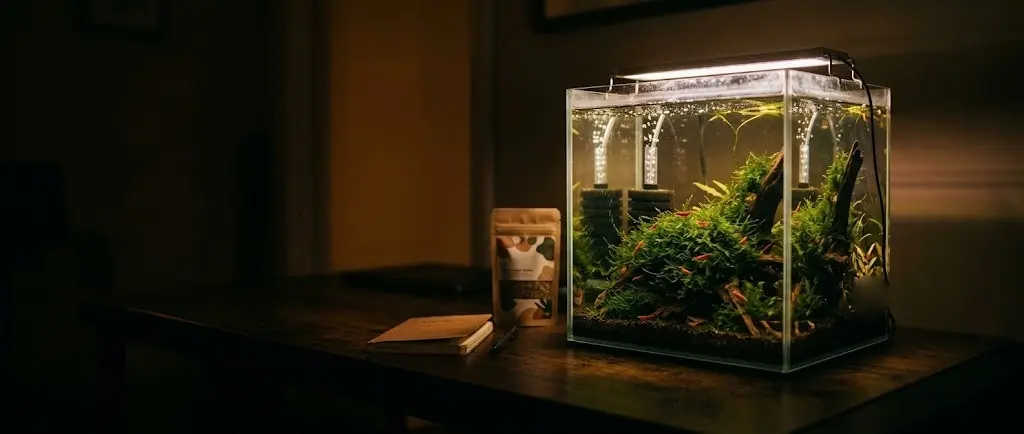
 AI illustration
Shrimp tank
A ten-gallon planted tank with a colony of cherry shrimp. Cheaper and calmer than fish, and they breed on the moss.
What it is like
A shrimp tank is a small planted aquarium kept for dwarf shrimp instead of fish. Red cherry shrimp grow to about an inch and a half, bright, busy and hardy; they mature in about a month and hatch as tiny copies of their parents, so in a tank without predators a small group grows into a colony. They graze algae and leftovers off the moss all day, which is both their charm and the reason the tank needs so little from you.
The hobby’s one real demand is patience at the start. A new tank has no bacteria to process waste, and shrimp are the first things to die when ammonia rises, so the tank runs empty for a month while it cycles. After that it is a weekly water change and a pinch of food, and a desk-sized world that gets more interesting the longer you watch it.
Shrimp are good at telling you how the tank is doing. Healthy cherry shrimp are bright, busy and constantly picking at the moss; females carry clusters of eggs under their tails and fan them with their swimming legs. Every few weeks each shrimp molts, leaving a ghostly empty shell that it later eats to recover the minerals. Stable water with the right hardness makes molting smooth, which is why shrimp keepers care more about steady conditions and small water changes than about any piece of equipment.
Once a colony is thriving, the hobby can go in several directions. Some keepers build tiny planted landscapes with stones and wood; others breed for color, keeping one line per tank because mixed colors drift back toward the wild brown. And a few move on to crystal and bee shrimp, with their soft, acidic water and their striking bands, after the cherries have taught them the basics.
- A session
- A few minutes a day to look and feed lightly.
- A week
- A small water change and a test once a week.
- Season
- All year indoors; three to six weeks of cycling before the first shrimp.
Indoors · Solo, With kids
Kinds and styles
Red Neocaridina: hardy, happy in most tap water and the classic first colony.
Blue, yellow, orange, green and black forms of the same species; keep one color per tank or they drift back to brown.
Caridina cantonensis forms with bold red, black or white bands; soft, acidic water and more care.
Larger algae eaters; their larvae need saltwater, so they do not breed in a freshwater tank.
Moss, stones and wood arranged as tiny landscapes with shrimp as the inhabitants.
Nerite or ramshorn snails alongside shrimp to share the cleaning.
Is it for you?
You will probably love it if
- You like watching small things go about their business
- You want an aquarium without a big tank, a heater or expensive fish
- You can wait a month for the tank to cycle before anything lives in it
Maybe not, if
- You want it running today; the waiting is the hobby's first test
- You travel for weeks; shrimp cope for a week, not a month
- Your tap water is very hard or very soft and you do not want to learn why that matters
What to buy first
- 0110-gallon glass tankEnough water to stay stable; small enough for a deskFind it on Amazon$28
- 02Sponge filter and a small air pumpShrimp-safe filtration; nothing to suck up the babiesFind it on Amazon$10
- 03Inert sand or fine gravel, a bagKeeps the water chemistry alone; cherry shrimp want neutral waterFind it on Amazon$14
- 04Clip-on LED lightFor the plants; shrimp do not careFind it on Amazon$20
- 05Java moss and a couple of easy plantsMoss is where babies hide and grazeFind it on Amazon$18
- 06Ten cherry shrimpNeocaridina, the hardy red ones; the colony grows from here$32
- 07Water conditioner and test stripsDechlorinate every bucket; test until the tank has cycledFind it on Amazon$26
- Everything you need to beginAbout $5 a month after that$148
Typical US prices for entry-level gear, rounded. Last checked October 2026. How we get the numbers
The Amazon links open a search for that type of item, not a product chosen for us, and the prices in the list are our typical figures, or the listing of the shop a line names, not Amazon's price for any listing. If you buy through one we may earn a commission at no extra cost to you; as an Amazon Associate we earn from qualifying purchases.
What to buy next
- 01Liquid test kitMore accurate than strips for ammonia, nitrite and nitrateFind it on Amazon After the first month
- 02GH and KH testHardness matters for molting and breedingFind it on Amazon Breeding shrimp
- 03Shrimp foodSmall, sinking food made for shrimpFind it on Amazon A growing colony
- 04Catappa leavesLeaves the shrimp graze on as they break downFind it on Amazon Any time
- 05Heater with thermostatKeeps the tank steady in winterFind it on Amazon Cold rooms
- 06Second tankSeparate colonies keep colors pureFind it on Amazon Another color or species
No prices here on purpose: these are later buys, and what to spend depends on how far the hobby has taken you. The Amazon links work like the ones above: a search for the type of item, and a possible commission for us at no extra cost to you.
Setting up a cherry shrimp tank, step by step
From choosing the shrimp to a colony that keeps growing, in the order it is done. At each step: what to do, what you can choose between and how the choices differ, and what tends to go wrong. The sources are Aquarium Co-Op's cherry shrimp guide and the Wikipedia articles on the shrimp and on fishless cycling; the month of waiting in the middle is not optional.
Warning: Before you start Water and electricity share a desk here. Use a drip loop on every cord, plug into a GFCI outlet, and unplug the heater or pump before putting hands in the tank. A full ten-gallon tank weighs about 110 lb, so the stand has to be sturdy and level. Keep copper-based medicines and fertilisers away from the tank. Never release shrimp, plants or tank water outdoors: cherry shrimp have become invasive in waterways in Japan, the US, Poland and Germany.
Rinse the substrate, fill the tank, plant the moss, start the filter. Add conditioner. Nobody moves in yet.
Add a pinch of fish food every other day. Test strips show ammonia, then nitrite, then only nitrate: that is the bacteria establishing. It takes three to six weeks.
Check your tap water's hardness. Cherry shrimp are happy in most tap water that is not very soft; if yours is, add a mineral supplement made for shrimp.
Float the bag, then drip tank water into it over an hour or two with airline tubing. Net the shrimp in and discard the shop water.
A tiny pinch of shrimp food every other day, and a blanched spinach leaf once a week. They mostly graze the moss. Change a fifth of the water weekly, slowly.
A shrimp tank, bottom to top
A 10-gallon tank cut through the front glass, in the order it is set up.
- A Inert sand A substrate that leaves the water chemistry alone. Step 3 →
- B Sponge filter Gentle, and nothing for babies to be sucked into. Step 4 →
- C Moss on wood, and plants Hiding places and grazing; the babies live in the moss. Step 3 →
- D Shrimp Last, after the cycle. Step 6 →
- E Water, dechlorinated Conditioner in every bucket. Step 4 →
- F Light For the plants; the shrimp do not need it. Step 3 →
- Step 1 of 10
Choose the shrimp
Cherry shrimp (Neocaridina davidi) are the usual first shrimp: they breed readily in a tank without predators, reach maturity in about 30 days and live one to two years (Wikipedia). They have been bred in red, orange, yellow, green, blue, violet, white and clear forms.
Red cherry shrimpBest forA first colony
The classic first shrimp. Grade names such as Sakura or Fire Red do not reliably tell you quality; Aquarium Co-Op's advice is to buy what you see, not what you read.
Other Neocaridina coloursBest forVariety
The same species in other colours (Wikipedia).
Crystal and bee shrimp (Caridina)Best forLater
Need soft, acidic water and a buffering substrate - a second-year shrimp, as the table above shows.
Amano shrimpBest forAlgae control
Excellent algae eaters, but their larvae drift to salt water to develop (Wikipedia), so they do not breed in a freshwater tank.
Goes wrong: Starting with females only. Aquarium Co-Op notes you need at least one male for a breeding group, unless you buy a female already carrying eggs.
- Step 2 of 10
Choose the tank and its place
A 10-gallon (38-litre) tank holds enough water to stay stable and fits on a shelf. Full, it weighs about 110 lb (50 kg), so the stand has to take it; and water and electricity share the shelf, so every cord needs a drip loop and a GFCI socket.
A 10-gallon tankBest forA first tank
Stable enough for a colony and small enough for a desk.
A smaller nano tankBest forAfter the first year
Less water means faster swings in temperature and water quality.
- Step 3 of 10
Lay the substrate and the hiding places
Rinse the substrate and plant the tank before filling it. Moss and cholla wood are the hiding places Aquarium Co-Op recommends - the babies shelter and graze in the moss.
Inert sand or fine gravelBest forCherry shrimp
Leaves the water chemistry alone, which suits cherry shrimp.
Buffering soilBest forCrystal and bee shrimp
Lowers and holds the pH and hardness for Caridina shrimp.
Crushed coralBest forVery soft water
A little in the substrate or the filter adds calcium for moulting (Aquarium Co-Op).
- Step 4 of 10
Fill, condition and start the filter
Fill the tank, add water conditioner to remove chlorine, and start the sponge filter.
Sponge filter and air pumpBest forShrimp tanks
Gentle flow and nothing that can suck up a baby shrimp.
- Step 5 of 10
Cycle the tank - and wait
Before anything lives in it, the tank has to grow the bacteria that turn ammonia from waste into nitrite and then into the far less harmful nitrate. In fishless cycling you feed those bacteria an ammonia source and test until ammonia and nitrite read zero and only nitrate shows (Wikipedia). The short version above allows three to six weeks.
Pure ammoniaBest forControl
Measured doses; Wikipedia's article calls it the better ammonia source.
A pinch of fish foodBest forSimplicity
Rots into ammonia; works, but adds phosphate as a by-product (Wikipedia).
Goes wrong: Bottled bacteria as a shortcut. In one study cited by Wikipedia, four bottled products did no better than nothing over the first 14 days - test, do not trust the label.
- Step 6 of 10
Bring the shrimp home
Float the bag to match temperature, then drip tank water into it slowly over an hour or two, net the shrimp across and throw the shop water away, as the short version above describes.
Goes wrong: Tipping the bag straight in. A sudden change of water is hard on shrimp; drip them in slowly.
- Step 7 of 10
Feed lightly
Cherry shrimp graze algae and biofilm all day and clean up leftovers; add a high-quality shrimp food (Aquarium Co-Op). Because they moult often they need calcium in their diet. Feed little, and take out what is left.
Grazing on moss and biofilmBest forEvery day
The base of their diet in a mature tank.
Shrimp foodBest forGrowing colonies
A small pinch every other day, as in the short version.
Blanched vegetablesBest forVariety
A blanched spinach leaf once a week, as in the short version.
Goes wrong: Overfeeding. Uneaten food rots and adds to the waste the bacteria have to deal with.
- Step 8 of 10
Change water little and often
A fifth of the water each week, matched in temperature and added slowly. Shrimp moult, and a sudden change in the water makes a moult go wrong.
- Step 9 of 10
Watch the colony grow
A female ready to breed shows a green or yellow 'saddle' of developing eggs on her back. After mating she carries 20-30 eggs under her tail - berried - for two to three weeks, fanning water over them, and they hatch as tiny copies of the adults; she may drop them if stressed or on her first clutch (Wikipedia). Babies lack colour until they mature (Aquarium Co-Op).
Let it runBest forA relaxed colony
A predator-free tank fills with shrimp on its own.
Select for colourBest forBright red lines
Aquarium Co-Op takes out the less-coloured young of each batch to keep the colour strong.
- Step 10 of 10
Keep the predators and the copper out
Anything that can fit a shrimp in its mouth will eat one; shrimp can share with bigger fish only with plenty of cover, and bettas are notorious for hunting them (Aquarium Co-Op). Copper is the other danger: copper sulfate is used to treat aquarium fish for parasites and to kill snails (Wikipedia), and a 2025 study on the related Amano shrimp found half died at about 1.15 mg of copper per litre, with lower doses dulling their sense of smell for food.
Goes wrong: A fish medicine or a plant fertiliser with copper. Read every label before it goes in a shrimp tank.
In shortIf it goes wrong
- Starting with females only.
- Step 1 · Choose the shrimp
- Bottled bacteria as a shortcut.
- Step 5 · Cycle the tank - and wait
- Tipping the bag straight in.
- Step 6 · Bring the shrimp home
- Overfeeding.
- Step 7 · Feed lightly
- A fish medicine or a plant fertiliser with copper.
- Step 10 · Keep the predators and the copper out
How you get better
- First 6 weeksA cycled tank
Substrate, moss, sponge filter and patience until ammonia and nitrite read zero.
- Weeks 6 to 10Ten cherry shrimp
Drip-acclimated, lightly fed, with small weekly water changes.
- Months 3 to 6The first babies
Berried females, tiny shrimplets in the moss, and a growing colony.
- Months 6 to 12Scaping and colors
A nicer planted layout, another Neocaridina color in a second tank.
- After thatCaridina
Crystal or bee shrimp in soft water with buffering substrate and remineralized water.
- Cycling a tank
- Reading test strips
- Understanding hardness (GH and KH)
- Drip acclimation
- Light feeding
- Small, matched water changes
- Growing moss and plants
- Recognizing a good molt
- Spotting berried females
- Avoiding copper
- Selective breeding
- Remineralizing soft water
Small things that help
- Let the tank cycle fully before adding shrimp.
- Drip-acclimate new shrimp over an hour or two.
- Feed small amounts; shrimp graze most of the day.
- Leave molts in the tank; shrimp eat them to recycle minerals.
- Change small amounts of water, matched in temperature.
- Never use copper-based medicines or fertilizers.
Beginner mistakes
- 01Shrimp in an uncycled tankAmmonia kills them within days. Wait for the cycle.
- 02OverfeedingLeftovers foul the water. Feed what is eaten in a couple of hours.
- 03Big water changesSudden changes upset molting. Small and slow.
- 04Keeping shrimp with fishMost fish eat shrimplets. A shrimp-only tank grows a colony.
- 05Mixing Neocaridina colorsMixed colors breed back toward wild brown. One color per tank.
Water for the two beginner shrimp
Typical ranges. Cherry shrimp forgive a lot; crystal shrimp do not.
| Shrimp | Temperature | pH | Hardness (GH) | Notes |
|---|---|---|---|---|
| Red cherry (Neocaridina davidi) | 65 to 78 F | 6.5 to 8.0 | 6 to 12 | Tap water in most places; the right first shrimp |
| Crystal red (Caridina cantonensis) | 68 to 74 F | 5.5 to 6.5 | 4 to 6 | Needs soft water and buffering substrate; second year |
Why people quit
- 01Adding shrimp to a new tankShrimp dropped into an uncycled tank die within days from ammonia. The month of waiting is not optional.
- 02CopperMany fish medications and some plant fertilisers contain copper, which kills shrimp outright. Read every label.
- 03Big, fast water changesShrimp moult, and a sudden change in water makes a moult go wrong. Small weekly changes, matched in temperature, dripped in.
Words you will meet
- Neocaridina
- The genus of cherry shrimp; hardy and easy.
- Caridina
- The genus of crystal, bee and Amano shrimp.
- Cycling
- Growing bacteria that turn ammonia into nitrate.
- Molt
- Shedding the old shell to grow.
- Berried
- Carrying eggs under the tail.
- Shrimplet
- A baby shrimp.
- GH
- General hardness: calcium and magnesium in the water.
- KH
- Carbonate hardness, which buffers pH.
- Sponge filter
- A gentle air-driven filter that cannot suck up babies.
- Drip acclimation
- Slowly mixing tank water into the bag before adding shrimp.
Questions people ask
How many shrimp should I start with?
About ten cherry shrimp in a 10-gallon tank gives a good chance of both sexes and a colony.
Do shrimp need a heater?
Cherry shrimp tolerate room temperatures from about 65 to 78 F; a heater helps in cold rooms.
How fast do they breed?
Cherry shrimp mature in about a month and hatch as tiny shrimp, so a healthy colony grows steadily.
Can I keep fish with shrimp?
Most fish eat baby shrimp; a shrimp-only tank grows a colony fastest.
Why did my shrimp die after a molt?
Often unstable water or wrong hardness. Keep changes small and check GH.
Where to go next
- 01Reef aquariumThe saltwater step up: corals, live rock and much stricter water - the cycle and the patience carry over. $673 to start
- 02TerrariumsA small closed world on land; paludariums mix the two, with a pool under the moss. $52 to start
- 03Carnivorous plantsAnother collection where water quality decides everything - pure water, low in minerals. $27 to start
How it compares
| Shrimp tank | Reef aquarium | Terrariums | Carnivorous plants | |
|---|---|---|---|---|
| Start cost | $148 | $673 | $52 | $27 |
| Each month | $5 | $50 | $2 | $3 |
| Space | A sturdy shelf | A corner of a room | A shelf | A sunny windowsill |
| Noise | Low | Low | Quiet | Quiet |
| First result | 4 to 6 weeks | 2 to 3 months | 1 afternoon | A few weeks |
| Mess | Water changes | Salt water | A little soil | None |
Where to learn more
- 01Aquarium Co-Op, cherry shrimp careA practical guide to setting up and keeping cherry shrimp.
Sources: Wikipedia, Fishless cycling · Wikipedia, Copper(II) sulfate (aquarium use) · Ravaux et al., Habitat selection and copper toxicity in the freshwater amphidromous shrimp Caridina multidentata, Journal of Crustacean Biology (2025) · Aquarium Co-Op, cherry shrimp care guide · Wikipedia, Neocaridina davidi · Wikipedia, Caridina cantonensis · Wikipedia, Caridina multidentata (Amano shrimp)
Researched and written by the Fjords Team.