 AI illustration
Game call making
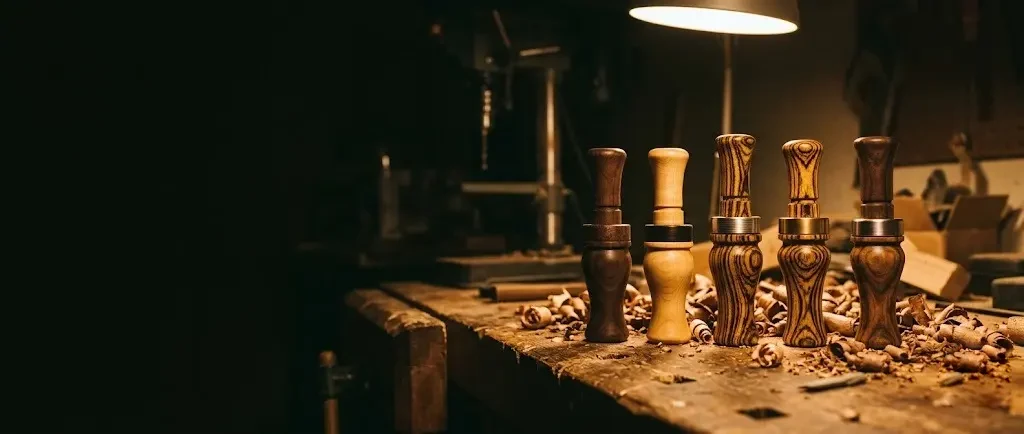
Turn a wooden barrel, fit a tuned insert, and you have a duck call that works. A small woodworking project with a loud result.
What it is like
A duck call is two parts. The insert holds the tone board, the reed and the wedge that clamps them, and it makes the sound. The barrel is the handle and the resonating chamber.
Kit inserts arrive tuned, so a first call is a barrel around a bought insert. Nothing you do to the barrel can make the call unusable, which makes it the gentlest place to start; plenty of makers stay with bought inserts for good.
Deer grunt tubes are simpler still, and turkey pot calls add a turned bowl with a slate or glass surface. Tuning your own tone boards comes last: small adjustments, blow, listen, repeat.
The craft has two halves that most makers learn in order. The barrel is woodworking - drilling a true bore, shaping a comfortable profile, finishing it so it survives rain and breath - and it rewards patience more than skill. The insert is acoustics: the length and thickness of the reed, the curve of the tone board and how tightly the cork or wedge holds them decide the sound, and tiny changes make big differences. Starting with tuned kit inserts lets the woodworking come first.
Calls also invite decoration. Contrasting bands, checkering, burned designs and laminated blanks turn a tool into something people collect, and many makers end up turning pots for turkey calls and grunt tubes alongside duck calls on the same lathe.
- A session
- An evening for drilling and shaping, then days for the oil to cure.
- A week
- A call or two a week once the steps are familiar.
- Season
- All year; most makers work before the autumn hunting seasons.
Indoors · Solo, A club
Kinds and styles
A barrel and an insert with one or more reeds over a tone board. Single reeds are louder and more versatile, double reeds easier for beginners to sound right.
Short-reed calls with a guttural honk and cluck; more technique to blow, and the same barrel-and-insert build.
A tube with a reed inside and often a flexible bellows; the simplest call to make.
A shallow turned pot with a slate, glass or aluminum surface, played with a striker; a lathe project.
A wooden box and a hinged paddle that scrapes its edges to make turkey yelps; careful woodworking and tuning.
Reed calls that imitate a distressed rabbit or bird for coyote and fox hunting.
Is it for you?
You will probably love it if
- You want a first turning project that is small and forgiving
- You have a drill, a vise and patience for sanding
- You hunt, or like instruments that are also tools
Maybe not, if
- You share walls with people who dislike quacking
- You want to design the sound from scratch on day one
- You have nowhere to clamp and drill
What to buy first
- 01Duck call insert kit, tunedThe insert is the voice; a bought one turns a black art into woodworkingFind it on Amazon$12
- 02Hardwood call blank, about 1.5 x 1.5 x 6 inchWalnut or maple drills and shapes easilyFind it on Amazon$10
- 03Forstner bit, 5/8 inchCuts the flat-bottomed seat the insert presses intoFind it on Amazon$9
- 04Tung or Danish oil, small canSeals the wood against rain and spit without deadening itFind it on Amazon$15
- 05220-grit sandpaperShaping and finishing while the blank spinsFind it on Amazon$5
- Everything you need to beginAbout $12 a month after that$51
Typical US prices for entry-level gear, rounded. Last checked October 2026. How we get the numbers
The Amazon links open a search for that type of item, not a product chosen for us, and the prices in the list are our typical figures, or the listing of the shop a line names, not Amazon's price for any listing. If you buy through one we may earn a commission at no extra cost to you; as an Amazon Associate we earn from qualifying purchases.
What to buy next
- 01Small wood latheTurns barrels and turkey pots round and trueFind it on Amazon After a few drill-shaped calls
- 02Lathe chiselsA spindle gouge and skew for shaping barrelsFind it on Amazon With the lathe
- 03Reed materialMylar reed stock to cut and fitFind it on Amazon Tuning your own calls
- 04Turkey pot call kitA pot, a slate surface and a striker to finishFind it on Amazon Branching out
- 05Wood burning penNames, ducks and checker patterns burned into the barrelFind it on Amazon Decorating
No prices here on purpose: these are later buys, and what to spend depends on how far the hobby has taken you. The Amazon links work like the ones above: a search for the type of item, and a possible commission for us at no extra cost to you.
From a hardwood blank to a duck call that works, step by step
A duck call is a barrel and an insert - the tone board, the reed and the cork that holds it - and the insert is where the sound is made (Wikipedia). Buying a tuned insert turns call making into woodworking. This guide goes from choosing the insert and wood to drilling, fitting, shaping, finishing and blowing, with the choices at each step.
Warning: Before you start Wear eye protection for drilling and a face shield at a lathe, keep sleeves tight and hair back. Sand with a dust mask: several call woods, cocobolo above all, cause allergic reactions. Let any finish cure completely before the call goes near your mouth.
Clamp the square blank upright and drill the wide seat, then the narrow through-bore, from the same end. Use the sizes on the kit's sheet.
The insert should push in on its O-rings with firm thumb pressure. No mallet, no rattle.
On a lathe, or with the blank on a long bolt in a clamped drill, shape with rasps and coarse paper, then sand through the grits.
Several thin coats, buffed between, and one pull-through for the bore. Let it cure fully before it meets your mouth.
Push the insert home. Soft air gives a growl, a hard grunt of air gives a quack.
A duck call, cut lengthwise
The barrel and the insert pressed into it, with the parts Wikipedia names.
- A Bore Drilled through after the wider seat, from the same end. Step 3 →
- B Barrel Turned hardwood or acrylic; shaped after drilling. Step 5 →
- C O-rings Hold the insert in the seat: firm thumb pressure, no rattle. Step 4 →
- D Reed Single or double; it vibrates against the tone board. Step 1 →
- E Tone board Its shape sets the style - Arkansas or Louisiana. Step 1 →
- F Cork wedge Holds the reed in place on the tone board. Step 1 →
Steps 1-2Choose
- Step 1 of 8 · Choose
Choose the insert
Calls are usually single or double reed; the tone board's shape sets the style, and the two most popular are Arkansas and Louisiana (Wikipedia).
Most people: double reed (beginners).
Start here Double reedBest forBeginners
Easier to make sound right.
Single reedBest forExperienced callers
Louder and more versatile, harder to control.
- Step 2 of 8 · Choose
Choose the barrel material
Warning: CAUTION Several exotic woods cause allergies: Wikipedia notes cocobolo's oil can cause allergic reactions through the skin, eyes or breathing. Sand any wood with a dust mask; wear eye protection for drilling and a face shield at a lathe, sleeves tight and hair back.
Wood and acrylic are the two common high-quality materials (Wikipedia).
Most people: hardwood - walnut or maple (timber and swamps).
Start here Hardwood - walnut or mapleBest forTimber and swamps
Traditional; drills and shapes easily, but moves with temperature and humidity.
AcrylicBest forBig open water
Louder, carries farther and varies less with temperature; needs a lathe.
Steps 3-6Build
- Step 3 of 8 · Build
Drill before shaping
Clamp the square blank upright, centre-punch both ends, and drill the wide flat-bottomed seat with a Forstner bit, then the narrow through-bore from the same end, at the sizes on the kit's sheet.
Goes wrong: A bore off centre. A wandering bore leaves a thin wall that cracks; drill slowly.
- Step 4 of 8 · Build
Test the fit
The insert should push in on its O-rings with firm thumb pressure - no mallet, no rattle.
Goes wrong: An insert too tight or too loose. Mallet-tight can split the barrel; loose rattles and leaks.
- Step 5 of 8 · Build
Shape the barrel
Turn it on a lathe, or spin the blank on a long bolt in a clamped drill and shape it with rasps and coarse paper, then sand through the grits.
Most people: lathe (round, even barrels).
Start here LatheBest forRound, even barrels
The usual tool for calls.
Drill and raspBest forNo lathe
The blank spins on a bolt; slower, still round.
- Step 6 of 8 · Build
Oil it
Several thin coats of tung or Danish oil, buffed between, and one pull-through for the bore. Let it cure completely before it goes near your mouth.
Goes wrong: Finish in the bore. A thick coat inside changes the sound.
Steps 7-8Blow it, then next
- Step 7 of 8 · Blow it, then next
Seat the insert and blow
Push the insert home. Wikipedia: the caller pushes air from the diaphragm, and beginners often say words like "hut" or "oak" into the call to make a quack. Soft air gives a growl; a hard grunt of air gives a quack.
- Step 8 of 8 · Blow it, then next
Choose the next call
The same barrel-and-insert build makes other calls.
Most people: deer grunt tube (the simplest build).
Goose callBest forWaterfowl
Short-reed calls with a honk and cluck; more technique to blow.
Start here Deer grunt tubeBest forThe simplest build
A tube with a reed inside, often with a bellows.
Turkey pot callBest forLathe practice
A shallow turned pot with a slate or glass surface, played with a striker.
In shortIf it goes wrong
- A bore off centre.
- Step 3 · Drill before shaping
- An insert too tight or too loose.
- Step 4 · Test the fit
- Finish in the bore.
- Step 6 · Oil it
How you get better
- First callA barrel on a kit insert
Drill, shape, sand and oil a hardwood barrel around a tuned insert.
- Calls 2 to 5Woods and shapes
Different hardwoods, barrel profiles and finishes; a deer grunt tube.
- Months 2 to 4A lathe and decoration
Turning barrels and turkey pots on a lathe, adding bands, checkering or burned designs.
- Months 4 to 12Reeds and tuning
Cutting your own reeds and adjusting tone boards for a sound you choose.
- After thatYour own inserts
Making complete calls from scratch, box calls, and entering call-making contests.
- Choosing and preparing blanks
- Drilling a straight bore
- Fitting an insert
- Shaping on a lathe or drill
- Sanding through the grits
- Oil and wax finishes
- Checkering and banding
- Turning turkey pots
- Cutting and fitting reeds
- Tuning tone boards
- Blowing technique
- Matching a call to its purpose
Small things that help
- Drill the bore first while the blank is still square; holding a round blank straight is much harder.
- Mark the center of both ends before drilling so the bore runs true.
- Test-fit the insert before any shaping.
- Let oil finishes cure fully before blowing the call.
- Keep the bore and the insert free of finish and sanding dust.
- Practice blowing with a recording of real ducks, not just the call's own sound.
Beginner mistakes
- 01Bore off centerA bore that wanders leaves a thin wall that cracks. Center-punch both ends and drill slowly.
- 02Insert too tight or too looseA mallet-tight insert can split the barrel; a loose one rattles and leaks. Aim for firm thumb pressure.
- 03Finish in the boreThick finish inside changes the sound. Wipe a thin coat and pull it through once.
- 04Sanding cocobolo without a maskSeveral exotic call woods cause allergic reactions. Wear a dust mask for any sanding.
Which call to build first
| Call | How it works | Difficulty |
|---|---|---|
| Deer grunt tube | Straight barrel, simple reed, flexible tube | Easiest |
| Duck call on a kit insert | You make the barrel, the insert is pre-tuned | Easy |
| Turkey pot call | Turned pot, slate or glass surface, separate striker | Medium |
| Duck call with your own tone board | Reed length and board curve set the voice | Hard |
Why people quit
- 01An off-center boreDrilling after shaping is luck. Bore the square blank first and everything else is cosmetic.
- 02A thin, airy soundUsually the O-rings not sealing. Pull the insert and seat it again.
- 03A dead callA thick plastic finish looks wonderful and mutes the wood. Use thin oil.
Words you will meet
- Barrel
- The outer part of the call you hold, and its resonating chamber.
- Insert
- The part that holds the tone board and reed and makes the sound.
- Tone board
- The shaped surface the reed vibrates against.
- Reed
- The thin strip that vibrates to make the sound.
- Single reed, double reed
- Calls with one or two reeds; double reeds are easier to blow, single reeds more versatile.
- Bore
- The hole through the barrel.
- Blank
- The block of wood or acrylic a barrel is made from.
- Forstner bit
- A drill bit that cuts a clean, flat-bottomed hole.
- Checkering
- A grid of fine grooves cut into the barrel for grip and decoration.
- Striker
- The peg used to play a turkey pot call.
Questions people ask
Do I need a lathe?
No. A blank on a long bolt spun by a clamped drill, shaped with rasps and sandpaper, works for first calls.
Which wood is best?
Walnut and maple are easy to drill and shape; exotic woods look striking but some cause allergies when sanded.
Single or double reed for a beginner?
Double reed inserts are easier to blow without squeaks; single reeds give more range once you have practiced.
Can I make the insert myself?
Yes, but tuning a tone board is the hardest part of the craft. Start with tuned kit inserts.
Do I have to hunt to enjoy this?
No. Many makers enjoy the woodworking and the sound itself, and well-made calls are collected.
Where to go next
- 01Decoy carvingThe decoys the call brings ducks to. $80 to start
- 02PyrographyBurning a name or pattern into the barrel. $54 to start
How it compares
| Game call making | Whittling | Decoy carving | Pyrography | |
|---|---|---|---|---|
| Start cost | $51 | $52 | $80 | $54 |
| Each month | $12 | $5 | $10 | $5 |
| Space | A workbench | A chair | A bench or a porch | A desk by a window |
| Noise | Loud | Quiet | Low | Quiet |
| First result | 1 weekend | 1 evening | 2 weekends | 1 evening |
| Mess | Shavings | Shavings | Chips and paint | Smoke and ash |
Sources: Wikipedia, Duck call (history)
Researched and written by the Fjords Team.