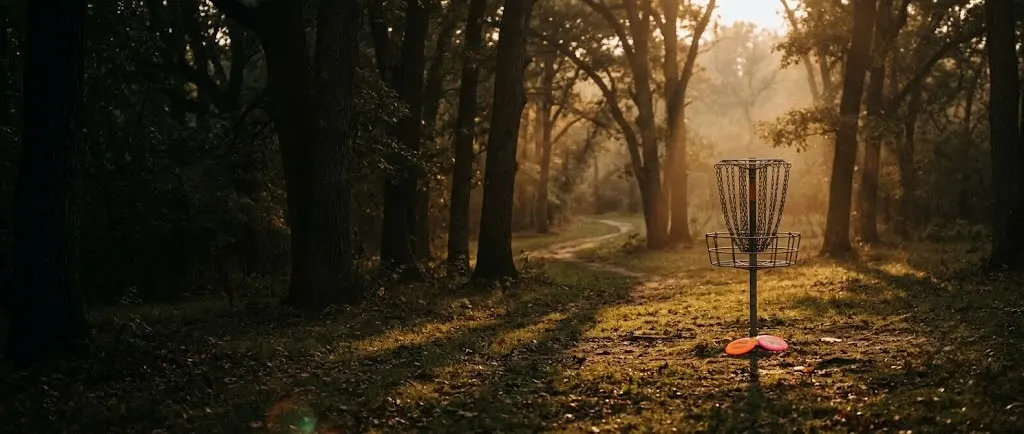
 AI illustration
Disc golf
Three discs, a free course in a park, and a round that takes an hour. The cheapest sport that gets you walking in the woods.
What it is like
Disc golf is golf with a flying disc and a basket of chains instead of a hole. Courses are laid through parks and woods, most are free, and a round of eighteen holes is a long walk with a game attached. The discs are smaller and heavier than a beach frisbee and come in types the way clubs do, but a beginner needs three.
It suits people who want to be outdoors with a purpose. The game is easy to start and slow to master: a first round is a comedy of discs in bushes, and by the tenth the throws go roughly where you meant. Because the course is a public park, it is also one of the most sociable hobbies on the site, with casual leagues on many courses that take anyone who turns up.
The throw is the whole game, and it is mostly technique. A disc wants to be released flat, at the right speed for its type, with a smooth pull across the chest rather than a hard arm swing. Slow, forgiving discs reward a clean release by flying straight; fast drivers punish a weak one by turning hard and disappearing. That is why experienced players hand beginners a putter and a midrange and suggest leaving the driver in the bag for a while.
Courses are a big part of the fun. Each hole has its own trees, slopes, water and gaps to thread, and many courses have several tee or basket positions for different skill levels. Working out the safest line, choosing the right disc for it and watching a familiar course get shorter over a season is what keeps many players coming back every week.
- A session
- About an hour for nine holes, two for eighteen, depending on the course and the group.
- A week
- One or two rounds, or a league night and some putting practice.
- Season
- All year; bright discs are easier to find in snow and fallen leaves.
Outdoors · Solo, For two, With kids, A club
Kinds and styles
Nine or eighteen holes with a friend or alone, counting your own throws. Where nearly everyone starts and many people stay.
Weekly evening rounds at a local course, often in pairs, open to beginners and a good way to meet regulars.
PDGA events in divisions by age and rating, from small local events to professional tours.
Holes threaded between trees, where accuracy and straight midranges matter more than distance.
Wide fields and long holes where drivers come into their own once your form is ready.
A practice basket in a garden or a course's practice target; putting decides most scores.
Is it for you?
You will probably love it if
- You want to be outside and moving without calling it exercise
- You like a game with a score you can beat next week
- You want something to do with a friend that costs nothing after the first day
Maybe not, if
- There is no course within reach; check an app before you buy discs
- You want polish and quiet; courses are public parks with dogs, kids and picnics
- You will be frustrated by a sport where the first month is mostly lost discs
What to buy first
- 01Beginner disc set: putter, midrange and fairway driverThree discs is a bag; the fast drivers come later, if everFind it on Amazon$27
- Everything you need to beginNothing to pay each month after that$27
Typical US prices for entry-level gear, rounded. Last checked October 2026. How we get the numbers
The Amazon links open a search for that type of item, not a product chosen for us, and the prices in the list are our typical figures, or the listing of the shop a line names, not Amazon's price for any listing. If you buy through one we may earn a commission at no extra cost to you; as an Amazon Associate we earn from qualifying purchases.
What to buy next
- 01Disc golf bagCarries discs, water and a towel on a long roundFind it on Amazon Five or more discs
- 02Second putterPractice and approach with one, putt with the otherFind it on Amazon Putting practice
- 03Portable practice basketPutting practice at home is the fastest way to lower scoresFind it on Amazon Working on putting
- 04Fairway driverMore distance without the difficulty of a distance driverFind it on Amazon When a midrange flies straight
- 05Disc retrieverRecovers discs from ponds without wadingFind it on Amazon Courses with water
No prices here on purpose: these are later buys, and what to spend depends on how far the hobby has taken you. The Amazon links work like the ones above: a search for the type of item, and a possible commission for us at no extra cost to you.
Disc golf starter sets compared
A starter set is usually a driver, a midrange and a putter. Two from Dynamic Discs, one standard-weight and one light.
| Model | Type | Specs | Who it suits | Links |
|---|---|---|---|---|
| Dynamic Discs Prime Burst Starter Set | 3 or 5 discs | Dynamic Discs' popular beginner molds in Prime Burst plastic; most of its starter sets are 170 g or heavier; weights and colors vary | Players who want standard-weight discs | Find it on AmazonMaker's page |
| Dynamic Discs 3-Disc Set, Lightweight (Drift) | 3 light discs | Escape fairway driver, Evidence midrange and EMAC Judge putter at 120-130 g; Dynamic Discs says light discs need less power for distance | Players who throw with less power | Find it on AmazonMaker's page |
How we put this together. Two sets compared on what Dynamic Discs states on its own product pages; Innova's and Discraft's stores could not be read. We have not thrown them side by side. Checked on 26 October 2026. There are no prices in this table: the Amazon link searches for the exact model, and we may earn a commission if you buy through it.
From three discs to a full round, step by step
Disc golf is played like golf with a flying disc and a chain basket. This guide goes from choosing discs to scoring a round and practising, with the choices at each step. Rules and terms are the ones the Professional Disc Golf Association uses, as summarised by Wikipedia.
Warning: Before you start A disc thrown hard is a hard object. Never throw while anyone is ahead on the fairway, shout a warning if a throw goes wild, and wait for groups to clear the basket. Courses run through rough ground: watch for poison ivy, ticks and water hazards, and leave a disc rather than wade for it.
A course-finder app lists every public course with a map. Pick a short one, nine or eighteen holes, in a park.
Fingers curled under the rim, thumb on top. Throw flat and level across the chest, release toward the target. Let the disc do the flying.
Play the first three holes with just the putter. It flies straight and short, and it teaches the release without the curve of a driver.
Off the tee, throw the midrange. It goes farther and still fairly straight. Save the driver for wide open holes.
Count every throw, including the ones into the bushes. Par does not matter; your own number from last week does.
One hole
From above, like a course sign: one player's throws from the tee to the basket.
- A Basket Into the chains It must rest in the tray or chains. Step 6 →
- B Approach Short and soft Leave an easy putt. Step 6 →
- C Lie Where it came to rest Every throw after the tee is made from here. Step 7 →
- D Out of bounds +1 penalty Replay near where it went out. Step 8 →
- E Tee pad Behind the tee line Lowest previous score throws first. Step 7 →
Steps 1-3Gear and course
- Step 1 of 9 · Gear and course
Choose three discs
Discs differ by their edge. Drivers have a sharp, bevelled edge with the weight on the rim and fly farthest; mid-ranges have a duller edge and more control; putters fly straight, slow and predictable (Wikipedia). Most are 21-22 cm across and weigh 130-180 g.
Most people: putter (learning the release).
Start here PutterBest forLearning the release
Straight and short; used near the basket and for short drives.
Mid-rangeBest forTee shots as a beginner
Wikipedia notes beginners often tee off with one, because it flies straight with less strength.
Fairway driverBest forOpen holes
Between a mid-range and a distance driver.
Distance driverBest forLater
Thrown slowly, a fast driver turns hard and gets lost.
Not for a first tryGoes wrong: Unmarked discs. Write your name and phone number on every disc; a disc without them is a disc you will not see again.
- Step 2 of 9 · Gear and course
Read the flight numbers
Many discs carry four numbers: speed, glide, turn and fade. Wikipedia explains the last two for Innova's ratings: turn, from +1 to -5, is how the disc drifts at high speed early in its flight; fade, from 0 to 6, is how hard it hooks at the end as it slows. For a right-handed backhand, overstable discs track left and understable ones track right.
Most people: understable (negative turn) (slower arms).
Start here Understable (negative turn)Best forSlower arms
Easier to fly straight at beginner speeds.
Overstable (high fade)Best forWind and hooks
Predictable finish to the left for a right-handed backhand.
- Step 3 of 9 · Gear and course
Find a course
Most courses have 9 or 18 holes, each with a tee and a target, usually a chain basket. The PDGA recommends holes averaging 200-400 ft (60-120 m). A course-finder app lists public courses with maps.
Most people: a short park course (first rounds).
Start here A short park courseBest forFirst rounds
Nine holes, short and open, with few places to lose a disc.
A wooded courseBest forAccuracy
Holes threaded between trees, where straight mid-ranges matter more than distance.
Steps 4-6Throwing
- Step 4 of 9 · Throwing
Learn the backhand
The most common throw. Grip with the fingers curled under the rim and the thumb on top, draw the disc across the front of the body, and release flat and level towards the target. Wikipedia notes the backhand can make a lot of spin and often goes farther than the forehand.
Most people: backhand (most throws).
Start here BackhandBest forMost throws
Drawn across the chest, like throwing a flying disc to a friend.
Forehand (sidearm)Best forCurving the other way
Drawn from behind and across the body, like a sidearm baseball throw.
Goes wrong: Throwing for distance. Hard, rushed throws go wide; a smooth, flat release goes straighter and often farther.
- Step 5 of 9 · Throwing
Use the curve
A disc curves in the direction of its spin. Thrown with the outer edge tilted down - hyzer - it falls the natural way; tilted the other way - anhyzer - it curves against it (Wikipedia). Tilting the disc is how you bend a throw around a tree.
- Step 6 of 9 · Throwing
Practise putting
Most throws in a round are short. A hole only counts when the disc rests in the basket's tray or in the chains below the chain support (Wikipedia). A practice basket in a garden, or a course's practice target, saves more strokes than any new driver.
Goes wrong: Neglecting putting. It decides most scores.
Steps 7-9Playing a round
- Step 7 of 9 · Playing a round
Play by the order and the lie
Warning: CAUTION A disc thrown hard is a hard object. Never throw while anyone is ahead on the fairway or near the basket, and shout a warning if a throw goes wild.
From the tee, do not step over the front of the tee pad before the disc leaves your hand. After that, throw again from where the disc came to rest. On each tee, the player with the lowest score on the previous hole throws first (Wikipedia).
- Step 8 of 9 · Playing a round
Know the penalties
A disc that lands out of bounds usually costs a penalty throw, and play resumes near where it went out. A mandatory, or mando, is a marked line the flight has to pass on a set side (Wikipedia). Course signs show both.
- Step 9 of 9 · Playing a round
Keep score
Count every throw, including the ones into the bushes, and compare with par: a birdie is one under, a bogey one over, an eagle two under. The lowest total wins. Your own number from last week is the score that matters at first.
Most people: casual round (most players).
Start here Casual roundBest forMost players
Alone or with friends, keeping your own card.
League nightBest forMeeting regulars
Weekly rounds at a local course, often in pairs.
PDGA tournamentBest forCompetition
Divisions by age and rating, from local events up.
In shortIf it goes wrong
- Unmarked discs.
- Step 1 · Choose three discs
- Throwing for distance.
- Step 4 · Learn the backhand
- Neglecting putting.
- Step 6 · Practise putting
How you get better
- First roundPutter and midrange only
Every hole finished, every throw counted, on a short park course.
- First monthStraight throws and putting
A flat, smooth release and putts from inside about 30 feet.
- Months 2 to 4A fairway driver and a league
Adding a fairway driver for open holes, trying forehand throws, and joining a casual weekly round.
- Months 4 to 12Angles and course management
Hyzer and anhyzer shots, choosing safe lines, and lowering your average on a home course.
- After thatTournaments and new courses
A PDGA membership and rating, local tournaments, and road trips to courses in other towns.
- Backhand grip and release
- Throwing flat
- Reading a hole
- Choosing the right disc
- Putting
- Approach shots
- Forehand throws
- Hyzer and anhyzer angles
- Run-up and footwork
- Rollers and upshots
- Course etiquette
- Scoring and the rules
Small things that help
- Write your name and phone number under every disc so a finder can return it.
- Throw slow discs well before fast discs badly.
- Practice putting more than driving.
- Let groups behind play through if you are slower.
- Play the same course often to see your score fall.
- Bright colors are much easier to find in leaves and long grass.
Beginner mistakes
- 01Throwing for distanceHard, rushed throws go wide. A smooth, flat release goes straighter and often farther.
- 02Distance drivers too soonFast discs thrown slowly turn hard and get lost. Stay with putter and midrange.
- 03Neglecting puttingMost throws in a round are short. Putting practice saves more strokes than any driver.
- 04Throwing with people aheadA disc can hurt someone. Wait for the fairway and the basket to clear.
- 05Unmarked discsA disc without a name on it is a disc you will not see again.
What the discs are for
The speed number is printed on most discs. Lower is slower, straighter and easier to throw.
| Disc | Speed | What it does | When |
|---|---|---|---|
| Putter | 1 to 3 | Flies straight and slow, stops in the chains | Inside about 60 feet, and most of your first month |
| Midrange | 4 to 5 | Straight and accurate | Tee shots on short holes, approach shots |
| Fairway driver | 6 to 9 | Longer, with some curve | Open holes once the midrange flies straight |
| Distance driver | 10 to 14 | Far, if thrown fast and well; otherwise into the trees | Later, or never |
Why people quit
- 01Throwing drivers too earlyA fast disc thrown slowly hooks hard and disappears. Everyone's first lost discs are drivers. Stay with putter and midrange for a month.
- 02Playing alone in the coldRounds are more fun in a pair. Many courses have a weekly casual league that welcomes beginners.
- 03Comparing yourself to the group aheadThey have thrown ten thousand discs. Count your own throws and watch your number fall.
Words you will meet
- Tee pad
- The area each hole is thrown from.
- Basket
- The chain-and-cage target that catches the disc.
- Lie
- Where your disc came to rest; the next throw is from there.
- Hyzer
- Releasing with the disc's outer edge tilted down, so it curves one way.
- Anhyzer
- The opposite angle, curving the other way.
- Stable and understable
- How much a disc resists turning; understable discs suit beginners.
- Flight numbers
- Printed speed, glide, turn and fade ratings on a disc.
- Ace
- A hole in one.
- Mando
- A mandatory route around a tree or marker.
- OB
- Out of bounds, which costs a penalty throw.
Questions people ask
How many discs do I need?
Three is plenty: a putter, a midrange and a fairway driver. Many beginners play only a putter and midrange for weeks.
Are courses free?
Most are; the UDisc directory counts about 90 percent of courses as free to play.
Can kids play?
Yes. Light, slow discs suit children, and many families play park courses together.
What do the numbers on a disc mean?
Speed, glide, turn and fade. For beginners, low speed numbers and understable discs fly straighter.
Do I need to join the PDGA?
Not to play. Membership is for tournaments and official ratings.
Where to go next
- 01Traditional archeryAnother target sport where a calm, repeatable release matters more than strength. $231 to start
- 02GeocachingMore reasons to walk park paths, this time with a map and a hidden box at the end. Free to start
How it compares
| Disc golf | Traditional archery | Slacklining | Geocaching | |
|---|---|---|---|---|
| Start cost | $27 | $231 | $66 | Free |
| Each month | Free | $15 | Free | $3 |
| Space | A park course | A club range | Two trees | The whole town |
| Noise | Low | Quiet | Quiet | Quiet |
| First result | One round | 1 afternoon | First steps the same afternoon | The first find |
| Mess | None | None | None | None |
Where to learn more
- 01Professional Disc Golf AssociationThe sport's governing body: rules, events, ratings and course resources.
- 02UDisc course directoryMaps and details of courses worldwide.
Sources: Professional Disc Golf Association, official rules · Wikipedia, Disc golf
Researched and written by the Fjords Team.