 AI illustration
Geocaching
Millions of small containers hidden around the world, each with a logbook, found with the phone already in your pocket. Free to start, and it turns every walk into a search.
What it is like
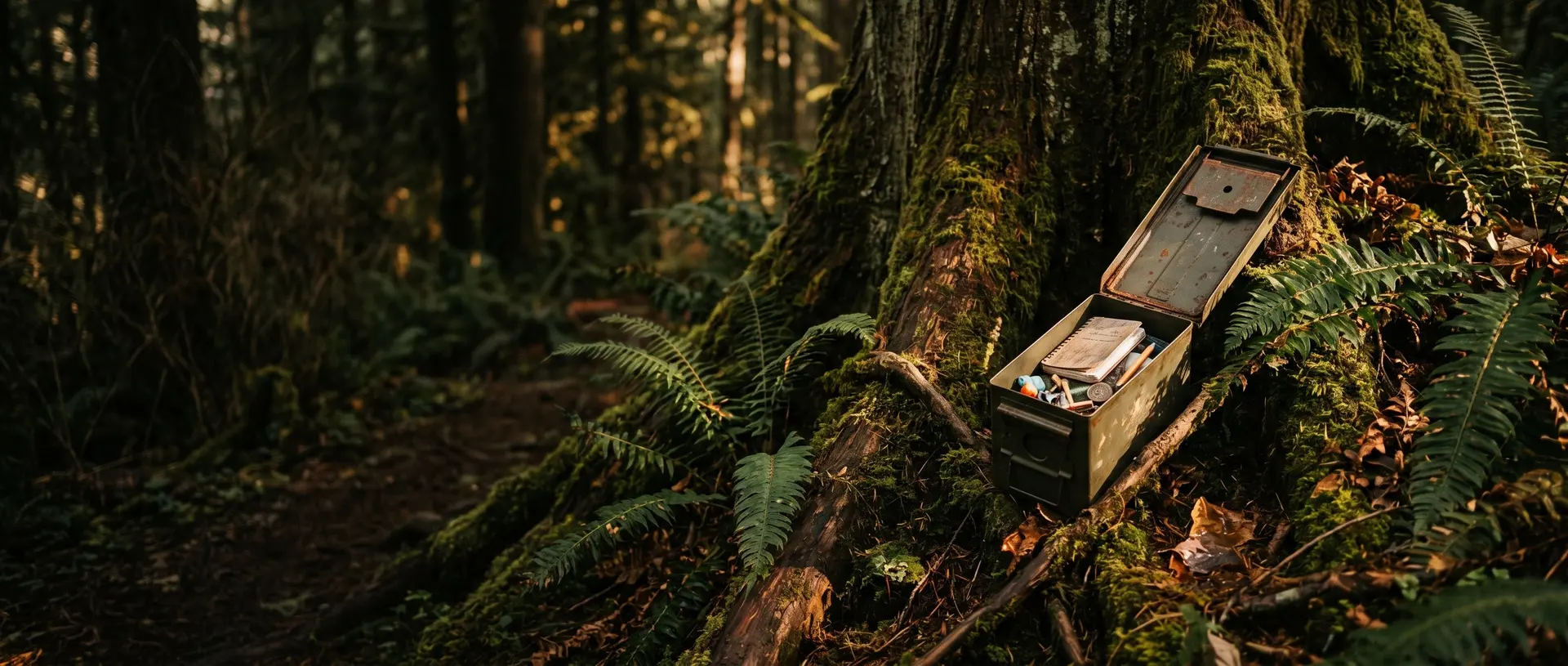
Geocaching is a worldwide hide-and-seek. People hide small waterproof containers, post the coordinates online, and others go and find them, sign the logbook and put them back. There are millions, in every city and most villages, and the free app on your phone shows the ones around you right now.
The hobby is really an excuse: to take a walk with a destination, to explore a corner of your own town you have passed for years, to give a child a quest on a dull Sunday. It costs nothing to begin, the finds get harder as you want them to, and it travels with you anywhere there are people and a phone signal.
Every cache page carries two ratings from 1 to 5: difficulty, for how hard the container is to spot or the puzzle to solve, and terrain, for how hard the walk is. Starting low on both and working up is the gentlest way in, and the page’s hint and recent logs usually explain the rest. Many caches are placed because the hider wanted to show you something - a view, a ruin, a piece of local history - and the description often tells the story.
As the finds add up, the hobby branches. Some people chase puzzles, some travel to old and famous caches, some collect EarthCaches and learn to read rocks, and some prefer to hide and maintain caches of their own. The basic etiquette stays the same everywhere: leave no damage, follow land rules, put it back exactly as you found it.
- A session
- Half an hour for a cache near home; an afternoon for a series or a multi-cache.
- A week
- A few finds on ordinary walks, or one longer outing.
- Season
- All year; winter brings snow and fewer leaves, summer ticks and nettles.
Outdoors · Solo, For two, With kids, A club
Kinds and styles
A container at the posted coordinates - the kind on this page and the bulk of what is out there.
Several stages, each giving the coordinates of the next, ending at the final container.
A puzzle to solve at home first; the answer gives the real coordinates.
No container: a lesson about the geology of a place, logged by answering questions about what you see there.
Meetups of local geocachers, from picnics to clean-up days, logged like a cache.
Tagged items such as Travel Bugs that move from cache to cache, their journeys logged online.
Is it for you?
You will probably love it if
- You like walking but want a reason to go somewhere particular
- You have children who need a mission
- You travel and want a way into every new town
Maybe not, if
- You want to be left alone; caches are in public places with people about
- Poking about in hedges and under benches would embarrass you
- You want the thing you find to be valuable; it is a logbook in a box
What to buy first
- 01The geocaching app on your own phoneThe free tier shows the easier caches near you, which is all a beginner needsFree
- 02A penMany logbooks are tiny and most caches have no penFree
- 03A pocket of small trinkets to tradeWhatever the kitchen drawer holds; take one, leave one of equal valueFree
- Everything you need to beginAbout $3 a month after thatFree
Typical US prices for entry-level gear, rounded. Last checked October 2026. How we get the numbers
What to buy next
- 01Spare logbook strips and pencilsMany micros have full or soggy logsFind it on Amazon Regular caching
- 02Small flashlightLook before you reach into a creviceFind it on Amazon Searching hollows and evening hunts
- 03Trackable tagSend an item traveling and follow its journeyFind it on Amazon Starting your own trackable
- 04Waterproof cache containerA sealed box that keeps the log dryFind it on Amazon Hiding your first cache
- 05Power bankGPS and maps drain a phone fastFind it on Amazon Long caching days
No prices here on purpose: these are later buys, and what to spend depends on how far the hobby has taken you. The Amazon links work like the ones above: a search for the type of item, and a possible commission for us at no extra cost to you.
From your first find to hiding a cache of your own, step by step
A geocache is a container with a logbook hidden at a set of coordinates. This guide goes from picking easy caches to signing the log, then to the other kinds of caches and to placing your own under Geocaching.com's guidelines.
Warning: Before you start Caches are placed on public land, by the roadside and in parks. Watch traffic, do not climb for a cache, do not dig, and never cross into private property; a cache that needs it has been placed wrongly. Put hands into holes and crevices only after a look, especially in snake and spider country, and check for ticks after woodland hunts. Children search with an adult.
Install the app and look at the map around your home. Pick three caches marked as easy: difficulty and terrain of 1.5 or less, size small or regular.
Each cache has a description, a hint and recent logs. If the last three logs say did not find, pick another.
The phone takes you to within ten feet or so. Then put it away and think like the hider: where would a box stay dry and unnoticed?
Sign the logbook with your username and the date. Put everything back exactly where and how it was, so the next person finds it.
Mark it found in the app with a line about the hunt. Three finds in an afternoon, and the map now has a hundred more.
The last ten feet
From above at the posted coordinates, and the cache opened.
- A Coordinates To about ten feet Then put the phone away. Step 3 →
- B Cache Never buried Look before reaching; never dig or pry. Step 3 →
- C Logbook Username and date Bring your own pen. Step 4 →
- D Trade item Similar or higher value No food or scented items. Step 5 →
Steps 1-2Start
- Step 1 of 9 · Start
Get the app and pack a pen
The free tier of the geocaching app shows the easier caches near you. Take a pen - logbooks are small and most caches have none - and a few small trinkets if you want to trade.
- Step 2 of 9 · Start
Pick easy caches
Each cache is rated for difficulty and terrain; start with low ratings and a small or regular container, which is easier to spot than a fingertip-sized nano (Wikipedia describes containers from magnetic nanos to buckets of 20 litres or more). Read the page: the description, the hint and the recent logs.
Goes wrong: A cache with a run of recent "did not find" logs. It may be missing; pick another.
Steps 3-6The hunt
- Step 3 of 9 · The hunt
Get close, then look
Warning: CAUTION Look before putting a hand into a hole or crevice, watch for traffic near roadside caches, and do not climb for a cache. Check for ticks after woodland hunts.
The phone takes you to within ten feet or so. Then put it away and think like the hider: where would a box stay dry and unnoticed? Geocaching.com's rules say a cache is never buried, so it will not need digging or prying.
Goes wrong: Damaging the site. Digging, prying or trampling ruins the spot for everyone.
- Step 4 of 9 · The hunt
Sign the log
Every physical cache holds a logbook (Geocaching.com). Sign it with your username and the date.
- Step 5 of 9 · The hunt
Trade fairly, or not at all
You may take an item - never the logbook or the pen - and leave something of similar or higher value (Wikipedia). No food or scented items: animals tear containers open for them, and the guidelines ban them.
Most people: sign only (micro caches).
Trade even or upBest forCaches with swag
A small toy for a small toy.
Start here Sign onlyBest forMicro caches
Most small caches hold nothing but the log.
- Step 6 of 9 · The hunt
Replace it and log the find
Put everything back exactly where and how it was, so the next person finds it. Then log the find in the app with a line about the hunt.
Goes wrong: Leaving it poorly hidden. A cache left in sight gets taken - or "muggled", as cachers say.
Steps 7-9Beyond finding
- Step 7 of 9 · Beyond finding
Try other kinds of cache
Wikipedia lists many types beyond the traditional box at the posted coordinates.
Most people: multi-cache (longer walks).
Start here Multi-cacheBest forLonger walks
Several stages, each giving the coordinates of the next.
Mystery or puzzle cacheBest forPuzzle lovers
Solve the puzzle at home to get the real coordinates.
EarthCacheBest forLearning about a place
No container: answer questions about the geology you see.
EventBest forMeeting other cachers
Meetups logged like a cache; Cache In Trash Out events pick up litter.
- Step 8 of 9 · Beyond finding
Move a trackable
Travel Bugs and geocoins travel from cache to cache, and their journeys are logged online (Wikipedia). Pick one up, carry it to another cache, and log both moves.
- Step 9 of 9 · Beyond finding
Hide a cache of your own
Geocaching.com's placement guidelines: get permission from the landowner or land manager, keep at least 0.1 mile (161 m) from other caches, never bury it, take accurate coordinates on site, use a waterproof container with a logbook, and leave out anything dangerous, edible, scented, meltable or liquid. Owners must check on the cache and fix a wet log or broken container.
Goes wrong: Ignoring land rules. Parks have hours and closed areas; a cache that needs trespassing is placed wrongly.
In shortIf it goes wrong
- A cache with a run of recent "did not find" logs.
- Step 2 · Pick easy caches
- Damaging the site.
- Step 3 · Get close, then look
- Leaving it poorly hidden.
- Step 6 · Replace it and log the find
- Ignoring land rules.
- Step 9 · Hide a cache of your own
How you get better
- First afternoonThree easy finds
Low difficulty and terrain, small or regular containers, signed and put back.
- First monthMicros and hints
Smaller containers, reading hints and recent logs, and stealth in busy places.
- Months 2 to 4Multi-caches and trackables
Stage-by-stage hunts, and moving a Travel Bug on its way.
- Months 4 to 12Puzzles, EarthCaches and events
Solving a mystery cache at home, learning a landscape's geology, and meeting local cachers.
- After thatYour own hides
Placing a cache within the guidelines, looking after it, and hunting on every trip.
- Reading the cache page
- Difficulty and terrain ratings
- Using the map and compass in the app
- Searching like a hider
- Spotting camouflage
- Stealth near other people
- Logging and trading
- Moving trackables
- Solving puzzles
- Reading geology for EarthCaches
- Respecting land rules
- Hiding and maintaining your own cache
Small things that help
- Read the last few logs before you go; several not-founds may mean it is missing.
- Put the phone away near the cache and look at the place instead.
- Bring a pen; many caches have none.
- Be discreet near other people so the cache is not discovered.
- Put the cache back exactly as you found it.
- Trade equal or up, and nothing food-related.
Beginner mistakes
- 01Damaging the siteDigging, prying or trampling to find a cache ruins it for everyone. Caches should never need that.
- 02Ignoring land rulesParks have hours and closed areas. Read the page and respect them.
- 03Leaving it poorly hiddenA cache left in sight gets taken. Hide it as well as it was.
- 04Putting food in a cacheAnimals tear containers apart. No food or scented items.
- 05Reaching in blindHoles can hold glass, insects or worse. Look first.
Cache sizes
| Size | Typically | Inside | Where it hides |
|---|---|---|---|
| Nano | A pencil eraser with a magnet | A rolled strip of paper | Signs, railings, lamp posts |
| Micro | A film canister or a pill tube | A logbook only | Hedges, fences, under benches |
| Small | A sandwich box | Logbook and small trinkets | Tree roots, rock piles |
| Regular | An ammo can or lunchbox | Logbook, trinkets, trackables | Woods and parks |
| Large | A bucket or bigger | Anything | Rare; a day out |
Why people quit
- 01Starting with hard onesA nano on a busy street corner is a frustrating first cache. Filter for easy and small or regular until you have a dozen finds.
- 02Trusting the arrowPhone GPS can wander by several feet or more among trees and buildings. At the end, the hunt is about reading the place, not the screen.
- 03Forgetting the pointThe box is nothing; the walk to a spot you would never otherwise have seen is the hobby. Read the cache page: the best ones are placed for a reason.
Words you will meet
- Cache
- The hidden container and its logbook.
- GZ
- Ground zero: the posted coordinates.
- D/T
- Difficulty and terrain ratings, from 1 to 5.
- Muggle
- A non-geocacher who might notice the hunt.
- DNF
- Did not find.
- FTF
- First to find a new cache.
- Swag
- Trade items in a cache.
- Trackable
- A tagged item that travels between caches.
- Travel Bug
- A common kind of trackable.
- TFTC
- Thanks for the cache, a common log note.
Questions people ask
Is geocaching free?
Yes. The free app shows many caches; a paid membership unlocks more and extra tools.
Do I need a GPS device?
No. A phone's GPS is enough for nearly all caches.
What do I do when I find a cache?
Sign the log with your username and date, trade if you like, put it back exactly as found, and log it in the app.
Is geocaching good for kids?
Very - easy regular-size caches with trinkets are perfect, with an adult along.
Can I hide my own cache?
Yes, after some finds. Follow the placement guidelines, get permission where needed and maintain it.
Where to go next
- 01Metal detectingAnother search outdoors - for things nobody hid on purpose, under its own set of land rules. $398 to start
- 02BirdwatchingThe same walks, with binoculars, and a list that grows with every visit. $161 to start
How it compares
| Geocaching | Birdwatching | Disc golf | Stargazing | |
|---|---|---|---|---|
| Start cost | Free | $161 | $27 | $82 |
| Each month | $3 | Free | Free | Free |
| Space | The whole town | Anywhere outside | A park course | A dark backyard |
| Noise | Quiet | Quiet | Low | Quiet |
| First result | The first find | Same day | One round | One clear night |
| Mess | None | None | None | None |
Where to learn more
- 01Geocaching.comThe main listing site and app, with guides for beginners.
- 02Geocaching.com placement guidelinesThe rules for where and how caches may be hidden.
Sources: Geocaching.com, cache placement guidelines · Wikipedia, Geocaching (history and cache types)
Researched and written by the Fjords Team.