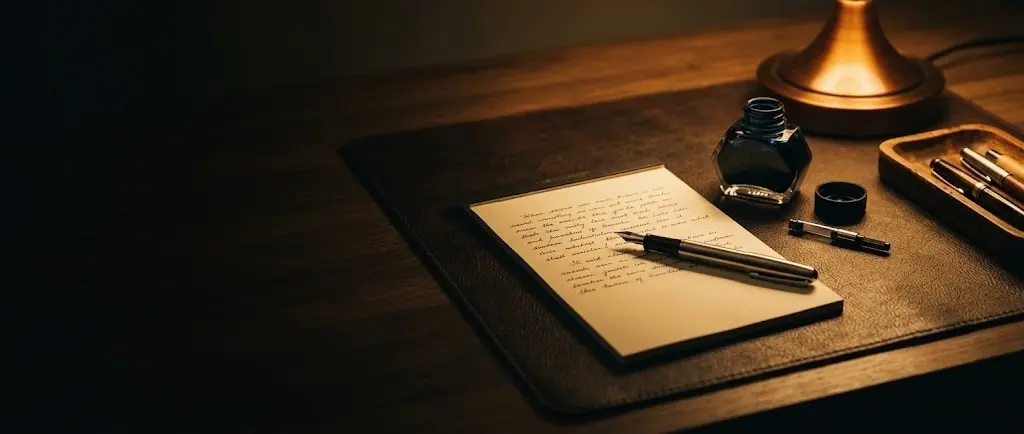
 AI illustration
Fountain pens
One steel-nib pen, one bottle of ink and paper that can take it. The cheapest collecting hobby here, and the only one that improves your handwriting.
What it is like
A fountain pen holds liquid ink and feeds it to a metal nib by capillary action, so it writes with no pressure at all. The feel is different from any ballpoint, and so is the line, which varies with the nib, the ink and the paper. A steel-nib pen from a serious maker costs about the same as a restaurant lunch and, flushed and looked after, keeps writing for years.
It is a collecting hobby in the gentlest sense. Most people own one pen for a year, learn what nib and ink they like, and then slowly add: a finer nib, a vintage pen from a market, a bottle of green. The pleasure is daily and practical, every note and list written with something you chose, and the whole collection fits in a drawer.
The magic is in the feed, the dark ridged piece under the nib. It lets ink run down to the slit between the tines while letting air back into the reservoir, so the pen writes smoothly without flooding. Gravity and capillary action do the rest, which is why a fountain pen needs no pressure and why pressing hard does harm rather than good.
Much of the hobby turns out to be about ink and paper rather than pens. The same nib can write thin and dry on one ink and wide and wet on another; the same ink can look crisp on smooth paper and fuzzy on cheap copy paper. Trying a few inks on a few papers, and keeping a small swatch card of each, teaches more in a month than buying another pen.
- A session
- Five minutes to fill or flush; the writing is whatever you write each day.
- A week
- Daily use keeps a pen flowing; a flush every few weeks or at each ink change.
- Season
- All year.
Indoors · Solo
Kinds and styles
Modern steel-nib pens that take cartridges or a converter for bottled ink. Where nearly everyone starts.
Pens with a built-in piston that draws ink straight from the bottle and hold more of it.
The barrel itself is filled with ink by dropper - the oldest system, with a huge ink capacity.
Lever fillers and other old pens from markets and estate sales, often restored with a new ink sac.
Flat-ground nibs that give thick and thin strokes, a bridge to calligraphy.
Bottles in every color, swatched on cards and notebooks; for many people the real collection.
Is it for you?
You will probably love it if
- You still write by hand: notes, journals, letters, lists
- You like small, well-made objects you use every day
- You want a collecting hobby that stays under a hundred dollars for years
Maybe not, if
- You write ten words a week; the pen will dry out between uses
- Ink on fingers or a shirt would upset you
- You want the pen to be the handwriting; it helps, it does not fix
What to buy first
- 01Steel-nib starter pen, medium nibA metal or sturdy plastic pen from a known maker; the medium nib is forgiving on any paperFind it on Amazon$25
- 02Ink converterA small piston that lets the pen fill from a bottle; some pens include oneFind it on Amazon$10
- 03A bottle of inkA well-behaved blue or blue-black; a bottle lasts a yearFind it on Amazon$14
- 04A pad of fountain-pen-friendly paperSmooth 90 gsm paper that does not feather or bleedFind it on Amazon$9
- Everything you need to beginAbout $3 a month after that$58
Typical US prices for entry-level gear, rounded. Last checked October 2026. How we get the numbers
The Amazon links open a search for that type of item, not a product chosen for us, and the prices in the list are our typical figures, or the listing of the shop a line names, not Amazon's price for any listing. If you buy through one we may earn a commission at no extra cost to you; as an Amazon Associate we earn from qualifying purchases.
What to buy next
- 01Bulb syringePushes water through the nib and feed quicklyFind it on Amazon Flushing
- 02Notebook with fountain-pen paperSmooth paper that shows the line and resists bleedFind it on Amazon Daily writing
- 03Ink sample vialsSmall amounts before buying a full bottleFind it on Amazon Trying colors
- 04Stub or italic nib penLine variation with no special techniqueFind it on Amazon After a few months
- 05Pen pouch or caseProtects nibs and pocketsFind it on Amazon Two or three pens
- 06Piston-filling penLarger ink capacity and fewer refillsFind it on Amazon Writing a lot
No prices here on purpose: these are later buys, and what to spend depends on how far the hobby has taken you. The Amazon links work like the ones above: a search for the type of item, and a possible commission for us at no extra cost to you.
From a first pen to keeping a small collection, step by step
A fountain pen is, in Wikipedia's phrase, a controlled leak: ink runs from a reservoir through the feed and down the slit in the nib by capillary action. This guide goes from choosing the pen, nib and filling system to inks, paper and care, with the choices at each step. Care advice follows Richard Binder's reference pages.
Warning: Before you start Nothing here is hazardous. Ink stains fabric; cap the pen before it goes in a pocket, and keep bottles away from the keyboard.
Twist the converter to push the piston down, dip the nib fully in the bottle, twist back to draw ink. Wipe the nib on the bottle's rim and then on a tissue.
A fountain pen writes with no pressure at all. Hold it loosely, nib flat to the paper, and let the ink flow; pressing bends the tines.
A page of anything. Notice where the line skips or blobs; that tells you about the paper and the angle, not the pen.
Copy paper, a notebook you own, the good pad. The difference is the first lesson of the hobby.
When the ink runs out, draw clean water in and out until it runs clear, then refill. Once a month keeps any pen happy; every change of ink needs it.
How the ink gets out
The nib from above, and the front of the pen cut lengthwise; the dashed line is the ink.
- A Tines Either side of the slit Pressure springs them apart. Step 6 →
- B Tip Hard alloy On a steel or gold nib. Step 1 →
- C Slit Ends in a hole Ink runs down it by capillary action. Step 1 →
- D Feed Under the nib Controls the ink flow; dried ink blocks it. Step 8 →
- E Converter Refillable Fits where a cartridge would go. Step 5 →
Steps 1-4Choose
- Step 1 of 9 · Choose
Choose a nib
Round nibs come in extra fine, fine, medium and broad; broad nibs show more shading and sheen in the ink, fine ones suit small writing (Wikipedia). Most nibs are stainless steel or gold, tipped with a hard alloy.
Most people: steel, medium (a first pen).
Start here Steel, mediumBest forA first pen
Forgiving on any paper; better steel alloys have narrowed the gap with gold.
Steel, fine or extra fineBest forSmall handwriting
Less ink on the page, less shading.
Italic or stubBest forLine variation
Flat-ground nibs for thick and thin strokes, a step towards calligraphy.
- Step 2 of 9 · Choose
Choose a filling system
How the pen takes up ink decides how much it holds and how easily you can change colours (Wikipedia).
Most people: cartridge and converter (most people).
Start here Cartridge and converterBest forMost people
Cartridges for travel; a converter lets the same pen fill from a bottle.
Piston fillerBest forBottled ink
A knob draws a piston up the barrel; holds more ink.
EyedropperBest forHuge capacity
The barrel itself is filled by dropper; simple, can be messy.
Lever or sac (vintage)Best forOld pens
A rubber sac squeezed and released; often needs a new sac.
- Step 3 of 9 · Choose
Choose an ink
Use ink made for fountain pens. Wikipedia explains why some inks wreck them: India ink contains shellac and clogs the pen quickly; most pigmented inks block the narrow channels, which is why fountain pen inks are mostly dye-based; traditional iron gall inks for dip pens corrode.
Most people: a well-behaved blue or blue-black (a first bottle).
Start here A well-behaved blue or blue-blackBest forA first bottle
Dye-based and easy to flush; a bottle lasts a year.
Iron gall made for fountain pensBest forPermanent writing
Gentler modern formulas, but they need regular flushing.
Goes wrong: India or drawing ink. It clogs a fountain pen.
- Step 4 of 9 · Choose
Choose the paper
Wet ink spreads - feathers - on thin, cheap paper; Wikipedia mentions 75 gsm. Smooth, heavier paper keeps the line crisp and stops bleed-through.
Steps 5-7Use
- Step 5 of 9 · Use
Fill the pen
With a converter: twist the piston down, dip the whole nib in the bottle, twist back to draw ink. Wipe the nib on the bottle's rim and then on a tissue.
- Step 6 of 9 · Use
Hold it lightly
A fountain pen writes with no pressure at all. Hold it loosely, nib flat to the paper, and let the ink flow.
Goes wrong: Pressing hard. Pressure springs the tines apart.
- Step 7 of 9 · Use
Write, and read the line
Write a page on three papers - copy paper, a notebook you own, a good pad. Skips and blobs tell you about the paper and the angle, not the pen.
Steps 8-9Care
- Step 8 of 9 · Care
Flush it regularly
Richard Binder flushes and refills pens about once a month, and always when changing inks, even between colours of one brand: empty the pen, then fill and empty it with cool water until it runs clear. For a stubborn clog he soaks the part in pen flush or a 1:10 solution of household ammonia in water.
Goes wrong: Leaving a pen inked for months. Ink dries and blocks the feed.
- Step 9 of 9 · Care
Store and travel with care
Flush pens before storing them and let them dry; store them nib up, out of bright light - sunlight discolours hard rubber - and away from heat, which pushes ink into the cap. Flying, Binder fills the pen completely, carries it nib up and does not write while the plane climbs.
In shortIf it goes wrong
- India or drawing ink.
- Step 3 · Choose an ink
- Pressing hard.
- Step 6 · Hold it lightly
- Leaving a pen inked for months.
- Step 8 · Flush it regularly
How you get better
- First monthOne pen, one ink
Daily writing with a medium steel nib and a well-behaved blue.
- Months 2 to 3Papers and a second ink
Notebooks that suit your ink, and a second color with a monthly flush.
- Months 3 to 6A different nib
A fine, a broad or a stub, and seeing how each changes your handwriting.
- Months 6 to 12A piston filler or a vintage pen
A bigger ink capacity, or a lever filler from a market or restorer.
- After thatA small collection
A few pens you use every day, gold nibs if you want them, ink swatch books and pen meets.
- Filling from a bottle
- Holding the pen light
- Finding the nib's sweet spot
- Choosing paper
- Flushing and cleaning
- Matching nib size to handwriting
- Swatching inks
- Storing pens
- Smoothing a scratchy nib
- Replacing a vintage ink sac
- Using italic and stub nibs
- Recognizing vintage makers
Small things that help
- Write a little every day; a pen in use rarely clogs.
- Hold it light - the nib should glide under its own weight.
- Flush the pen every time you change ink.
- Test new inks on the paper you write on.
- Cap the pen whenever you stop writing.
- Store long-term pens clean and dry.
Beginner mistakes
- 01Pressing hardPressure springs the tines apart. A fountain pen needs none.
- 02Mixing inks in one penSome inks react and clog. Flush between them.
- 03Leaving a pen inked for monthsInk dries and blocks the feed. Use it or flush it.
- 04Cheap thin paperWet ink feathers and bleeds through. Choose smoother, heavier paper.
- 05Using India inkDrawing inks clog fountain pens. Use ink made for fountain pens.
Nibs and papers
| Thing | What it means | Beginner's choice |
|---|---|---|
| Extra fine (EF) | Thin line, scratchier, works on bad paper | If your handwriting is small |
| Fine (F) | Thin, smooth enough | A good all-rounder |
| Medium (M) | Standard line, smoothest | The first pen |
| Broad (B) and stub | Wide, wet line with shading | Later, for the look of it |
| Japanese nibs | About one size finer than Western | A Japanese medium is a Western fine |
| 80 gsm copy paper | Feathers and bleeds with wet inks | Notes only |
| 90 gsm smooth paper | Sharp lines, slow drying | The good pad |
Why people quit
- 01PressingBallpoint habits ruin nibs. The pen should write under its own weight; if it does not, the problem is the pen or the ink, not the hand.
- 02A dried penA pen left inked and unused for a month clogs. Use it daily or flush it and store it empty.
- 03Buying before learningTen pens in the first month and none of them understood. One pen, one ink, three months. Then a second.
Words you will meet
- Nib
- The metal point that puts ink on paper.
- Tines
- The two halves of the nib either side of the slit.
- Feed
- The part under the nib that controls ink flow.
- Converter
- A refillable reservoir that fits where a cartridge would go.
- Piston filler
- A pen with a built-in piston to draw ink.
- Eyedropper
- A pen whose barrel is filled directly with ink.
- Sac
- The rubber ink bag in many vintage pens.
- Feathering
- Ink spreading into paper fibers along the line.
- Bleed-through
- Ink soaking through to the back of the page.
- Sheen
- A metallic shine some inks leave where they pool.
Questions people ask
What is the best first fountain pen?
A steel-nib pen with a medium nib from a known maker, with a converter for bottled ink.
Can I use any ink?
Only ink made for fountain pens. India and drawing inks contain binders that clog the feed.
How often should I clean my pen?
Flush it when you change ink and every few weeks of use; more often with shimmer or heavily saturated inks.
Are fountain pens good for left-handers?
Yes. Fast-drying inks and a fine nib help avoid smudging under the hand.
Do I need a gold nib?
No. Steel nibs write very well; gold is a matter of feel and price, not a requirement.
Where to go next
- 01CalligraphyAn italic nib is the bridge from handwriting to lettering. $29 to start
- 02BookbindingBinding your own notebooks with paper that suits your pens. $37 to start
How it compares
| Fountain pens | Bookbinding | Collecting vintage tackle | Film photography | |
|---|---|---|---|---|
| Start cost | $58 | $37 | $83 | $193 |
| Each month | $3 | $5 | $20 | $25 |
| Space | A pocket | A kitchen table | A shelf | A camera bag |
| Noise | Quiet | Quiet | Quiet | Quiet |
| First result | The first page | 1 afternoon | Your first find | A week to the first scans |
| Mess | Inky fingers, sometimes | Paper trimmings | A little oil | None |
Where to learn more
- 01The Fountain Pen NetworkA long-running forum with reviews, repair threads and ink comparisons.
- 02Richard's Pens, reference pagesA restorer's reference articles on nibs, filling systems and vintage pens.
Sources: Endless Pens, how to use a fountain pen · Wikipedia, Fountain pen (history) · Richard Binder, Care and feeding: how to pamper your pens
Researched and written by the Fjords Team.