 AI illustration
Stargazing
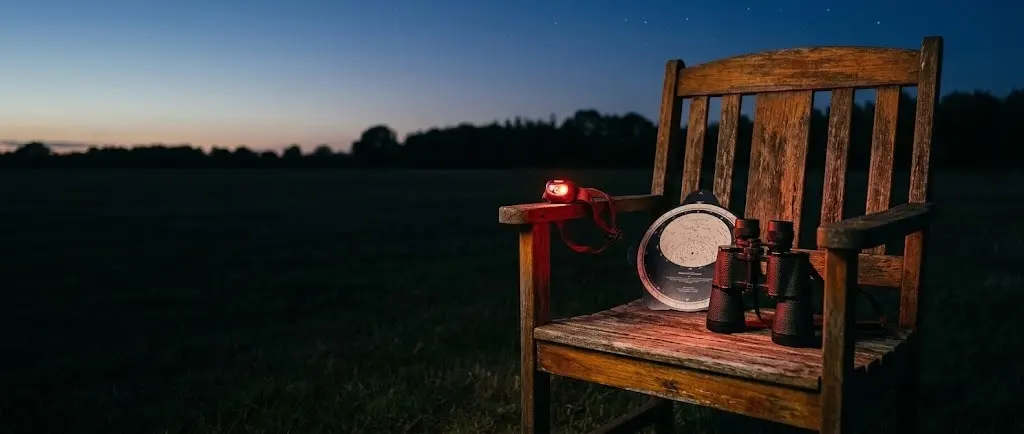
A pair of binoculars, a red torch and a dark corner of the yard. The Moon, Jupiter's moons and a few famous clusters are all there the first clear night.
What it is like
Stargazing with binoculars is the hobby most people think needs a telescope. It does not. A pair of 10x50 binoculars shows the craters of the Moon, the moons of Jupiter, the great clusters and the nearest galaxy, and it shows them with a wide field that makes finding things easy and the sky feel large. A star wheel or an app does the navigation.
It is a slow, cheap, seasonal hobby. The sky changes through the year, so there is always something that is only visible now, and learning it is a matter of a few evenings a month over a couple of years. Many people never buy a telescope; those who do, having learned the sky with binoculars first, buy the right one.
The sky is a calendar as much as a map. Because Earth moves around the Sun, different constellations fill the evening sky in each season - Orion in winter, the Summer Triangle in summer - while the planets wander slowly along their own path and the Moon cycles through its phases every month. Learning the sky is really learning that rhythm, so that each clear night has its own short list of things worth looking for.
Binoculars are the perfect teacher because they show a wide piece of sky. It is easy to start from a bright star you can see with your eyes and hop to a cluster beside it, and the view is right way up and natural. Many stargazers keep their binoculars long after buying a telescope, for quick looks on a clear evening and for the big, sprawling objects that do not fit in a telescope’s narrow view.
- A session
- Thirty minutes to a few hours, after twenty minutes of dark adaptation.
- A week
- Whenever the sky is clear and the Moon is out of the way for faint objects.
- Season
- All year; winter nights are long and clear, summer nights warm but short.
Outdoors · Solo, For two, With kids, A club
Kinds and styles
Constellations, bright stars, planets and meteor showers with nothing but dark-adapted eyes and a star wheel.
Wide, bright views of the Moon, Jupiter's moons, clusters and nearby galaxies - the approach on this page.
A Dobsonian or other telescope for planets' details, faint galaxies and double stars.
Working through the 110 Messier objects, a classic list for amateurs.
Reclining under a dark sky on peak nights such as the Perseids in August.
Variable star estimates, sky brightness counts and other observations shared with professionals.
Is it for you?
You will probably love it if
- You like quiet, slow attention and a little reading
- You can get somewhere darker than a city street, even a park edge
- You want a hobby that costs nothing after the first evening
Maybe not, if
- You go to bed early and live where it is light until ten in summer
- You want pictures; astrophotography is a separate and expensive hobby
- Cold, damp evenings are a hard no
What to buy first
- 0110x50 binocularsWide, bright and handheld; better than any cheap telescope for a first yearFind it on Amazonor at OpticsPlanet$52
- 02Red headlampRed light leaves your night vision alone; a phone screen wrecks itFind it on Amazon$21
- 03Planisphere (star wheel) for your latitudeDial the date and hour and it shows the sky; needs no battery or signalFind it on Amazon$9
- Everything you need to beginNothing to pay each month after that$82
Typical US prices for entry-level gear, rounded. Last checked October 2026. How we get the numbers
The Amazon links open a search for that type of item, not a product chosen for us, and the prices in the list are our typical figures, or the listing of the shop a line names, not Amazon's price for any listing. If you buy through one, or through a shop link in the same row, we may earn a commission at no extra cost to you; as an Amazon Associate we earn from qualifying purchases.
What to buy next
- 01Binocular tripod adapterSteady views with no shaking armsFind it on Amazon Longer sessions
- 02Star atlasDetailed charts for finding faint objectsFind it on Amazon Star hopping
- 03Reclining camp chairComfortable viewing overheadFind it on Amazon Meteor showers
- 04Dobsonian telescopeLarge aperture for the money and simple to useFind it on Amazon After a year of binoculars
- 05Moon mapNames craters, seas and mountainsFind it on Amazon Exploring the Moon
No prices here on purpose: these are later buys, and what to spend depends on how far the hobby has taken you. The Amazon links work like the ones above: a search for the type of item, and a possible commission for us at no extra cost to you.
From a first clear night to finding things on your own, step by step
Most of the sky's famous sights are within reach of binoculars. This guide goes from choosing the night and the gear to finding the Moon, a planet, a cluster and a galaxy, then to telescopes and star-hopping, with the choices at each step.
Warning: Before you start Never point binoculars or a telescope at the Sun, even near sunset; permanent eye damage is instant. Dark sites are remote: tell someone where you are, carry a torch and a charged phone, dress for a temperature ten degrees colder than forecast, and park where you can leave without lights blinding other observers.
A clear forecast, and ideally a Moon that is a crescent or absent. Give your eyes twenty minutes in the dark before you expect to see much.
Look along the line between light and dark. Craters and mountains stand out in relief there and nowhere else.
The star wheel or an app shows which planets are up. Jupiter in binoculars is a bright disc with up to four tiny moons in a line; they move night to night.
The Pleiades in autumn and winter, the Beehive in spring: fuzzy to the eye, a spray of stars in binoculars.
The Orion Nebula below the belt in winter; the Andromeda Galaxy in autumn, a faint oval smudge about 2.5 million light-years away. Rest the binoculars on a fence or a wall to steady them.
Four targets in binoculars
Each in a round binocular field, brightest first; not to scale with each other.
- A The Moon Along the terminator Craters in relief. Step 5 →
- B A planet Jupiter Up to four moons in a line. Step 5 →
- C A cluster Pleiades or Beehive A spray of stars. Step 6 →
- D A galaxy Andromeda, autumn A faint oval smudge. Step 7 →
Steps 1-3Gear and place
- Step 1 of 9 · Gear and place
Choose your optics
Wikipedia notes that binoculars give a wider field of view and are more portable than most telescopes - which makes them the easier start.
Most people: 10x50 binoculars (a first year).
Start here 10x50 binocularsBest forA first year
Wide, bright and handheld; rest them on a wall or fence to steady them.
Naked eye and a star wheelBest forNo budget
Constellations, bright stars, planets and meteor showers.
A cheap telescopeBest forNobody at first
Wobbly mounts and high magnification frustrate; binoculars first.
Not for a first try - Step 2 of 9 · Gear and place
Find a dark spot
Light pollution washes out faint objects, which is why many observers travel to rural areas (Wikipedia). The Bortle scale rates sky darkness from 1, an excellent dark site where the Milky Way casts shadows, to 9, an inner-city sky with little beyond the Moon, planets and the brightest clusters; in a class 7 suburban sky the Milky Way is nearly or totally invisible.
Most people: a dark corner of the yard (moon, planets, clusters).
Start here A dark corner of the yardBest forMoon, planets, clusters
Out of the direct glare of lights.
A rural siteBest forGalaxies and the Milky Way
Tell someone where you are and park so your headlights do not blind other observers.
- Step 3 of 9 · Gear and place
Bring a red light and a star wheel
Red light leaves night vision alone; a white phone screen wrecks it. A planisphere set for your latitude shows the sky for any date and hour, with no battery or signal.
Steps 4-7The night
- Step 4 of 9 · The night
Pick the night and adapt
A clear forecast and a Moon that is a thin crescent or below the horizon. Give your eyes twenty minutes in the dark before you expect to see much, and dress for colder than the forecast.
Goes wrong: Observing at full Moon. Moonlight hides faint objects; plan around the phase.
- Step 5 of 9 · The night
Start with the Moon and a planet
Warning: WARNING Never point binoculars or a telescope at the Sun, even near sunset: the eye damage is instant and permanent.
On the Moon, look along the line between light and dark: craters and mountains stand out in relief there. A star wheel or app shows which planets are up; Jupiter in binoculars is a bright disc with up to four tiny moons in a line, which move from night to night.
- Step 6 of 9 · The night
Find a cluster
The Pleiades in autumn and winter, the Beehive in spring: a fuzzy patch to the eye, a spray of stars in binoculars.
- Step 7 of 9 · The night
Find a nebula or galaxy
The Orion Nebula below Orion's belt in winter; the Andromeda Galaxy in autumn, a faint oval smudge about 2.5 million light-years away.
Goes wrong: Expecting photo colours. Nebulae and galaxies look grey and faint to the eye; that is normal.
Steps 8-9Going further
- Step 8 of 9 · Going further
Learn to find things yourself
Wikipedia describes the two ways amateurs locate objects.
Most people: star hopping (learning the sky).
Start here Star hoppingBest forLearning the sky
Following a chart from a bright landmark star to the target.
GoTo telescopeBest forShort sessions
Points itself at a chosen object after calibration.
- Step 9 of 9 · Going further
Choose where to go next
After a year of binocular nights, observers branch out.
Most people: the Messier list (a goal).
A Dobsonian telescopeBest forFaint objects
A reflector on a simple base: a lot of mirror for the money.
Start here The Messier listBest forA goal
A classic catalogue of 110 objects for amateurs to work through.
Citizen scienceBest forUseful observations
Amateurs monitor variable stars, double stars and sunspots and have discovered comets and novae (Wikipedia).
In shortIf it goes wrong
- Observing at full Moon.
- Step 4 · Pick the night and adapt
- Expecting photo colours.
- Step 7 · Find a nebula or galaxy
How you get better
- First clear nightFive objects
The Moon, a planet, a cluster, a nebula or galaxy, all in binoculars.
- First monthConstellations
The main constellations of the season and star hopping from them.
- Months 2 to 6Seasons and showers
Objects of each season, a meteor shower, and following Jupiter's moons night to night.
- Months 6 to 12Messier objects and a club
Ticking off Messier objects, star parties and looking through other people's telescopes.
- After thatA telescope
A Dobsonian or similar scope bought with knowledge, and perhaps citizen science.
- Reading a star wheel
- Dark adaptation
- Finding constellations
- Star hopping
- Steadying binoculars
- Averted vision
- Moon phases and planning
- Identifying planets
- Using a star chart or app
- Logging observations
- Choosing a dark site
- Weather and seeing
Small things that help
- Give your eyes twenty minutes in the dark.
- Use red light only.
- Check the Moon phase; faint objects need a dark sky.
- Rest binoculars on a fence, wall or tripod.
- Look slightly to the side of faint objects to see them better.
- Dress warmer than you think.
Beginner mistakes
- 01Buying a cheap telescope firstWobbly mounts and high magnification frustrate. Binoculars first.
- 02Using a white phone screenIt wipes out night vision. Red mode or red light.
- 03Expecting photo colorsNebulae and galaxies look gray and faint to the eye. That is normal.
- 04Looking during a full MoonMoonlight hides faint objects. Plan around the phase.
- 05Pointing at the SunNever. It causes instant eye damage.
What binoculars show, by season
Northern hemisphere, evening sky. All of these are easy from a suburban yard; the galaxy wants a dark one.
| Object | When | What you see |
|---|---|---|
| The Moon | Any month, around first quarter | Craters along the terminator, mountains, dark plains |
| Jupiter and its four moons | Whenever it is up | A bright disc with tiny moons in a line |
| The Pleiades (M45) | Autumn and winter | A tight bright cluster, dozens of stars |
| The Orion Nebula (M42) | Winter | A glowing patch with stars inside it |
| The Beehive cluster (M44) | Spring | A loose swarm of stars |
| The Milky Way in Sagittarius | Summer, dark site | Star clouds and dark lanes |
| The Andromeda Galaxy (M31) | Autumn | A faint elongated glow |
Why people quit
- 01The department-store telescopeA wobbly tripod and useless magnification have ended more astronomy hobbies than cloud. Binoculars first, then a Dobsonian if you still want more.
- 02Not knowing where to lookThe sky is big and most of it is empty. The star wheel or a free app, used for ten minutes before going out, turns a blank sky into a map.
- 03Cloud and coldClear, dark and warm rarely coincide. A thermos, a reclining chair and a blanket keep the hobby alive through winter, which is the best season.
Words you will meet
- Planisphere
- A star wheel that shows the sky for any date and time.
- Dark adaptation
- The eyes adjusting to darkness over twenty minutes or more.
- Averted vision
- Looking slightly to the side to see faint objects.
- Messier object
- One of the 110 objects on the Messier list: 103 from Charles Messier's own catalog of 1781, the rest added later from his notes.
- Nebula
- A cloud of gas and dust in space.
- Cluster
- A group of stars born together.
- Terminator
- The line between light and dark on the Moon.
- Star hopping
- Finding objects by stepping from known stars.
- Dobsonian
- A simple, stable telescope mount design.
- 10x50
- Binoculars with 10x magnification and 50 mm lenses.
Questions people ask
Do I need a telescope?
No. Binoculars show the Moon's craters, Jupiter's moons, star clusters and the Andromeda Galaxy.
Can I stargaze from a city?
Yes, for the Moon, planets and bright clusters; Jupiter's moons show in binoculars even with light pollution.
What binoculars are best?
10x50 or 7x50 binoculars are a classic balance of brightness and steadiness.
When is the best time to stargaze?
Clear nights away from the full Moon; winter nights are long, summer ones warmer.
What can I contribute as an amateur?
Amateurs help monitor variable stars and have discovered comets and supernovae.
Where to go next
- 01BirdwatchingThe same binoculars by daylight, and the same habit of noting what you saw. $161 to start
- 02Film photographyLong exposures of the night sky are a classic film project. $193 to start
How it compares
| Stargazing | Birdwatching | Geocaching | Backpacking | |
|---|---|---|---|---|
| Start cost | $82 | $161 | Free | $660 |
| Each month | Free | Free | $3 | $10 |
| Space | A dark backyard | Anywhere outside | The whole town | Trails, and a closet for gear |
| Noise | Quiet | Quiet | Quiet | Quiet |
| First result | One clear night | Same day | The first find | 1 weekend |
| Mess | None | None | None | None |
Where to learn more
- 01NASA Night Sky NetworkFind astronomy clubs and star parties near you, with observing guides.
Sources: NASA Night Sky Network · Wikipedia, Galilean moons · Wikipedia, Messier object · Wikipedia, Amateur astronomy · Wikipedia, Andromeda Galaxy · Wikipedia, Bortle scale
Researched and written by the Fjords Team.