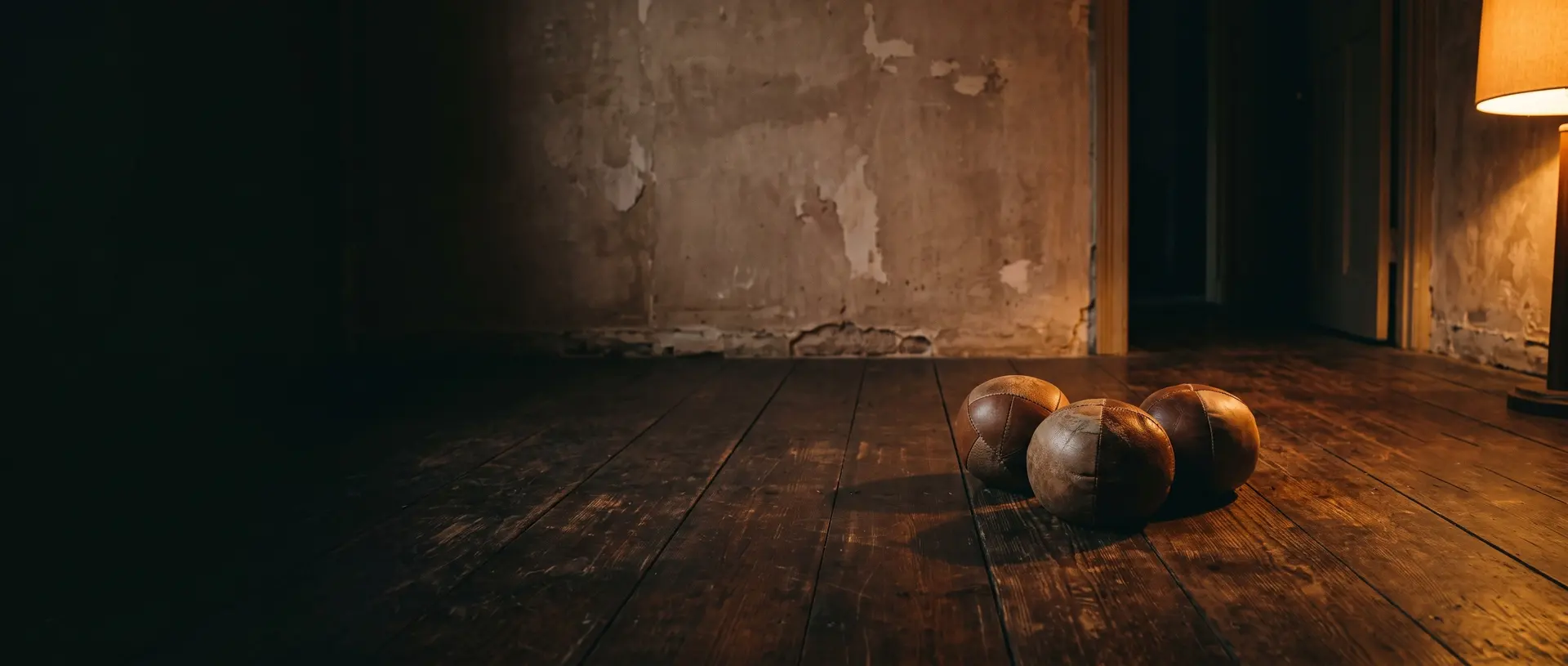
 AI illustration
Juggling
Three beanbags, a patch of floor and a wall to stand near. A ten-catch cascade comes in a weekend, and nothing else is ever needed.
What it is like
Juggling three balls is a single pattern, the cascade, learned in a fixed order of steps that most teachers use: one ball, two balls, a flash of three, and then the pattern continues. For many adults it takes a weekend of short sessions to reach ten catches and a few weeks to reach a hundred.
It is the cheapest skill hobby on the site and the most portable. A set of beanbags lives in a coat pocket, practice happens in the gaps of a day, and progress is visible almost every session, which is a rare and pleasant thing for an adult to feel. Beyond the cascade lies a lifetime of tricks, clubs and rings, none of which you ever have to learn.
The three-ball cascade is a figure eight lying on its side. Each ball crosses from one hand to the other and peaks at about eye level, and a new throw goes up only when the incoming ball reaches the top of its arc. Once that rhythm clicks the pattern keeps itself going, which is why the learning sequence builds it piece by piece - one ball for the arc, two for the exchange, three thrown once for the flash - before the cascade continues.
After that the hobby opens up in every direction. Tricks change where and how balls are thrown, clubs add spin, passing adds a partner, and more balls add speed and height. Jugglers even have their own notation, siteswap, which writes patterns as numbers and has been used to discover new ones. None of it is required: plenty of people keep three beanbags on the desk for years and are happy just keeping them in the air.
- A session
- Five to fifteen minutes is ideal; several short sessions a day beat one long one.
- A week
- A few minutes most days.
- Season
- All year, indoors or out.
Indoors or out · Solo, With kids, For two
Kinds and styles
Beanbags and stage balls, from the three-ball cascade to tricks and more balls. Where nearly everyone starts.
Spinning clubs thrown in the same patterns; heavier and showier, and the classic for passing.
Flat rings that fly edge-on and stack well for high numbers.
Two or more jugglers throwing to each other - one of the most social sides of the hobby.
Rolling a clear ball over hands and arms without throwing it.
Related skill toys: a spool spun on a string, or a stick tapped between two hand sticks.
Is it for you?
You will probably love it if
- You want a skill that shows progress by the day
- You like practice in five-minute bursts while the kettle boils
- You want something to do with restless hands and a restless mind
Maybe not, if
- You are easily frustrated by dropping things a few hundred times
- Your shoulders or wrists do not like repetitive overhead movement
- You want an audience; juggling for others is a different and harder hobby
What to buy first
- 01Set of three beanbag juggling ballsBeanbags do not roll away when dropped, which is most of the first weekFind it on Amazon$20
- Everything you need to beginNothing to pay each month after that$20
Typical US prices for entry-level gear, rounded. Last checked October 2026. How we get the numbers
The Amazon links open a search for that type of item, not a product chosen for us, and the prices in the list are our typical figures, or the listing of the shop a line names, not Amazon's price for any listing. If you buy through one we may earn a commission at no extra cost to you; as an Amazon Associate we earn from qualifying purchases.
What to buy next
- 01Stage or thud ballsLarger, softer balls for tricks and performingFind it on Amazon After the cascade is solid
- 02Juggling clubsThree clubs for spinning throws and passingFind it on Amazon A few months in
- 03Extra beanbagsMatching balls for higher numbersFind it on Amazon Trying four and five
- 04DiaboloA different skill with a similar learning curveFind it on Amazon A second skill toy
- 05Juggling ringsEdge-on throws and numbers jugglingFind it on Amazon Exploring props
No prices here on purpose: these are later buys, and what to spend depends on how far the hobby has taken you. The Amazon links work like the ones above: a search for the type of item, and a possible commission for us at no extra cost to you.
Juggling balls compared
Three ball lines from one maker, Gballz, in the sizes and weights it lists. Size is the diameter in inches.
| Model | Type | Specs | Who it suits | Links |
|---|---|---|---|---|
| Gballz E8 | 8-panel beanbag, millet filled | Ultraleather; sizes from 1.8 in at 70 g (mini) through 2.5 in at 100 g, 2.7 in at 130 g and 3.0 in at 180 g, up to 3.7 in at 315 g; custom-made to order, with a heavier fill available at the same size | Choosing a size and weight to suit your hands | Find it on AmazonMaker's page |
| Gballz E8 Pro | 8-panel beanbag, plastic filled | Like the E8 but with a lighter plastic filling; 2.5 in at 85 g to 3.0 in at 155 g | A lighter ball of the same size | Find it on AmazonMaker's page |
| Gballz N8 Pro | 8 triangular panels, plastic resin filled | A 'saggy' beanbag in small (2.3 in, 70 g), medium (2.5 in, 110 g) and large (2.7 in, 130 g); Gballz pitches it for numbers juggling and for learning one more ball | Moving on to four and five balls | Find it on AmazonMaker's page |
How we put this together. All figures come from Gballz's own product pages, read on 26 October 2026; no prices, because they change (Gballz prices the N8 Pro per ball). We have not juggled them side by side. Checked on 26 October 2026. There are no prices in this table: the Amazon link searches for the exact model, and we may earn a commission if you buy through it.
From one ball to the three-ball cascade, and beyond, step by step
The three-ball cascade is where nearly everyone starts: Wikipedia calls it possibly the simplest juggling pattern to execute. This guide breaks it into the steps jugglers teach, then shows where to go next.
Warning: Before you start Nothing here is dangerous. Warm up the shoulders, stop when the wrists complain, and keep the balls away from the good lamp.
Throw from one hand to the other in an arc that peaks at eye level. Elbows at your sides, hands at waist height. A hundred throws, both directions.
One in each hand. Throw the right; when it peaks, throw the left under it. Catch, catch. The second throw is the whole trick; most people throw it too early.
Two in the right hand, one in the left. Throw right, left, right as each one peaks. Three throws, three catches, then stop. Do it fifty times.
After the third throw, just keep throwing whichever hand has a ball at the moment the incoming ball peaks. Count catches. Ten is the goal.
If the balls drift forward, face a wall a foot away. It forces the throws back into the plane in front of your chest.
The three-ball cascade
From the front, at the moment one ball peaks and the other hand throws under it.
- A Peak About eye level Every throw the same height. Step 2 →
- B Catch On the outside Then carry it in and throw again. Step 5 →
- C Throw From the inside As the incoming ball peaks, throw under it. Step 3 →
Step 1Gear
- Step 1 of 9 · Gear
Choose what to throw
Three of the same thing, the size of a small orange and soft enough not to roll.
Most people: beanbags (learning).
Start here BeanbagsBest forLearning
They do not roll away when dropped, which is most of the first week.
Stage ballsBest forPerforming
Bouncier and brighter; they roll.
RingsBest forHigh numbers
Flat rings thrown edge-on, which stack well when juggling many.
ClubsBest forLater
The same patterns with spin added; heavier, and they hurt when caught wrong.
Not for a first try
Steps 2-6The cascade
- Step 2 of 9 · The cascade
Throw one ball
Throw from one hand to the other in an arc that peaks at about eye level, elbows at your sides and hands at waist height. A hundred throws, both ways, until the arc is the same every time.
Goes wrong: Throwing too low. A low throw leaves no time for the next one; a higher arc slows everything down.
- Step 3 of 9 · The cascade
Exchange two balls
One ball in each hand. Throw the right; when it reaches the top of its arc, throw the left underneath it. Catch, catch. The second throw is the whole trick.
Goes wrong: Throwing too early. The second ball goes before the first has peaked; wait for the top.
- Step 4 of 9 · The cascade
Do the flash
Two balls in the right hand, one in the left. Throw right, left, right, each one as the previous ball peaks, then catch all three and stop. Fifty times.
- Step 5 of 9 · The cascade
Keep it going: the cascade
After the third throw, keep throwing from whichever hand holds a ball when the incoming ball peaks. In Wikipedia's description of the cascade, each hand alternately sends throws of equal height to the opposite hand, and balls are caught on the outside of the throws. Count catches; ten is the first goal.
Goes wrong: Grabbing at catches. Reaching up snatches the pattern apart; let the balls drop into your hands.
- Step 6 of 9 · The cascade
Stop the drift
Balls that drift forward have you chasing them across the room. Stand facing a wall a foot away: it keeps every throw in the flat plane in front of your chest.
Goes wrong: Marathon sessions. Tired hands learn bad habits; short, frequent practice works better.
Steps 7-9Beyond the cascade
- Step 7 of 9 · Beyond the cascade
Learn a trick
Wikipedia describes the classic three-ball patterns that come after the cascade.
Most people: reverse cascade (the first trick).
Start here Reverse cascadeBest forThe first trick
The cascade with the balls caught on the inside instead of the outside.
ShowerBest forA circle
One hand throws high to the other, which passes the ball straight back across - often the pattern non-jugglers try first.
ColumnsBest forVertical patterns
Balls go straight up and down; the two outside balls thrown together, the middle one between.
Mills' MessBest forA showpiece
The arms cross and uncross as the balls go through the middle; named after Steve Mills.
- Step 8 of 9 · Beyond the cascade
Write patterns down
Jugglers note patterns in siteswap. Each number is how many beats a ball stays in the air before it is thrown again: odd numbers cross to the other hand, even numbers come back to the same hand, and the average of the numbers is the number of balls. The cascade is 3; 441 is another three-ball pattern, since (4+4+1)/3 = 3 (Wikipedia).
- Step 9 of 9 · Beyond the cascade
Find other jugglers
Juggling clubs and conventions are where tricks spread and where passing - two or more people throwing to each other - is learned. The International Jugglers' Association runs a festival and lists events.
In shortIf it goes wrong
- Throwing too low.
- Step 2 · Throw one ball
- Throwing too early.
- Step 3 · Exchange two balls
- Grabbing at catches.
- Step 5 · Keep it going: the cascade
- Marathon sessions.
- Step 6 · Stop the drift
How you get better
- First weekendTen catches
One ball, two balls, the flash, then the cascade running.
- First monthA hundred catches
Steady throws at one height, and juggling while walking or turning.
- Months 2 to 4First tricks
Reverse cascade, columns, over the top and under the leg.
- Months 4 to 12Clubs or passing
Three clubs, or passing patterns with a friend or a juggling club.
- After thatMore objects and siteswaps
Four and five balls, siteswap patterns, and juggling conventions.
- Clean single throws
- The two-ball exchange
- The flash
- The three-ball cascade
- Consistent throw height
- Recovering from bad throws
- Reverse cascade
- Columns
- Over the top
- Under the leg
- Mills mess
- Four and five balls
Small things that help
- Throw to eye height, every time.
- Watch the top of the arcs, not your hands.
- Practice over a bed or sofa so drops are easy to pick up.
- Count catches to see progress.
- Stop while it is still going well; the hands learn between sessions.
- Stand facing a wall if the balls drift forward.
Beginner mistakes
- 01Throwing too earlyThe second throw goes before the first has peaked. Wait for the top.
- 02Throwing forwardBalls drift away and you chase them. Keep throws in a flat plane in front of you.
- 03Throwing too lowLow throws give no time. Higher arcs slow everything down.
- 04Grabbing at catchesReaching up snatches the pattern apart. Let balls drop into your hands.
- 05Marathon sessionsTired hands learn bad habits. Short, frequent practice is better.
The ladder, and roughly how long each rung takes
| Stage | What it is | Typical time |
|---|---|---|
| One ball | Clean arcs at eye height, both ways | 10 minutes |
| Two balls | Exchange: throw, throw, catch, catch | An hour, over a day or two |
| Flash | Three throws, three catches, stop | A day |
| Cascade, 10 catches | The pattern runs | A weekend |
| Cascade, 100 catches | You are a juggler | Two to four weeks |
| First tricks | Over the top, under the leg, columns | Months, happily |
Why people quit
- 01Throwing too fastNearly every early failure is a second throw that goes before the first has peaked. Higher, slower throws give the hands time.
- 02Chasing ballsPractice over a bed or a sofa and the drops land where you can reach them. Beanbags help; bouncy balls punish.
- 03Long sessionsTen minutes, three times a day beats an hour on Sunday. The hands learn between sessions.
Words you will meet
- Cascade
- The basic pattern for an odd number of balls, each crossing between hands.
- Fountain
- The basic pattern for an even number, each hand juggling separately.
- Flash
- Throwing and catching each ball once.
- Exchange
- Throwing a ball and catching the one coming in.
- Reverse cascade
- A cascade with balls thrown over the top instead of from the inside.
- Columns
- Balls going straight up and down instead of crossing.
- Passing
- Throwing objects between jugglers.
- Siteswap
- A number notation for juggling patterns.
- Drop
- Every juggler's constant companion.
Questions people ask
How long does it take to learn to juggle?
Many people get ten catches of the three-ball cascade within a weekend of short sessions; a steady hundred can take a few weeks.
Which balls should I buy?
Beanbag balls: they do not bounce or roll away.
Is juggling good for kids?
Yes. Start with scarves or beanbags and short sessions.
Can I learn alone?
Yes, although juggling clubs and conventions are a great way to learn tricks and passing.
What comes after three balls?
Tricks with three, then clubs, rings, passing or more balls - there is no end.
Where to go next
- 01SlackliningBalance practice with the same short, frequent sessions - and some people juggle on the line. $66 to start
- 02Decorative knotsAnother skill of the hands learned by repetition, with a whole notation of its own. $11 to start
How it compares
| Juggling | Slacklining | Decorative knots | Bouldering | |
|---|---|---|---|---|
| Start cost | $20 | $66 | $11 | $47 |
| Each month | Free | Free | $3 | $80 |
| Space | A patch of floor | Two trees | Your lap | A climbing gym |
| Noise | Low | Quiet | Quiet | Quiet |
| First result | A weekend to ten catches | First steps the same afternoon | 1 evening | One session |
| Mess | None | None | None | Chalk |
Where to learn more
- 01International Jugglers' AssociationThe oldest juggling organization, with festivals, competitions and learning resources.
Sources: International Jugglers' Association · Wikipedia, Juggling (history) · Wikipedia, International Jugglers' Association · Wikipedia, Siteswap · Wikipedia, Juggling pattern
Researched and written by the Fjords Team.