 AI illustration
Rock collecting
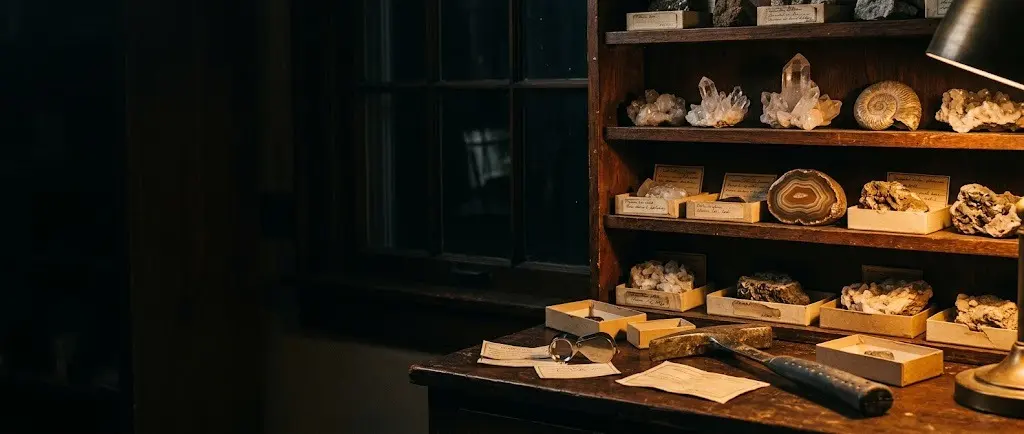
A hammer, a hand lens and a field guide. Rockhounding turns every beach, cutting and creek bed into a place to look down.
What it is like
Rock collecting, or rockhounding, is looking for and keeping interesting rocks, minerals and fossils, and then working out what they are. The finding happens on beaches, in creek beds, at road cuts and at sites the local club knows; the identifying happens at the kitchen table with a hand lens, a knife, a tile and a field guide. A labeled shelf of fifty specimens from places you have been is a kind of travel diary.
The appeal is attention. Once you have learned to see a quartz vein or a fossil shell in a wall of gray, you cannot stop seeing them, and a dull walk becomes a search. The rules about where you may collect are the one real piece of homework, and a local club, which most areas have, is the fastest way to learn them and the best way to find sites.
Identification is detective work with a few simple tests. Hardness on the Mohs scale says which minerals can scratch which; the streak on an unglazed tile shows a mineral’s true powder color, which can differ completely from its surface; luster, the way a surface shines, separates metallic from glassy, pearly or dull; and cleavage shows whether it splits along flat planes. Put together with where the stone was found, these narrow most finds down to a short list in a regional field guide.
Collections grow in character as much as in size. Some people sort by place, some by mineral family, some chase one kind of thing - agates, crystals, fossils or glowing minerals under UV light. A small numbered label with the locality turns every stone into a record of a day outdoors, and local clubs and gem and mineral shows are where those records get compared, traded and, now and then, corrected.
- A session
- A morning or afternoon at a beach, creek or road cut; an evening of identifying.
- A week
- A trip every week or two, plus identifying and labeling at home.
- Season
- All year; after rain and in winter storms new stones are exposed.
Indoors or out · Solo, For two, With kids, A club
Kinds and styles
Quartz points, calcite, pyrite and garnets - identified by hardness, streak, luster and crystal shape.
Shells, plants and trace fossils from sedimentary rock, where collecting rules allow.
Agates, jasper and polished pebbles from gravel bars and shorelines.
Tumbling, cutting and polishing your finds into smooth stones and cabochons.
Tiny perfect crystals collected and studied under a microscope.
Specimens that glow bright colors under ultraviolet light.
Is it for you?
You will probably love it if
- You already pick up interesting stones and feel guilty leaving them
- You like identification: keys, tables, a hand lens and a little chemistry
- You want a hobby that makes a dull drive interesting at every road cut
Maybe not, if
- You have no shelf space and no tolerance for boxes of rocks in the hall
- The rules about where you may collect feel like too much to learn
- You want gemstones; most of what you find is common and that is the point
What to buy first
- 01Rock hammerA geologist's hammer with a pick end; a carpenter's hammer can shatterFind it on Amazon$44
- 02Safety glassesRock chips fly; every hammer blow needs themFind it on Amazon$5
- 0310x hand lensCrystal faces, grain and fossils appear at ten timesFind it on Amazon$10
- 04A field guide to the rocks and minerals of your regionLocal is better than a world guide; it tells you what is likelyFind it on Amazon$24
- Everything you need to beginNothing to pay each month after that$83
Typical US prices for entry-level gear, rounded. Last checked October 2026. How we get the numbers
The Amazon links open a search for that type of item, not a product chosen for us, and the prices in the list are our typical figures, or the listing of the shop a line names, not Amazon's price for any listing. If you buy through one we may earn a commission at no extra cost to you; as an Amazon Associate we earn from qualifying purchases.
What to buy next
- 01Streak plate and hardness kitReference points for the Mohs scaleFind it on Amazon Identifying
- 02Specimen boxes and labelsKeeps each find with its number and localityFind it on Amazon As the collection grows
- 03Rock tumblerTurns rough stones into smooth, shiny ones over weeksFind it on Amazon Polishing finds
- 04UV flashlightReveals glowing minerals at nightFind it on Amazon Fluorescent minerals
- 05Collecting bag and chiselCarries finds and trims samples safelyFind it on Amazon Field trips
- 06Stereo microscopeDetail a hand lens cannot showFind it on Amazon Small crystals
No prices here on purpose: these are later buys, and what to spend depends on how far the hobby has taken you. The Amazon links work like the ones above: a search for the type of item, and a possible commission for us at no extra cost to you.
Rock tumblers compared
Five rotary tumblers from two makers, from a starter kit to a 12 lb barrel, plus a grit kit. Barrel size is what each maker states; Wikipedia advises loading stones of similar or the same hardness.
| Model | Type | Specs | Who it suits | Links |
|---|---|---|---|---|
| Lortone 3A Rock Tumbling Kit | Starter kit | A model 3A tumbler with Lortone's 4-step polish kit, plastic pellets, rough stone and an instruction booklet; Lortone pitches it as an introduction to tumbling | A first tumble with everything in one box | Find it on AmazonMaker's page |
| Lortone 33B | Rotary tumbler, two barrels | Twin 3 lb rubber barrels on an upgraded drive, so two batches (or two grit stages) run at once; base 6.25 x 10.25 in; needs oiling | Running two stages side by side | Find it on AmazonMaker's page |
| Lortone QT6 | Rotary tumbler, one barrel | A single 6 lb all-rubber barrel on a sturdy drive | Bigger batches from one barrel | Find it on AmazonMaker's page |
| Thumler's Tumbler A-R12 | Rotary tumbler, made in USA | 12 lb hexagon rubber barrel; overload protection, continuous-duty fan-cooled motor; Thumler's calls it quiet | The serious hobbyist, by the maker's own description | Find it on AmazonMaker's page |
| Thumler's Tumbler Model B | Heavy-duty rotary tumbler, made in USA | Commercial-grade; processes about 10 lb of rock; metal barrel with a 1/4 in rubber liner for quiet running; thermally protected motor | Large batches | Find it on AmazonMaker's page |
| Lortone 4-Step Abrasive and Polish | Grit kit | Coarse and fine silicon carbide abrasives and aluminum oxide polish, enough for up to 14 lb of rock | Refilling the grit for any tumbler | Find it on AmazonMaker's page |
How we put this together. All details come from the makers' own product pages (Lortone and Thumler's Tumbler), read on 26 October 2026; no prices, because they change. We have not run these tumblers side by side. The tumbling steps in the FAQ below are Wikipedia's (Tumble finishing). Checked on 26 October 2026. There are no prices in this table: the Amazon link searches for the exact model, and we may earn a commission if you buy through it.
From a first legal site to a labelled collection, step by step
Rockhounding is knowing where you may collect, looking carefully and writing down where each stone came from. This guide goes from the land rules to field tests and labels, with the choices at each step. Rules are US ones; check the land manager wherever you are.
Warning: Before you start Wear safety glasses for every hammer blow, and gloves for sharp rock. Stay off unstable slopes and never undercut a cliff or a quarry face; loose rock above you kills. Quarries and mines are entered only with permission and a guide. Know the land: collecting is banned in national parks and many state parks, casual collecting of small amounts is allowed on most Bureau of Land Management and national forest land, and private land needs the owner's permission. Fossils of vertebrates are protected on public land. Children collect with an adult, and keep small specimens away from toddlers.
A public beach, a creek gravel bar, a road cut on a quiet public road, or a site your local rock club lists. National parks are off limits; private land needs the owner's yes.
Most good finds are loose on the surface after rain. Turn stones, look at broken faces, and use the hammer only to trim or to open a likely rock.
Scratch with a fingernail, a copper coin, a steel knife: that gives hardness. Rub on an unglazed tile for the streak color. Look at the fracture with the lens.
Each specimen in its own bag with a slip: where, when, what you think it is. A rock without a place is just a rock.
Warm water and an old toothbrush. Write a small numbered label, keep a notebook or a spreadsheet with the number, and the shelf becomes a collection.
The Mohs scale in the field
The ten reference minerals, and the everyday tools placed at their hardness.
- A Streak tile About 7 Unglazed porcelain; shows the powder colour. Step 5 →
- B Glass 5.5 Quartz (7) scratches it. Step 4 →
- C Steel knife 4-4.5 Ordinary steel. Step 4 →
- D Copper 2.5-3 Copper is 2.5-3. Step 4 →
- E Fingernail Above gypsum Scratches talc and gypsum. Step 4 →
Steps 1-2Before you go
- Step 1 of 9 · Before you go
Find a legal spot
The Bureau of Land Management generally allows the public to collect reasonable amounts of rocks, mineral specimens and semiprecious stones on its land for non-commercial use - but generally not on developed recreation sites, on active mining claims or where the mineral rights are private, and its local offices can add restrictions. National parks forbid collecting; private land needs the owner's yes.
Most people: beaches and creek gravel bars (first trips).
Start here Beaches and creek gravel barsBest forFirst trips
Loose, washed stones in plain view - agates, jasper, quartz.
A rock club field tripBest forGood sites, with permission
Clubs arrange access and know what is there.
Road cutsBest forSeeing the bedrock
Only quiet public roads, well off the traffic.
Goes wrong: Collecting where it is banned. Check before every new site.
- Step 2 of 9 · Before you go
Pack the kit
Warning: CAUTION Wear safety glasses for every hammer blow: rock chips fly. Stay off unstable slopes and never work under an overhang or a quarry face.
A geologist's hammer with a pick end, safety glasses, a 10x hand lens, gloves, bags and slips of paper, and a field guide to your own region - it tells you what is likely.
Steps 3-6In the field
- Step 3 of 9 · In the field
Look before you hit
Most good finds lie loose on the surface, especially after rain. Turn stones over, look at broken faces, and use the hammer only to trim or to open a likely rock.
Goes wrong: Hammering everything. It ruins more than it finds.
- Step 4 of 9 · In the field
Test the hardness
The Mohs scale ranks minerals from talc (1) to diamond (10), with quartz at 7. Scratch tests place an unknown mineral on it: Wikipedia lists copper at 2.5-3, ordinary steel at 4-4.5 and glass at 5.5. Try a fingernail, then a copper coin, then a steel knife; whatever scratches the mineral is harder than it.
- Step 5 of 9 · In the field
Do a streak test
Drag the mineral across an unglazed porcelain tile. The powder's colour is more consistent than the colour of the specimen, which impurities change - hematite looks black but leaves a red streak (Wikipedia). The tile is about 7 on the Mohs scale, so harder minerals leave no streak.
- Step 6 of 9 · In the field
Bag and note on the spot
Each specimen in its own bag with a slip: where, when, and what you think it is.
Goes wrong: Unlabelled finds. A specimen without its locality loses most of its interest.
Steps 7-9At home
- Step 7 of 9 · At home
Clean gently
Warm water and an old toothbrush first. Anything stronger only once you know what the mineral is.
Goes wrong: Over-cleaning. Harsh chemicals and wire brushes ruin crystals.
- Step 8 of 9 · At home
Number and catalogue
A small numbered label on each specimen and the same number in a notebook or spreadsheet with the place, date and identification. That is what turns a shelf of stones into a collection.
- Step 9 of 9 · At home
Choose a specialty
Most collectors drift towards one kind of stone.
Most people: minerals and crystals (identification).
Start here Minerals and crystalsBest forIdentification
Quartz, calcite, pyrite, garnet - hardness, streak and crystal shape.
LapidaryBest forMaking things
Tumbling, cutting and polishing finds.
FossilsBest forSedimentary rock
Shells and plants where rules allow; vertebrate fossils are protected on public land.
Fluorescent mineralsBest forNight displays
Specimens that glow under ultraviolet light.
In shortIf it goes wrong
- Collecting where it is banned.
- Step 1 · Find a legal spot
- Hammering everything.
- Step 3 · Look before you hit
- Unlabelled finds.
- Step 6 · Bag and note on the spot
- Over-cleaning.
- Step 7 · Clean gently
How you get better
- First tripTen labeled specimens
A legal site, a bag and note for each find, and identification at home.
- First monthTests and a catalog
Hardness, streak and luster on every specimen, and a numbered notebook or spreadsheet.
- Months 2 to 4A local club
Field trips to club sites, shows, and help identifying puzzling finds.
- Months 4 to 12A focus
Fossils, agates, crystals or one region, and a better hand lens or microscope.
- After thatLapidary or specialization
A tumbler or cutting, micromounts, fluorescent minerals or trading with other collectors.
- Knowing where collecting is allowed
- Reading the landscape
- Safe hammer use
- Hardness testing
- Streak testing
- Luster and cleavage
- Using a hand lens
- Field notes
- Cleaning specimens
- Labeling and cataloging
- Identifying fossils
- Tumbling and polishing
Small things that help
- Find out who owns the land before you collect.
- Look after rain, when fresh stones are washed clean.
- Take only what you will label.
- Test hardness on a fresh surface.
- Wear safety glasses for every hammer blow.
- Join a local club for sites and help with identification.
Beginner mistakes
- 01Collecting where it is bannedNational parks and many protected areas forbid it. Check first.
- 02Unlabeled findsA specimen without a locality loses most of its interest.
- 03Hammering everythingMost good finds are loose. Use the hammer sparingly.
- 04Working under unstable facesLoose rock above you is dangerous. Stay away from overhangs.
- 05Over-cleaningHarsh chemicals and wire brushes can ruin crystals. Start with water and a soft brush.
The Mohs scale, with things in your pocket
A mineral scratches anything softer than itself. Test on a fresh face, not a weathered one.
| Hardness | Mineral | Scratched by |
|---|---|---|
| 1 | Talc | A fingernail, easily |
| 2 | Gypsum | A fingernail (about 2.5) |
| 3 | Calcite | A copper coin (about 3.5) |
| 4 | Fluorite | A steel knife, easily |
| 5 | Apatite | A steel knife (about 5.5), with effort |
| 6 | Orthoclase feldspar | A steel file; scratches glass |
| 7 | Quartz | Scratches steel and glass easily |
| 8 | Topaz | Only harder minerals |
| 9 | Corundum | Only diamond |
| 10 | Diamond | Nothing else |
Why people quit
- 01Collecting everythingA bucket of unlabeled gray rocks is a burden, not a collection. Take fewer, write more.
- 02Not knowing the rulesA fine for collecting in a protected area ends the hobby fast. Learn who owns the ground before the hammer comes out; the local club knows.
- 03Chasing treasureGold, gems and museum fossils are rare and mostly on claimed or protected land. Enjoy the quartz.
Words you will meet
- Mineral
- A naturally occurring solid with a definite chemistry and crystal structure.
- Rock
- A mixture of one or more minerals.
- Mohs scale
- The 1 to 10 scratch-hardness scale for minerals.
- Streak
- The color of a mineral's powder on an unglazed tile.
- Luster
- How a mineral's surface reflects light.
- Cleavage
- The way some minerals split along flat planes.
- Road cut
- Rock exposed where a road was cut through a hill.
- Locality
- Where a specimen was found.
- Lapidary
- Cutting and polishing stones.
- Fossicking
- The Australian and New Zealand word for amateur rock collecting.
Questions people ask
Where can I collect rocks legally?
Many beaches, creeks and Bureau of Land Management lands allow casual collecting of small amounts; national parks do not, and private land needs permission.
How do I identify a rock?
Start with hardness, streak, luster and a regional field guide; a local club can help with the rest.
Can I keep fossils I find?
It depends on the land and the fossil. Vertebrate fossils on US public land are protected; check rules first.
What is the difference between a rock and a mineral?
A mineral is a single natural solid with a set chemistry; a rock is made of one or more minerals.
How does rock tumbling work?
A slowly turning barrel holds rocks of similar hardness, abrasive grit and water, so the rocks slide past each other with the grit between them. Wikipedia describes a full tumble as at least three steps over 3 to 5 weeks: coarse silicon carbide grit (about 60-90 mesh) to shape, then finer grits (120-220, then 400-600), an optional pre-polish, a wash with detergent, and a final polish such as cerium oxide or tin oxide, often with plastic pellets to cushion the stones.
Rotary or vibratory tumbler?
Wikipedia calls rotary tumbling the more common, simpler, quieter and cheaper kind; a vibratory tumbler keeps more of the rough rock's original shape.
Do I need a tumbler?
No - most collectors start with rough specimens. A tumbler is a fun later step for polishing finds.
Where to go next
- 01Metal detectingAnother way of searching the ground, under the same rule: know whose land it is. $398 to start
- 02GyotakuPrinting from natural forms - the same patient looking at shape and texture. $40 to start
How it compares
| Rock collecting | Shed hunting | Collecting vintage tackle | Geocaching | |
|---|---|---|---|---|
| Start cost | $83 | Free | $83 | Free |
| Each month | Free | Free | $20 | $3 |
| Space | A shelf with labels | Fields and woods | A shelf | The whole town |
| Noise | Quiet | Quiet | Quiet | Quiet |
| First result | The first find | A few walks | Your first find | The first find |
| Mess | Dust and mud | Muddy boots | A little oil | None |
Where to learn more
- 01American Federation of Mineralogical SocietiesThe US umbrella group for rock and mineral clubs, with a code of ethics for collectors.
- 02Bureau of Land Management, rockhoundingOfficial rules for collecting on BLM public lands.
Sources: US Geological Survey, the Mohs hardness scale · Bureau of Land Management, rockhounding on public lands · Wikipedia, Mohs scale (history) · Wikipedia, Amateur geology · Wikipedia, Streak (mineralogy)
Researched and written by the Fjords Team.