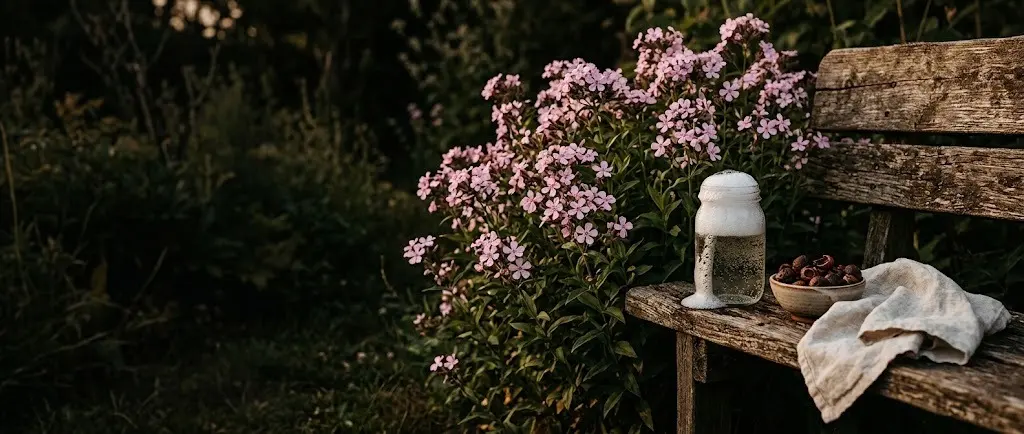
 AI illustration
Soap plants
Some plants make their own detergent. Grow soapwort, brew its root into a gentle wash, and do a load of laundry with soap nuts.
What it is like
Many plants make saponins, compounds that dissolve in both water and fat, which is the same trick soap does. Shake a jar of soapwort-root water and it foams.
Soapwort root was used historically as a soap, especially for delicate woolens, and soap nuts were used for washing by ancient peoples in Asia and the Americas. Soapwort is a tough pink-flowered perennial. Soap nuts are the dried fruit shells of a tree and need no garden at all.
This is washing chemistry at tea-kettle scale: a simmered root, a strained jar, nothing caustic. It cleans ordinary clothes and delicate fabric gently. It is not a strong detergent and does not pretend to be.
The chemistry is pleasingly simple. A saponin molecule has a part that likes water and a part that likes fats, so in a jar of water it lines up around greasy dirt and lifts it away - and when shaken it traps air and foams, the quick test that a brew has worked. Different plants keep their saponins in different places: soapwort mostly in its roots and leaves, soapberry trees in the fruit, yuccas in the roots, the soapbark tree in its bark.
As a hobby it sits between gardening and old household crafts. A pot of soapwort, a bag of soap nuts and a few experiments in the kitchen show how people cleaned wool and linen long before modern detergents, and the same gentle washes fit naturally with natural dyeing, knitting and caring for old textiles.
- A session
- Half an hour to brew a jar; a laundry load takes no more time than usual.
- A week
- A wash or two with soap nuts; soapwort brews keep under a week.
- Season
- Soap nuts all year; soapwort roots are harvested in autumn from established clumps.
Indoors or out · Solo, With kids
Kinds and styles
Saponaria officinalis, a pink-flowered perennial whose simmered roots and leaves give a gentle wash - the garden plant on this page.
Dried Sapindus fruit shells, used in a cloth bag in the washing machine; no garden needed.
A traditional soap and shampoo of the American Southwest, made from the roots of soaptree and other yuccas.
Quillaja saponaria bark from Chile, a commercial source of saponins for foaming drinks and products.
Soapnut washes used to scour silk and cotton yarn before natural dyeing.
Gentle saponin washes for old lace, wool and heirloom fabrics, tested first on a hidden corner.
Is it for you?
You will probably love it if
- You like plants with a job
- Your skin argues with commercial detergent
- Kitchen-scale experiments appeal to you
Maybe not, if
- You expect it to shift engine grease
- You have a pond the rinse water could reach
- You wanted to make bar soap: that is a different, caustic craft
What to buy first
- 01Soap nuts, 1 lb bag with a wash bagReady-made saponin: five or six shells wash a loadFind it on Amazon$15
- 02Soapwort seeds or one potted plantThe root is next autumn's harvestFind it on Amazon$5
- 03A 1 quart glass jar you already ownFor brewing and the foam testFree
- Everything you need to beginAbout $3 a month after that$20
Typical US prices for entry-level gear, rounded. Last checked October 2026. How we get the numbers
The Amazon links open a search for that type of item, not a product chosen for us, and the prices in the list are our typical figures, or the listing of the shop a line names, not Amazon's price for any listing. If you buy through one we may earn a commission at no extra cost to you; as an Amazon Associate we earn from qualifying purchases.
What to buy next
- 01Soap nut liquidReady-made saponin wash for delicatesFind it on Amazon Hand washing
- 02Large pot for brewingA pot kept for washes, not foodFind it on Amazon Bigger batches
- 03Mesh wash bagsHolds shells in the drumFind it on Amazon Regular soap nut laundry
- 04Undyed wool yarnPractice gentle washing and scouringFind it on Amazon Scouring before dyeing
- 05Plant labelsKeep saponin plants clearly marked in the gardenFind it on Amazon Growing soap plants
No prices here on purpose: these are later buys, and what to spend depends on how far the hobby has taken you. The Amazon links work like the ones above: a search for the type of item, and a possible commission for us at no extra cost to you.
Growing soapwort and washing with plants, step by step
From planting soapwort to a jar of gentle wash, in the order it is done, with soap nuts as the no-garden route. At each step: what to do, what you can choose between, and what tends to go wrong. Plant washes are mild and they foam less than detergent; that is the nature of saponins, not a failure.
Warning: Before you start Saponins are mildly toxic if swallowed and are toxic to fish: keep the plants, the brew and the rinse water away from ponds and streams, and label the jar so nobody drinks it. Patch-test on skin before wider use and keep it out of eyes. Horse chestnuts (conkers) are poisonous to eat. Making bar soap needs lye, which is caustic, and is not covered here.
Tie five or six half-shells in the cloth bag, drop it in the drum, run a warm cycle. Reuse the bag three or four times until the shells stop foaming.
Sun or part shade, any soil. Sink it in a pot or give it room: the running roots that you will harvest also spread like mint.
Scrub and chop a handful of root from a two-year clump, simmer gently in a liter of water for twenty minutes, cool and strain.
The jar crowns with fine foam. Use it within a week for wool, old lace or as a mild hand wash, and keep it in the fridge.
From root to wash
A soapwort clump with the soil cut away, and the finished brew.
- A Flowering clump Dig while it flowers Saponin in the roots peaks, up to 20 per cent, while the plant flowers. Step 4 →
- B Foam The foam test A head of fine foam means the brew is working. Step 6 →
- C Labelled jar Into a clean jar Label it, so nobody drinks it. Step 5 →
- D Rhizomes Spreading sideways It spreads by them - contain it. Step 2 →
- E Roots A handful, chopped Washed and cut small before simmering. Step 5 →
- Step 1 of 9
Choose the route
Plants that clean do it with saponins - compounds named, like the soapwort itself, after the Latin sapo, soap - which make a lather in water. Two of them are easy at home.
Soapwort (Saponaria officinalis)Best forA garden plant with a job
A pink-flowered perennial whose roots and leaves, boiled in water, give a lathery liquid that dissolves fats and grease; historically used to clean delicate textiles, especially wool (Wikipedia).
Soap nuts (Sapindus)Best forLaundry without a garden
The dried fruit shells of soapberry trees, which contain saponins and have long been used for washing in Asia and the Americas (Wikipedia). Bought, not grown.
Yucca root and soapbarkBest forReading further
Other traditional saponin sources - the soaptree yucca of the American Southwest, and Quillaja bark from Chile.
- Step 2 of 9
Plant soapwort - and contain it
Soapwort grows in patches to about 70 cm (28 in), with clusters of sweetly scented pink or white flowers from late spring to early autumn (Wikipedia). It spreads by tough rhizomes, and the Missouri Department of Conservation notes that even a small piece of rhizome can send up a flowering stalk; it has escaped from gardens and become invasive in much of North America.
A large potBest forSmall gardens, North America
The simplest way to keep the rhizomes where you put them.
A bed with a root barrierBest forA bigger harvest
Sunk edging around the clump to stop it running through the border.
Goes wrong: Planting it loose. In a border it runs, and colonies are hard to remove (Missouri Department of Conservation); check whether it is listed as invasive where you live.
- Step 3 of 9
Let it establish
Give the clump its first season to settle before harvesting roots; the short version above waits for a two-year clump. The plant is a perennial, so the same clump gives root year after year if you take only part of it.
- Step 4 of 9
Harvest root or leaves
Wikipedia gives the saponin content of the roots as up to 20 per cent while the plant is flowering, against about 15 per cent in Indian soap nuts - so dig during the flowering season. The leaves have also long been used: the Missouri Department of Conservation notes they were often the source of the soap.
RootBest forA stronger wash
The richest part; lift a section from the edge of the clump, scrub it clean and chop it.
LeavesBest forQuick, small batches
Chopped, boiled and strained the same way (Wikipedia); no digging needed.
Goes wrong: The seeds. The Missouri Department of Conservation lists soapwort seeds as poisonous; nothing from the plant is for eating.
- Step 5 of 9
Brew the wash
Boiling the chopped leaves or roots in water gives a lathery liquid that can be used as soap (Wikipedia). The short version above simmers a handful of chopped root in a litre of water for about twenty minutes, then cools and strains it into a jar.
Goes wrong: An unlabelled jar in the fridge. Saponins are mildly toxic if swallowed; label the jar.
- Step 6 of 9
Test the foam
Shake the cooled jar: a head of fine foam shows the brew is working. Expect much less lather than from detergent - saponins clean with far less foam - and judge the washing, not the bubbles.
- Step 7 of 9
Wash something delicate
Soapwort is a very gentle soap, usually used dilute, and was valued for cleaning delicate and unique textiles, especially wool (Wikipedia). Use it for hand-washing wool or old lace, or as a mild hand wash; patch-test on skin first and keep it out of the eyes.
Wool and delicate fabricBest forKnitwear, old lace
The traditional use (Wikipedia); hand-wash gently and rinse well.
A mild hand washBest forSensitive skin
Some people use it for dry skin; patch-test first.
Goes wrong: Expecting it to shift grease and grime like detergent. It is a gentle wash; heavy dirt needs ordinary soap.
- Step 8 of 9
Launder with soap nuts
Put the shells in the cloth bag they come with, drop it in the drum and run the wash, following the amounts printed on the pack. The same bag does several loads until the shells stop foaming; then they go in the compost.
- Step 9 of 9
Keep it away from water life
Saponins are toxic to fish - saponin-rich plants have long been used as fish poisons - so keep the plants, the brew and the rinse water away from ponds and streams (Wikipedia, Piscicide).
In shortIf it goes wrong
- Planting it loose.
- Step 2 · Plant soapwort - and contain it
- The seeds.
- Step 4 · Harvest root or leaves
- An unlabelled jar in the fridge.
- Step 5 · Brew the wash
- Expecting it to shift grease and grime like detergent.
- Step 7 · Wash something delicate
How you get better
- First weekA load with soap nuts
Five or six shells in a bag, a warm cycle, and reusing the bag until it stops foaming.
- First springPlanting soapwort
A contained clump in sun or part shade.
- First autumnA brewed wash
Leaves or a little root simmered, strained and used on wool or as a mild hand wash.
- Year 2Root harvests and uses
Roots from an established clump, and washes for delicate textiles.
- After thatLinking crafts
Scouring yarn for natural dyeing and washing handmade textiles.
- Choosing saponin plants
- Growing and containing soapwort
- Harvesting roots
- Simmering and straining
- The foam test
- Washing with soap nuts
- Hand-washing wool
- Patch testing
- Small-batch storage
- Scouring yarn
- Disposing of rinse water safely
- Labeling homemade washes
Small things that help
- Judge the cleaning, not the foam.
- Brew small batches; they spoil within a week.
- Patch-test washes on skin and fabric first.
- Grow soapwort in a pot or a contained bed.
- Keep rinse water away from ponds and streams.
- Label every jar clearly.
Beginner mistakes
- 01Expecting detergent powerSaponin washes are gentle. Fine for light dirt and delicates, not for grease.
- 02Letting soapwort runIt spreads by roots. Contain it.
- 03Keeping brews too longNo preservative means short life. Use within a week, refrigerated.
- 04Pouring rinse water into pondsSaponins are used as fish poisons. Keep them away from water life.
- 05Confusing it with soapmakingBar soap needs lye, a caustic chemical. This craft avoids it.
Why people quit
- 01Modest latherSaponins clean with far less foam than detergent. Judge the laundry, not the bubbles.
- 02A spoiled jarThe brew has no preservative and keeps under a week. Make small batches.
- 03Soapwort everywherePlanted loose in a border it runs. Contain it from day one.
Words you will meet
- Saponin
- A plant compound that foams in water and dissolves both oil and water.
- Soapwort
- Saponaria officinalis, also called bouncing-bet.
- Soap nut
- The dried fruit of a Sapindus soapberry tree.
- Quillaja
- The soapbark tree of Chile.
- Decoction
- A brew made by simmering plant material in water.
- Surfactant
- A substance that loosens dirt by acting between water and oil.
- Scouring
- Washing fiber before dyeing.
- Lye
- Caustic sodium hydroxide used in making bar soap.
- Piscicide
- A substance poisonous to fish; saponins are one.
Questions people ask
Do soap nuts really clean clothes?
They contain saponins with surfactant properties and work for everyday laundry, more gently than detergent.
Can I wash my hair with soapwort?
It is a very gentle wash; patch-test first and keep it out of your eyes.
Is soapwort safe?
Saponins are usually toxic if swallowed; label brews, keep them from children and pets, and do not drink them.
Why does my brew barely foam?
Saponins clean with less foam than detergents; judge the result, not the bubbles.
Can I make bar soap this way?
No. Bar soap needs lye and is a separate, caustic craft.
Where to go next
- 01Natural dyeingSoap nut washes are used to scour silk and cotton yarn before natural dyeing - the next step for a plant-based laundry. $65 to start
- 02Candle makingAnother kitchen-scale craft that turns plant and wax into things you use every day. $75 to start
How it compares
| Soap plants | Natural dyeing | Microgreens | Candle making | |
|---|---|---|---|---|
| Start cost | $20 | $65 | $33 | $75 |
| Each month | $3 | $12 | $8 | $10 |
| Space | A pot or a border | A kitchen counter | A windowsill | A kitchen counter |
| Noise | Quiet | Quiet | Quiet | Quiet |
| First result | 1 wash | 1 weekend | 8 to 12 days | 1 afternoon |
| Mess | A wet jar | Pots and splashes | Soil and water | Wax |
Where to learn more
- 01Missouri Department of Conservation, SoapwortA field guide entry on soapwort, its uses and how it spreads.
Sources: Missouri Department of Conservation, field guide: Soapwort (Bouncing Bet) · Wikipedia, Saponaria officinalis · Wikipedia, Sapindus (soapnuts) · Wikipedia, Saponin · Wikipedia, Yucca (soap uses) · Wikipedia, Piscicide
Researched and written by the Fjords Team.