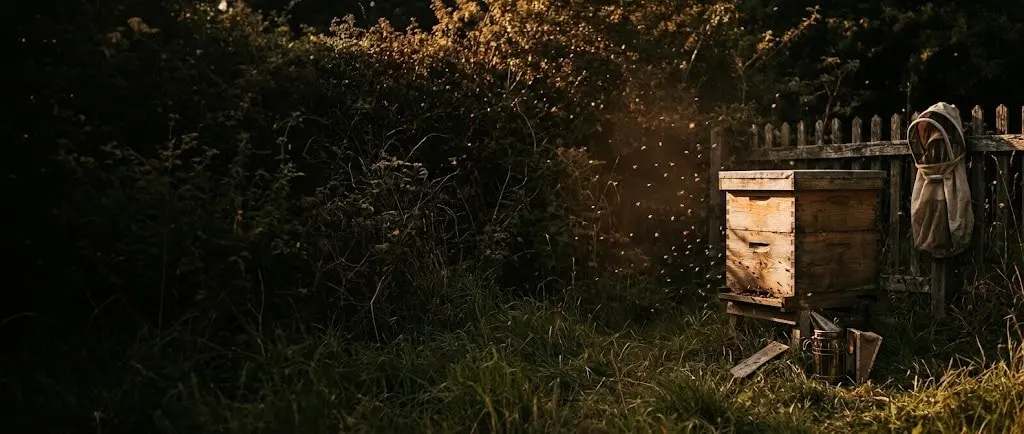
 AI illustration
Beekeeping
A hive in the yard, a suit, a smoker and a year of patience. The most absorbing animal hobby there is, and the one with the most homework.
What it is like
Beekeeping is livestock keeping with an insect that organizes itself. You provide a hive, a place in the sun and a few hours a month of attention; the colony forages, builds comb, raises brood and, in a good year, stores more honey than it needs. A single hive in a suburban yard is common where local rules allow it - check your town and state first - and absorbing in a way that few hobbies match.
It is also the hobby on this site with the most to learn before you start. The bees’ main enemy is the varroa mite, which you cannot count without a test; the calendar is unforgiving; and colonies whose mites are not monitored and managed are at high risk of dying, often over winter. A course and a mentor at the local beekeeping association are the real first purchase.
The beekeeping year follows the flowers. In spring the colony builds up fast and the beekeeper’s job is to give it room; in early summer the risk is swarming, when half the bees leave with the old queen; in late summer the honey flow fades and mite numbers peak, which is when monitoring and treatment matter most; in autumn the colony needs enough stores for winter; and in winter the hive stays closed. Missing a season’s job is how most first colonies are lost.
An inspection is short and calm when it goes well: a few puffs of smoke, the lid off, frames lifted one at a time to look for eggs, healthy brood, stores and space. With practice it takes a quarter of an hour, and the bees tolerate a slow, gentle beekeeper far better than a hurried one.
After the start-up kit and the bees, the running costs are modest: sugar for feeding, mite treatments, replacement frames and the occasional new box. Honey, when it comes in the second year, can more than cover them - but most keepers stay for the bees.
- A session
- An inspection takes 15 to 30 minutes on a warm, calm day.
- A week
- Every week or two in spring and summer; much less in autumn, almost nothing in winter.
- Season
- Spring build-up, summer flow, late-summer mite control, autumn feeding, winter waiting.
Outdoors · Solo, A club
Kinds and styles
Stacked square boxes of removable frames - the standard hive in North America, with parts from every supplier fitting together.
One long horizontal box with bars the bees hang comb from; no heavy boxes to lift, less honey, and comb that is more fragile to handle.
Small stacked boxes with top bars, added from below; a 'hands-off' style that is harder to inspect for mites.
Managing strong colonies for a summer honey crop, with supers added on top and an extractor to spin the frames.
One or two hives kept mainly for the garden and the bees themselves, with honey as a bonus.
Mason and leafcutter bee houses: no stings to speak of, no honey, and a much smaller commitment.
Is it for you?
You will probably love it if
- You like a hobby with real responsibility and a calendar
- You are happy to join a club and take a winter course before buying bees
- You can stay calm with thousands of insects in the air around you
Maybe not, if
- Anyone at home is allergic to stings
- You want honey this summer; the first year is for the bees
- You cannot commit to checking for mites and treating them; untreated colonies die
What to buy first
- 01Beginner starter kit: assembled 10-frame Langstroth hive, jacket with veil, gloves, smoker and hive toolThe standard hive and the gear to open it, sold as one box by every bee supplierFind it on Amazon$340
- 02Nucleus colony of beesFive frames of bees, brood and a laying queen; a running start compared with a package$190
- Everything you need to beginAbout $15 a month after that$530
Typical US prices for entry-level gear, rounded. Last checked October 2026. How we get the numbers
The Amazon links open a search for that type of item, not a product chosen for us, and the prices in the list are our typical figures, or the listing of the shop a line names, not Amazon's price for any listing. If you buy through one we may earn a commission at no extra cost to you; as an Amazon Associate we earn from qualifying purchases.
What to buy next
- 01Mite testing kitA shaker jar for alcohol washes or sugar rolls to count varroa mitesFind it on Amazon First summer
- 02Second deep box and framesRoom for the colony to grow before it feels crowdedFind it on Amazon When 7 to 8 of 10 frames are drawn
- 03Honey supersShallower boxes for honey above the brood boxesFind it on Amazon Second year
- 04Hive scale or feederChecking or adding winter storesFind it on Amazon Autumn
- 05Spare hive tool and nitrile glovesHive tools get lost; thin gloves give better feel once you are confidentFind it on Amazon Any time
No prices here on purpose: these are later buys, and what to spend depends on how far the hobby has taken you. The Amazon links work like the ones above: a search for the type of item, and a possible commission for us at no extra cost to you.
A first hive through its first year, step by step
From the winter order to a colony that goes into its first winter strong. Each step gives the choices beekeepers make and how they differ, with the numbers from university extension services. Mite thresholds and dates vary by region, so a local club and state apiary inspector have the last word.
Warning: Before you start Stings are certain. Anyone with a known allergy to bee or wasp stings should not keep bees, and every beekeeper should know the signs of anaphylaxis and how to call for emergency help; whether to keep an epinephrine auto-injector is a question for a doctor. Wear the veil every time. Check local ordinances: many towns limit hives or require registration, and some ban them. Site the hive so the flight path does not cross a neighbor's door.
Join the local beekeeping association and take their beginner course. Check your town's rules and your state's hive registration. Order a nucleus colony for spring; they sell out.
Move the five frames from the nuc into your hive on a warm afternoon. Feed sugar syrup until the bees have drawn out most of the first box.
Every week or two, open the hive for ten minutes: eggs present, queen laying, space to grow. Add the second box when seven or eight of ten frames are drawn.
Do a mite wash or sugar roll. Above the threshold your club teaches, treat. This is the step that decides whether the colony lives.
The first year's honey stays with the bees as winter stores. Reduce the entrance, make sure the hive is dry, and do not open it in the cold. Your jar comes next summer.
A Langstroth hive, taken apart
The parts of a 10-frame hive lifted apart, each box cut through to show its frames.
- A Bottom board and entrance reducer The reducer narrows the entrance while the colony is small (ACES). Step 5 →
- B Brood box, 10 frames The nuc frames go in the middle, in order, with foundation either side. Step 5 →
- C Second box Added when seven or eight of the ten frames are drawn. Step 8 →
- D Inner cover A flat board; a feeder can sit inside the hive. Step 6 →
- E Outer cover Telescoping lid that keeps the hive dry. Step 10 →
Steps 1-4Before the bees
- Step 1 of 10 · Before the bees
Check the rules and your allergy
Many towns limit hives or require registration, and some ban them; neighbours have a say too. Stings are certain, so anyone with a known allergy to bee or wasp stings should not keep bees. Join a local beekeeping association: its beginner course and its mentors teach the local timing that no general guide can.
- Step 2 of 10 · Before the bees
Choose how to start
A new colony is bought either as a package of loose bees with a caged queen or as a nucleus colony (a nuc) - a small working colony on frames. Alabama Cooperative Extension and UF/IFAS Extension compare the two.
Most people: nucleus colony (a first hive).
Start here Nucleus colonyBest forA first hive
Five frames with drawn comb, a laying queen, brood and stores (ACES). It establishes faster and may give a little honey the first year; bought locally, it is likely adapted to the climate (UF/IFAS).
PackageBest forA lower price
About 3 lb of bees (roughly 10,000) and a mated queen, with no comb (UF/IFAS). It has to build all its comb, needs feeding through the first year, and is unlikely to give honey that year (ACES).
Goes wrong: Bees from an unknown seller. UF/IFAS advises buying only from an established, reputable local supplier.
- Step 3 of 10 · Before the bees
Choose the site
Mississippi State Extension's apiary guide (P2937): face the entrance between south and east, keep hives out of woodland (full sun or a tree line), give a windbreak on the north side, and avoid flood-prone ground and the bottom of a hill. Bees need water all year, natural or provided.
Full sunBest forFewer pests
Mississippi State finds full sun suppresses small hive beetles and Varroa mites - but it is hard on the bees in a humid summer.
Along a tree lineBest forHot summers
Some shade; the guide warns against the understory itself, which favours hive beetles and ants.
Goes wrong: A flight path across a path or a neighbour's door. In public areas Mississippi State puts a barrier at least 6 ft (1.8 m) tall a few feet in front of the entrance, so bees fly up and over people.
- Step 4 of 10 · Before the bees
Order in winter
Bees sell out. ACES places orders in November or December for spring delivery, with packages from mid-March through April and nucs from mid-March to early May in Alabama; UF/IFAS pre-orders in December to February for April bees in central Florida. Further north the dates are later - the local association knows them. Set up the hive before the bees arrive.
Steps 5-6Spring: bees in
- Step 5 of 10 · Spring: bees in
Install the colony
Both kinds go into a 10-frame brood box in the same way ACES describes, with an entrance reducer in place.
Most people: a nuc (nucleus colonies).
Start here A nucBest forNucleus colonies
Set the nuc box beside the hive for 5 days. On day 6 move the frames, in order and facing the same way, into the centre of the brood box, with foundation frames either side (ACES).
A packageBest forPackages
Hang the queen cage between frames with its candy end open, set the package inside, close up, and after three days check the queen is out (ACES).
- Step 6 of 10 · Spring: bees in
Feed sugar syrup
A new colony needs food while it builds comb. ACES mixes light syrup from 1 lb of white cane sugar to 1 lb (2 cups) of warm water. Packages must be fed actively through the first year.
Most people: feeder inside the hive (weaker colonies).
Start here Feeder inside the hiveBest forWeaker colonies
ACES notes internal feeders reduce robbing by other bees.
Entrance feederBest forSpring only
ACES uses them only in warm spring weather, not in summer or autumn.
Steps 7-9The first season
- Step 7 of 10 · The first season
Inspect, briefly and regularly
Light the smoker, wear the veil every time, and keep each look short. The short version above opens the hive every week or two. What to look for, after ACES: a queen that is laying well, plenty of healthy brood and adult bees, food stores and freshly drawn comb, and no signs of pests or disease.
Goes wrong: Opening the hive too often. Each inspection disturbs the colony; every week or two in the season is plenty.
- Step 8 of 10 · The first season
Give them room
A colony that runs out of space crowds and may swarm. Add the second box when seven or eight of the ten frames are drawn, as the short version describes; ACES expects a healthy nuc to fill two boxes with comb, brood and honey by the end of its first year.
Goes wrong: Queen cells along the bottom of the frames in spring. They are a sign the colony is preparing to swarm.
- Step 9 of 10 · The first season
Count the mites every month
Varroa mites cannot be judged by eye. Penn State Extension's alcohol wash: shake the bees off a frame of open brood (check the queen is not on it), scoop about ½ cup of bees into a pint jar with 250 ml of alcohol over 70 per cent, shake for 60 seconds, and pour through a mesh lid and filter to count the mites. Penn State tests monthly and before and after any treatment, and keeps written records; ACES samples about a month after a nuc goes in. Treat above the threshold your club or state inspector gives - it varies with the season.
Most people: alcohol wash (an accurate count).
Start here Alcohol washBest forAn accurate count
Penn State's preferred method. The sampled bees die.
Soapy water washBest forNo alcohol to hand
The same method with 2 tablespoons of dish soap per gallon of water (Penn State).
Goes wrong: Skipping the counts. Varroa is a leading cause of colony losses, and the numbers climb unseen.
Step 10Autumn and winter
- Step 10 of 10 · Autumn and winter
Leave them the honey
ACES expects no honey from a package in its first year and perhaps a little from a nuc: what the bees store is their winter food. Reduce the entrance, keep the hive dry, and do not open it in the cold.
In shortIf it goes wrong
- Bees from an unknown seller.
- Step 2 · Choose how to start
- A flight path across a path or a neighbour's door.
- Step 3 · Choose the site
- Opening the hive too often.
- Step 7 · Inspect, briefly and regularly
- Queen cells along the bottom of the frames in spring.
- Step 8 · Give them room
- Skipping the counts.
- Step 9 · Count the mites every month
How you get better
- The winter beforeA course and a mentor
A beginner course at the local association, the town and state rules, and a nucleus colony ordered for spring.
- First spring and summerInstall and inspect
Installing the nuc, regular short inspections, and adding the second box as the colony grows.
- First late summerMites and stores
Mite counts and treatment as the club teaches, and leaving the honey for winter.
- Second yearSwarms and the first honey
Spotting swarm preparations, making a split, and harvesting surplus honey in summer.
- After thatMore colonies and queens
A second hive for backup, raising queens, or helping new beekeepers at the club.
- Lighting and using a smoker
- Opening a hive calmly
- Spotting eggs and the queen
- Reading brood patterns
- Recognizing swarm signs
- Adding boxes at the right time
- Mite counts
- Mite treatment timing
- Feeding syrup
- Wintering a colony
- Harvesting honey
- Keeping hive records
Small things that help
- Inspect on warm, calm afternoons when most foragers are out.
- Move slowly and keep frames over the open hive so a dropped queen falls back in.
- Keep a notebook for each hive - date, eggs seen, frames drawn, mites counted.
- Place the hive where the entrance faces away from paths and a neighbor's fence.
- Provide a water source nearby so bees do not visit a neighbor's pool.
- Join the local association before the bees arrive, not after a problem.
Beginner mistakes
- 01Skipping mite countsVarroa mites are invisible without a test and are a leading cause of colony losses. Count them on a schedule.
- 02Taking honey the first yearA new colony usually needs its first year's stores to survive winter. Your jar comes in year two.
- 03Opening the hive too oftenDaily inspections stress the colony. Every week or two is plenty.
- 04Missing swarm signsQueen cells along the bottom of frames in spring mean the colony is about to leave. Learn to spot them.
- 05Ignoring neighbors and rulesHive placement, numbers and registration are regulated in many places. Check and talk to neighbors first.
The first year, roughly
Timing shifts with your climate; your local club's calendar wins.
| Season | Job | Time |
|---|---|---|
| Winter before | Course, club, hive assembly, order bees | A few evenings |
| Spring | Install the nuc, feed syrup, first inspections | Weekly, 20 minutes |
| Early summer | Add a box, watch for swarming | Every 7 to 10 days |
| Late summer | Mite count and treatment | An afternoon, then follow-ups |
| Autumn | Winter prep: stores, entrance reducer, dry roof | One afternoon |
| Winter | Leave alone; listen at the wall on mild days | Minutes |
Why people quit
- 01A dead colony in springMost first-year losses trace back to mites that were never counted. Learn the mite wash before you learn anything else.
- 02The moneyHive, bees and kit is a few hundred dollars before a drop of honey. People who go in for the honey quit; people who go in for the bees stay.
- 03Going it aloneBeekeeping without a mentor is a slow way to make every mistake. The club is half the hobby.
Words you will meet
- Colony
- One family of bees: a queen, thousands of workers and, in season, drones.
- Nuc
- A nucleus colony: a small colony on a few frames with a laying queen.
- Package
- Bees and a queen sold in a screened box without comb.
- Brood
- Eggs, larvae and pupae.
- Super
- A box placed on top of the brood boxes for the bees to store surplus honey.
- Varroa
- A parasitic mite of honey bees and the main threat to colonies.
- Swarm
- Half or more of a colony leaving with the old queen to start a new home.
- Bee space
- The gap bees leave open; hive parts are spaced to it.
- Smoker
- A can that puffs cool smoke to calm bees during inspections.
- Propolis
- Plant resin the bees use to seal gaps; sticky in summer, brittle in winter.
Questions people ask
Is beekeeping legal where I live?
Often, but check: many towns limit hive numbers or placement, and many states require hives to be registered.
How much honey will I get?
Usually none in the first year - the colony needs it for winter. From the second year a healthy colony may produce a surplus, depending on weather and forage.
Will I get stung?
Yes, occasionally, even with a veil and gloves. Anyone with a known allergy to stings should not keep bees.
Nuc or package?
A nucleus colony comes with drawn comb, brood and a laying queen, so it starts faster; a package is cheaper but starts from nothing.
What do I do in winter?
Mostly nothing: keep the hive dry and wind-sheltered, make sure it went into autumn with enough stores, and do not open it in the cold.
Where to go next
- 01Backyard chickensAnother small flock kept for what it produces, with daily rather than weekly care. $467 to start
- 02Candle makingBeeswax from the hive is one of the waxes candle makers pour. $75 to start
How it compares
| Beekeeping | Backyard chickens | Worm composting | Natural dyeing | |
|---|---|---|---|---|
| Start cost | $530 | $467 | $71 | $65 |
| Each month | $15 | $30 | Free | $12 |
| Space | A yard | A backyard | Under a sink | A kitchen counter |
| Noise | Low | Medium | Quiet | Quiet |
| First result | A year to the first honey | About 5 months to eggs | About 3 months | 1 weekend |
| Mess | Propolis and the odd sting | Bedding and droppings | Damp bedding | Pots and splashes |
Where to learn more
- 01Honey Bee Health Coalition - varroa managementGuides on monitoring and managing varroa mites, written with beekeepers and researchers.
- 02American Beekeeping FederationA national US beekeeping organization; ask it or your state association for a local club.
Sources: Honey Bee Health Coalition, tools for varroa management · Wikipedia, Langstroth hive · Alabama Cooperative Extension, Establishing a honey bee colony (UNP-2197) · UF/IFAS Extension, Starting new honey bee colonies: packages vs. nucs · Mississippi State University Extension, Choosing an apiary location (P2937) · Penn State Extension, Alcohol wash for varroa mite monitoring
Researched and written by the Fjords Team.